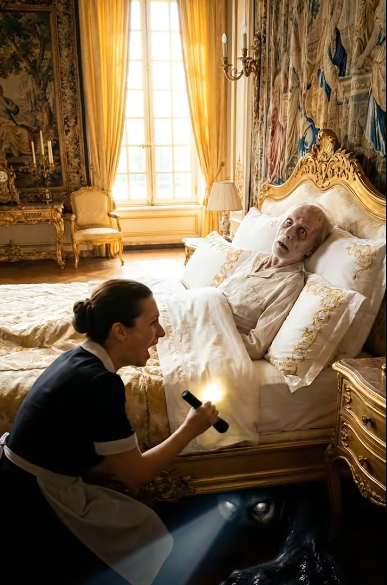
The Invisible Cure
Chapter 1: The Ghost in the Tower
I was a ghost in the house of a dying king.
That is the only way to describe my life at the Carter Estate. I moved through the fifteen bedrooms and seven bathrooms like a whisper, my rubber-soled shoes silent on the imported Italian marble. I polished gold fixtures until they blinded me, I dusted books in a library that smelled of old paper and leather, and I tried my best to remain invisible.
My name is Sophia Ramirez. I had been working at the estate in Greenwood Hills for three months, and in all that time, the man who owned it had never truly looked me in the eye.
Nathan Carter.
To the outside world, he was a thirty-one-year-old tech mogul, a genius who had revolutionized data processing. But to me, he was a shadow. A pale, exhausted figure trapped in the Master Suite, coughing his life away while expensive doctors shrugged and prescribed more pills that didn’t work.
It was a Thursday morning when the silence of the house began to feel heavy, like a storm holding its breath.
“Good morning, Mr. Carter,” I said, knocking gently on the heavy oak door of the Master Suite.
A hoarse voice, dry as dead leaves, scratched back from the other side. “Come in, Sophia. But please… be quick. I feel terrible today.”
I pushed the door open. The air inside hit me like a physical wall—stagnant, overheated, and thick with a cloying, sweet sickness.
Nathan was buried under a mountain of king-sized bedding. His skin was translucent, the blue veins at his temples visible in the dim light. He looked less like a billionaire and more like a watercolor painting left out in the rain—fading, running, dissolving.
His cough tore through the room, a wet, violent sound that made me wince.
“You’ve been like this since I started here,” I said, the words slipping out before I could stop them. I moved to the bedside table, wiping away the ring of condensation from his water glass. “You haven’t improved at all, sir.”
Nathan sighed, a sound of bone-deep exhaustion. He didn’t open his eyes.
“I’ve seen four doctors this month,” he whispered. “They’ve tested for everything. Lungs, heart, rare tropical diseases. Nothing. They say it’s ‘psychosomatic.’ Stress. Anxiety.”
He laughed bitterly, triggering another coughing fit. “Apparently, my mind is trying to kill my body.”
I frowned. I grew up in a neighborhood in East Los Angeles where we didn’t have concierges or private specialists. We had grandmothers who knew that a fever meant one thing and a cold sweat meant another. My Abuela always said: The body never lies, Sophia. Only the mind lies.
Something about this room felt wrong. It felt… poisonous.
“Do you spend all day in here?” I asked carefully, moving toward the heavy velvet drapes.
“Mostly,” Nathan admitted. “I try to work in the office downstairs in the mornings. But by noon, I’m exhausted. I come back here to rest. It’s the only place I can shut out the world.”
The irony was bitter. The place he came to heal was the place that looked like a tomb.
“Can I open the window?” I asked. “Just for a moment?”
He waved a weak hand. “Go ahead.”
I pulled back the curtains. Dust motes danced in the sudden shaft of sunlight. I cranked the window open, and the fresh breeze from the gardens rushed in, fighting the stale, sickly air of the room.
“There,” I said. “Finished here, sir. You can rest.”
I moved to leave, pushing my cleaning cart toward the door. But as I passed the massive walk-in closet that lined the far wall, I stopped.
The smell.
It wasn’t just the smell of sickness or unwashed sheets. It was something earthier. Sharper. Like wet cardboard and old mushrooms. It was faint, masked by the expensive reed diffusers placed around the room, but it was there.
I looked at Nathan. He had drifted back into a fitful sleep.
I shouldn’t have done it. I should have kept walking. I needed this job. My sister, Laya, was counting on me to help with rent. Prying into the structural integrity of a billionaire’s mansion wasn’t in my job description.
But the smell gnawed at me.
I crouched down near the baseboards where the closet met the exterior wall. I ran my gloved hand along the carpet.
It was damp.
I leaned closer, peering into the shadow behind a heavy mahogany shoe rack. There, blooming in the darkness like a black bruise, was a patch of fuzz.
Mold.
My stomach tightened into a knot. This wasn’t just mildew. This was black, slimy, and angry. It was festering right near the intake vent of the room’s private climate control system.
I stood up, my heart hammering.
Nathan was breathing that air. Every hour he spent “resting,” he was inhaling spores. The room he retreated to for safety was slowly assassinating him.
I looked at him, defenseless in his luxury.
I had a choice. I could ignore it. I could stay safe, stay employed, and let the doctors figure it out. Or I could speak up, risk being called crazy, risk overstepping my bounds, and try to save a man who barely knew I existed.
I stared at the black patch on the wall. The body never lies.
I quietly backed out of the room, closing the door on the poison. But as I walked down the marble hallway, I knew I couldn’t unsee it. And I knew that by tomorrow, I would have to make a decision that could cost me everything.
Chapter 2: The Courage to Speak
I carried the secret home with me like a stone in my pocket.
That night, in our cramped apartment downtown, the sounds of the street were loud—sirens, reggaeton from a passing car, the shout of a neighbor. It was a stark contrast to the deathly silence of the Carter Estate.
Laya was at the stove, flipping quesadillas. She looked at me, her nursing scrubs still on.
“You look like you’ve seen a ghost,” she said. “Did you break a vase?”
“Worse,” I said, sitting heavily at the small kitchen table. “I think the house is killing him.”
I told her everything. The constant illness. The doctors who found nothing. The damp patch. The smell that clung to the back of my throat even now.
Laya stopped cooking. She turned to me, the spatula dripping grease onto the linoleum.
“Sophia,” she said, her voice serious. “Toxic mold isn’t a joke. If he’s immunocompromised or just exhausted, that stuff can shut down his respiratory system. It causes brain fog, fatigue, everything you’re describing.”
“I know,” I whispered. “But who am I to tell him? He has specialists from Harley Street. I’m the cleaning lady who didn’t finish college.”
“You’re the only one with eyes,” Laya countered fiercely. “Those doctors look at charts. You look at the room. If you don’t say anything, and he gets worse… can you live with that?”
I looked at my hands. They were rough from bleach and work. But they were steady.
“No,” I said. “I can’t.”
The next morning, the drive to Greenwood Hills felt longer than usual. The iron gates of the estate swung open, and I felt like I was entering a battlefield.
I found Nathan in his downstairs office. He was coughing, a dry, hacking sound, but he looked slightly better than he had in the bedroom. He was sitting up, reviewing documents on a tablet.
I parked my cart outside the door. I took a deep breath, smoothed my uniform, and knocked.
“Mr. Carter?”
He looked up, surprised to see me there at this hour. “Sophia? Is something wrong?”
“May I have a word, sir?” My voice trembled, but I forced it to firm up. “It’s important.”
He gestured to the chair opposite his massive glass desk. “Of course. Sit.”
I didn’t sit. I stood, needing the ground beneath my feet.
“Mr. Carter, I know this isn’t my place,” I began, my hands clasping together. “But I’ve noticed something. You always feel better when you’re out of the house, or here in the office. Your symptoms… they get worse the moment you go back to the Master Suite.”
He frowned, rubbing his temples. “I told you, Sophia, it’s stress. The bedroom is where I try to relax, so that’s where the anxiety hits.”
“With all due respect, sir,” I said, stepping closer. “I don’t think it’s anxiety. I think it’s the wall.”
He blinked. “The wall?”
“Yesterday, while cleaning, I found a damp patch behind the walk-in closet. There is black mold growing between the drywall and the floorboards. It’s right next to your air intake.”
I saw the skepticism cloud his eyes. It was the look rich people gave when the help tried to be smart.
“Sophia, the house is inspected quarterly. My maintenance team—”
“Your maintenance team checks the filters and the lights,” I interrupted, a surge of adrenaline pushing me forward. “They don’t check the corners. They don’t smell the air. I grew up in buildings where landlords painted over damp spots instead of fixing pipes. I know that smell, Mr. Carter. It’s poison. And you are sleeping in it.”
The room went silent. The clock on the wall ticked loudly.
Nathan stared at me. He looked at my uniform, my determined face, my shaking hands. Then, slowly, he stood up.
“Show me,” he said.
We walked upstairs in silence. When we entered the Master Suite, the heaviness hit us both.
I walked straight to the closet. I moved the shoe rack aside. I pointed to the dark, fuzzy corner.
“There,” I whispered.
Nathan leaned in. He sniffed. He recoiled instantly, coughing as the acrid scent hit his nose.
“My God,” he choked out, covering his mouth. “It smells like… like rotting meat.”
“It’s deep in the wall,” I explained. “Every time the AC turns on, it blows those spores right over your bed.”
Nathan backed away, staring at the spot with horror, and then at me with dawning realization.
“The headaches,” he muttered. “The fog. It always happens in the morning.”
He looked at me. The skepticism was gone, replaced by a profound, stunned gratitude.
“How did no one else see this?” he asked.
“Because they weren’t looking,” I said softly. “They were looking at you. I was looking at your life.”
He sat on the edge of the bed—far away from the vent—and ran a hand through his hair.
“Sophia,” he said, his voice shaking. “You realized the room was killing me. And you risked your job to tell me.”
“I couldn’t watch you fade away, sir. Not when I knew why.”
He looked up at me, and for the first time, he really saw me. Not the uniform. Not the cart. Me.
“You saved my life,” he said. “I can’t believe I didn’t see it myself.”
“Sometimes,” I said, “it’s hard to see the poison when you’re living inside it.”
That afternoon, a specialized remediation team arrived. They tore open the wall. Behind the drywall, it was a catastrophe—a leaking pipe from the floor above had created a massive colony of toxic black mold spanning six feet. The lead contractor told Nathan that another month in that room could have caused permanent lung failure.
Nathan moved into the guest wing.
By Monday, the change was miraculous. The color returned to his cheeks. The cough vanished. The dark circles under his eyes began to fade.
I was dusting the library when he found me. He looked vibrant, wearing a crisp button-down shirt instead of pajamas.
“Sophia,” he said. “Stop working for a second.”
I froze, clutching my duster. “Is everything okay, sir?”
“Better than okay,” he smiled, and it was a dazzling, genuine smile. “I just got off the phone with my doctor. My lung capacity is already up 20%. The fog is gone.”
“I’m so glad, Mr. Carter.”
“Nathan,” he corrected. “Please. Call me Nathan.”
He reached into his pocket and pulled out a brochure.
“I did some digging,” he said, looking a bit shy. “I spoke to the agency that hired you. They told me you scored in the top percentile on their aptitude tests but didn’t have the credentials for management.”
My face heated up. “I… I didn’t have the money for school.”
“Well,” Nathan said, handing me the brochure. “You have an eye for detail that most of my executives lack. You saw what was broken and you fixed it.”
I looked at the paper. It was for an accelerated Business Management program at the most prestigious private college in the city.
“I’ve paid the tuition,” he said simply. “Full ride. And I’m keeping you on salary here, but with reduced hours so you can study.”
I dropped the duster. “Sir… Nathan… I can’t accept this.”
“Consider it an investment,” he said, his eyes intense. “I want you to have every chance to succeed. You gave me my life back, Sophia. Let me help you start yours.”
I looked at the brochure, then at him. The power dynamic in the room shifted. I wasn’t just the help anymore. I was a project. I was a potential equal.
And as I looked into his eyes, I realized that the danger wasn’t over. A new kind of danger was beginning. The danger of hoping for something I wasn’t supposed to have.
Chapter 3: The View from Coyoacán
The months that followed were a blur of textbooks and marble floors.
I would spend my mornings managing the estate—Nathan had promoted me to House Manager, giving me a clipboard instead of a mop—and my afternoons in lecture halls, learning about supply chains and organizational psychology.
Nathan changed, too. He wasn’t the ghostly figure in the tower anymore. He was alive. He filled the house with music. He started hosting small meetings again.
But the biggest change was between us.
It started with coffee. He would “coincidentally” come into the kitchen when I was reviewing the grocery orders. We would talk. First about the house, then about my classes, then about life.
I learned that he was lonely. That his wealth isolated him. That he loved old jazz records and hated truffles.
He learned about Laya. About my parents dying when I was nineteen. About how I had to grow up too fast.
One Thursday afternoon, I was in the library, shelving books. The late afternoon sun turned the dust motes into gold.
Nathan walked in. He was wearing a suit, but he looked nervous. He was twisting his watch band—a habit I’d noticed he did when he was unsure.
“Sophia,” he said. “Do you have a minute?”
“Of course.” I set down a stack of encyclopedias.
“I… I want to invite you to dinner tomorrow night,” he blurted out.
I froze. “Dinner? Like… a business meeting? To discuss the staff schedule?”
“No,” he said, stepping closer. “Not business. Not employer and employee. Just… us. As friends. Or… I don’t know. People.”
My heart did a traitorous flip in my chest.
I knew the rules. I knew what people would say. The maid and the millionaire. It was a cliché. It was dangerous.
But then I looked at him. I saw the man who had encouraged me when I failed my first accounting exam. The man who remembered my sister’s birthday.
“I’d like that,” I heard myself say.
His face broke into a relieved grin. “Perfect. I’ll pick you up at seven.”
I spent the next twenty-four hours in a state of panic. Laya helped me pick out a dress—a simple navy blue slip dress that she swore made me look sophisticated.
“He won’t be able to take his eyes off you,” she promised.
When Nathan picked me up, he wasn’t driving the limousine. He was in a modest sedan. And he didn’t take me to Le Jardin or any of the stuffy places in Greenwood Hills.
He drove us to Coyoacán, a small, vibrant Mexican bistro tucked away in a neighborhood that felt like home. The walls were painted terracotta, candles flickered in glass jars, and a guitarist played soft acoustic melodies in the corner.
“I asked Laya where you liked to eat,” he confessed as we sat down. “She said you missed authentic mole.”
I stared at him. “You called my sister?”
“I wanted tonight to be perfect,” he said, pouring me a glass of wine. “I wanted you to be comfortable.”
That was the moment. That was the coup d’état of my heart.
We talked for hours. We ignored the food until it got cold. He told me about the pressure of his legacy, how he felt like an imposter in his own company sometimes. I told him about my dreams of starting my own logistics firm.
There, in the candlelight, the walls of the Carter Estate melted away. We weren’t the billionaire and the maid. We were just Nathan and Sophia.
“You’re different than anyone I know,” he said softly, reaching across the table to brush his fingers against mine. “Most people look at me and see dollar signs. You looked at me and saw a human being who was hurting.”
“It’s easy to see people when you’re used to being invisible,” I whispered.
“You are not invisible, Sophia,” he said, his thumb tracing my knuckles. “Not to me. Never to me.”
We left the restaurant late. He walked me to my apartment door. He didn’t kiss me. He just held my hand for a lingering moment, his eyes searching mine.
“Thank you,” he said. “For saving me. Twice.”
“Twice?”
“Once from the mold,” he smiled. “And once from the loneliness.”
I went inside and leaned against the door, my heart pounding so hard I thought it would bruise my ribs. I was falling in love with Nathan Carter. And I knew, with a terrifying certainty, that this bubble was about to burst.
Chapter 4: The Final Inspection
The bubble burst two weeks later.
We had been seeing each other quietly. Dinners. Walks in the garden. Stolen moments in the library. But secrets in a house full of staff don’t stay secret for long.
Whispers started. I saw the way the cook looked at me. The way the gardener stopped talking when I walked by. Who does she think she is?
Then came the real test.
“My parents are coming for dinner,” Nathan told me one morning. He looked pale, but not from sickness this time. From nerves. “I want them to meet you.”
“Meet me?” I clarified. “As the House Manager?”
“No,” he said firmly. “As my partner.”
I felt the blood drain from my face. Nathan’s parents were old money. They were the kind of people who thought people like me were background scenery.
“Nathan, are you sure? This… this could go badly.”
“I don’t care,” he said. “I’m tired of hiding the best thing in my life.”
The dinner was set for Saturday.
I dressed in the navy dress again. I pulled my hair back. I walked into the dining room not with a tray, but as a guest.
Nathan’s parents, Mr. and Mrs. Carter, were seated at the long table. They looked at me with polite confusion as Nathan pulled out the chair to his right.
“Mother, Father,” Nathan said, taking his seat. “You know Sophia. She has been managing the estate.”
“Yes, of course,” Mrs. Carter said, her smile not reaching her eyes. “Excellent work with the gardens, dear. But… why are you joining us?”
Nathan took my hand. He placed it on the table, interlacing our fingers on the white tablecloth.
“Because Sophia is the reason I am alive,” he said. His voice was steady, resonant. “She is the one who found the mold when the doctors failed. She is the one who nursed the house back to health so I could breathe.”
He looked at his parents.
“And she is the woman I am falling in love with.”
The silence was deafening. Mrs. Carter’s fork clattered against her china. Mr. Carter stared at our joined hands.
“Nathan,” his father said slowly. “She is… staff.”
“She is brilliant,” Nathan countered, his grip on my hand tightening. “She is finishing her degree at the top of her class. She has more integrity in her little finger than the entire social circle you try to force me into.”
He looked at me, and his eyes were full of defiance and adoration.
“I almost died in this house,” he said to them. “I spent years trapped in a room that was poisoning me, trying to live up to expectations that were suffocating me. I’m done with that. I choose life. And I choose Sophia.”
Mrs. Carter looked at me. She looked for a long time. I didn’t look down. I held her gaze, remembering what Laya had said. You are the only one with eyes.
“Is this true?” Mrs. Carter asked me. “Did you really find the problem?”
“I did,” I said, my voice calm. “I saw what was hurting him. And I stopped it.”
Mrs. Carter let out a long breath. Her shoulders relaxed. The ice in her eyes melted, just a fraction.
“Then,” she said, picking up her wine glass, “we owe you a debt we cannot repay. Please. Pass the bread.”
It wasn’t a hug. But it was an acceptance.
Epilogue
Two years later.
I stood on the balcony of the Master Suite. The air was crisp and clean. The gardens below were blooming with jasmine and roses.
I wasn’t wearing a uniform. I was wearing a blazer. I had just returned from the city, where I had signed the lease on my own logistics consulting firm.
Nathan walked up behind me, wrapping his arms around my waist. He rested his chin on my shoulder. He was healthy, strong, and happy.
“What are you thinking about?” he murmured.
“I was thinking about the mold,” I said.
He laughed. “Romantic.”
“I was thinking about how it grows in the dark,” I said, turning to face him. “How it thrives when no one is looking. And how the only way to kill it is to let the light in.”
“You were the light, Sophia,” he said, kissing my forehead.
“We were both the light,” I corrected him. “You just needed someone to open the curtains.”
Life didn’t become a fairy tale. There were still people who whispered. There were still challenges. Laya still made fun of me for dating a guy who didn’t know how to cook rice.
But as I stood there, holding the hand of the man I loved, looking out at a world that was finally wide open, I knew one thing for sure.
Helping someone is never just about the act itself. It’s about opening a door. You never know who is going to walk through it—or who you will become when you step through it with them.
If you were Sophia, would you have accepted Nathan’s invitation to dinner knowing the risks? Would you have risked your job to speak up about the mold? Let me know in the comments below. And if this story inspired you to let a little light in, hit that like button and share.