My grandson called me at five a.m. and said, “Grandma, don’t wear your red coat today.” I asked why, and with a trembling voice, he said, “You’ll understand soon. At nine.”
The phone rang at exactly five in the morning. I know because I was already awake, sitting in my grandmother’s rocking chair by the window, watching the darkness slowly surrender to the Montana dawn. At sixty-three, sleep comes in fragments, scattered like puzzle pieces I can’t quite fit together anymore.
When I saw Danny’s name on the screen, my heart lurched. My grandson never called at this hour. Never.
“Grandma?” His voice was barely a whisper, trembling like a candle flame in the wind.
“Danny, sweetheart, what’s wrong?”
“Grandma, please. You have to listen to me.” There was something in his tone that made my blood run cold. Fear mixed with a terrible urgency. “Don’t wear your red coat today. Please.”
I glanced at the coat rack where my cherry-red winter coat hung. I’d bought it three years ago, a splurge I justified because it made me visible on the dark rural roads. Safe.
“Danny, what are you talking about?”
“Just please, Grandma, don’t wear it. Wear anything else. Promise me.”
“You’re scaring me, honey. Where are you? Are you alright?”
“I can’t explain right now. You’ll understand soon. Just promise me.” The line went dead.
I sat there, the phone cooling against my ear, staring at that red coat. I didn’t wear it. Instead, I pulled on my old brown jacket, the one with worn elbows I usually saved for the barn. Something in Danny’s voice, a grandmother’s instinct, told me to trust him without question.
At nine o’clock, I walked down our long gravel driveway toward the county road where the bus stopped. I’d been taking the same bus into town every Tuesday and Friday for five years, ever since my husband, Frank, passed. The routine was comforting. But today, there was no bus.
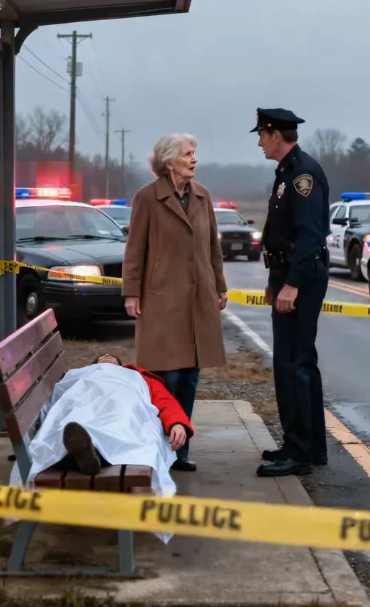
Instead, there were police cars, four of them, their lights painting the gray morning in urgent reds and blues. Yellow tape stretched across the bus stop shelter where I’d waited countless times.
Sheriff Tom Brennan saw me approaching and stepped forward, his hand raised. “Mrs. Alexia Foster, you need to stay back.”
“Tom, what happened? I need to catch the bus.”
“There won’t be a bus this morning, Alexia.” His face was grave. We’d gone to high school together forty-five years ago. “There’s been an incident.”
“What kind of incident?”
He hesitated, glancing back at the crime scene investigators. “A body was found here this morning. About six a.m.”
The world tilted slightly. “A body? Who?”
“We haven’t identified her yet, but Alexia…” he paused, his eyes searching mine, “…she was wearing a red coat. Cherry red, just like yours.”
My knees went weak. Tom caught my elbow, steadying me. Through the windshield of his patrol car, I could see them photographing a shape covered with a white tarp.
“Tom,” I said, my voice thin, “Danny called me this morning. At five. He told me not to wear my red coat today.”
The sheriff’s expression shifted instantly from concerned neighbor to focused lawman. “Your grandson called you? What exactly did he say?”
I repeated the conversation word for word.
“Where is Danny now?”
“I don’t know. He sounded terrified.”
“When did you last see him?”
“Sunday dinner. Three days ago. He seemed fine then.” But even as I said it, I wondered. Had he seemed normal, or had I been too caught up in the usual family chaos to notice? Sunday dinners had become tense. My son, Robert, and his wife, Vanessa, had been pushing me to sell the farm and move into a retirement community.
“Mom, you’re not getting any younger,” Robert would say, parroting his wife. “This place is too much for you.” But it wasn’t too much. It was my life.
A young detective with sharp eyes approached. “I’m Detective Roxane Merrick. I understand your grandson may have information.”
I explained again about Danny’s call. She exchanged a glance with Tom. “We need to speak with Danny as soon as possible.” When I tried calling his phone, it went straight to voicemail.
“Who specifically would know you take the bus on Tuesday and Friday mornings from this stop?” Tom asked, his voice low.
“My family, the other regular riders… half the town, probably.”
“Tom, what are you suggesting?”
“I’m not suggesting anything yet. But someone was killed here, wearing a coat identical to yours, at the exact location where you would normally be standing. And your grandson warned you to stay away.”
The implication crashed over me. Someone had wanted to kill me, and somehow, impossibly, Danny had known.
Tom’s radio erupted with urgent voices. He pressed it to his ear, his face darkening. He looked at me, and I saw something that made my heart stop. Not just concern now, but suspicion. “Alexia, I need you to come down to the station with me.”
“Why? What’s happening?”
“That body. We just identified her through her phone.”
“Who is she?”
Tom’s jaw tightened. “Her name was Rachel Morrison. She worked at County Records, and according to her phone logs, she’d been in contact with your grandson, Danny, multiple times over the past two weeks.” He paused, letting the weight of his next words settle. “There’s something else. We found a document in her coat pocket. It’s a property deed for your farm.”
“That’s impossible.”
“This deed is dated last month. And according to the document, you signed the property over to your son, Robert, and his wife, Vanessa.”
“That’s insane. I would never sign away this farm.” But even as I said it, doubt crept in. Vanessa was always putting papers in front of me during dinner—insurance policies, tax documents. She worked in real estate. Had she tricked me?
As I stood to follow Tom, I caught movement from the corner of my eye. A car was parked about fifty yards down the road, a dark blue sedan. And behind the wheel, watching us, was my daughter-in-law, Vanessa. Our eyes met. She didn’t wave, just stared with an expression I’d never seen before: cold, calculating, almost triumphant. Then she put the car in gear and drove away.
The sheriff’s station smelled like burnt coffee and old paperwork. Detective Merrick sat across from me in a pale green interview room. “Mrs. Foster, I need you to walk me through everything again.”
I repeated it all, but this time I forced myself to remember more. The background noise on Danny’s call. Water. Running water, like a creek or river. “He wasn’t calling from home,” I said. “He was outside somewhere.”
“What’s his relationship like with his parents?”
I hesitated. “My son, Robert, works long hours. Vanessa… Vanessa is very focused on appearances. On status. Danny and she have clashed lately. About me, about the farm.”
Merrick leaned forward. “Do you believe your daughter-in-law could be involved in forging that property deed?”
Before I could answer, Tom stepped in. “Alexia, your son is here. He’s demanding to see you. He brought a lawyer.”
Robert burst in, a thin man in an expensive suit trailing behind him. “Mom, don’t say another word. This is Peter Mitchell, a criminal defense attorney. We’re leaving.”
“Robert, I don’t need a defense attorney. I haven’t done anything wrong.”
“Mother, a woman is dead. The police think Danny might be involved. And Vanessa just told me about some property deed nonsense. We need to protect ourselves.”
In the parking lot, I looked at him directly. “Did you know about that property deed? The one giving you and your wife my farm?”
His face went pale. “What? No. What deed?” He stopped, his expression changing. “Vanessa. She’s been after me for months to convince you to sell. She says the farm is sitting on prime development land, that we could make millions. I told her you’d never agree, but she kept pushing.” He ran a hand through his hair. “You don’t think she would actually forge something?”
“Your wife was watching the crime scene this morning, Robert. She was parked down the road, just watching.”
When we got back to my house, Vanessa’s white Lexus was parked near the barn. We found her in my kitchen, going through my filing cabinet.
“What the hell are you doing?” Robert demanded.
Vanessa spun around, startled but composed. “Robert, I was just looking for documents to help your mother.”
I stepped forward. “Vanessa, did you forge my signature on a property deed?”
Her face transformed, the mask of concern cracking to reveal something cold underneath. “Of course not. How dare you accuse me? After everything I’ve done for this family. This farm is a burden. I’ve been trying to protect you from yourself.”
“By stealing my property?”
“I haven’t stolen anything!” Her voice rose, sharp and brittle. “But maybe if someone did forge that deed, they were doing you a favor! This place is falling apart. You’re falling apart. How long before you fall down those stairs and die alone, and no one finds you for days?”
“Vanessa, stop it!” Robert grabbed her arm.
She jerked away. “No! Someone needs to tell her the truth. She’s clinging to this farm like it’s a life raft, but it’s an anchor dragging all of us down!”
“Get out,” I said quietly.
Her eyes narrowed. “Fine. But you should know, Alexia, the deed is legal and binding. Your signature is notarized, witnessed. Whether you remember signing it or not, you did.” After she left, Robert sank into a chair, his head in his hands. “I’m sorry, Mom. I swear I didn’t know.”
I believed him. Robert had always been weak, easily led, but not malicious.
My phone buzzed. A text from an unknown number. Grandma, I’m sorry. I didn’t know it would go this far. Meet me at the old mill at midnight. Come alone. They’re watching you. The text ended with something only Danny and I would understand: Remember the strawberry summer? It was our code for trust me.
“I’m going,” I said.
“Then I’m coming with you.”
“No. The message said, ‘Come alone.’”
At eleven-thirty, I grabbed my flashlight and headed for my truck. As I backed out, headlights flicked on behind me. Someone had been waiting. They followed me, keeping a professional distance. Three miles from the old mill, I made a decision. I killed my headlights and swung onto a narrow logging road Frank and I used to take hunting. My truck bounced over ruts and holes, branches scraping the sides. Behind me, the other vehicle’s headlights swept past the turnoff. I’d lost them.
By the time I pulled into the crumbling parking lot of the Clearwater Mill, it was twelve-fifteen. The old mill rose against the sky like a tombstone. “Danny?” I called softly as I stepped inside.
On the second floor, I found him. He looked like he’d aged five years in three days. “Grandma,” his voice broke. “I’m so sorry. I’ve done something terrible. I helped her.”
“Help who?”
“Rachel Morrison.”
The story came out in fragments. Three months ago, Danny had met Rachel. She was pretty, smart, and worked at County Records. She said her own grandmother had been tricked out of her property by developers. She said she wanted to help protect my farm.
“You gave her access to the farm documents?” My blood ran cold.
“I thought I was helping. But last week, I saw her meeting with Vanessa at a restaurant. When I confronted Rachel, she laughed. She said I was just a useful idiot, that Vanessa had hired her months before we even met. The whole relationship was a lie to get information.”
“But why was she killed?”
“Because she got greedy. She told me she demanded more money from Vanessa, a lot more. She had copies of everything—the forged signature, emails, proof. She was going to blackmail her.” He pulled a thumb drive from his pocket. “Rachel gave me this two days ago. She said it was insurance. Copies of everything, recordings of phone calls.”
“Have you looked at it?”
“Some of it. Grandma, it’s bad. Vanessa forged your signature on multiple documents—loan applications, a power of attorney, even a will leaving everything to Robert and her. And there are emails about hiring someone to… to make sure you had an accident after the deed transfer was complete.”
The abandoned mill suddenly felt very cold.
“Rachel called me at four-thirty yesterday morning, terrified,” Danny continued. “She said someone was following her. She’d taken your red coat from the mudroom during Sunday dinner. She was going to meet you at the bus stop to confess and give you the proof. She said if anything happened to her, I should warn you. Then the line went dead.”
“There’s more,” he said, his hands shaking. “The last folder on this drive is encrypted. I can’t open it. And there’s a video file that won’t play. Rachel said it was the most important evidence, but I can’t access it. And… in the emails, she mentions paying off someone in the sheriff’s department.”
Footsteps echoed from below. Heavy boots. At least three people.
“Mrs. Foster?” a voice called out. “We know you’re in here. We just want to talk.”
Danny pulled me toward a back office overlooking the river thirty feet below. Before we could reach the fire escape, the office door opened. A man stood silhouetted in a deputy’s uniform. “I’m Deputy Marcus Hall. Sheriff Brennan sent me.”
“Stay back,” I said.
Then, a woman’s voice from behind him. “We needed to make sure you came alone.” Vanessa stepped into view. “Hello, Alexia. I believe my stepson has something that belongs to me.”
Deputy Hall had his hand on his weapon.
“You killed her,” I said.
“Of course not,” Vanessa’s smile was terrible. “That’s what hired help is for. Rachel got ambitious. A necessary loss.”
“And you’re going to kill us, too?”
“You’re going to sign over your farm tonight, willingly, with Deputy Hall as a witness. Then you’re going to have a tragic accident on your way home. Elderly woman, dark country roads. These things happen.”
“People know we’re here.”
“No one knows. Now, give me the thumb drive.”
Danny’s hand closed around mine, pressing the small drive into my palm. I pulled out my phone, held it up so she could see the screen. It was recording.
“I’ve been a farmer’s wife for forty years, Vanessa. I’ve survived drought, flood, and economic collapse. I’ve run a business that men twice your age said I couldn’t handle. And I’m smart enough to document everything.”
Vanessa’s face went white. Deputy Hall reached for his gun. And that’s when the real police kicked in the door.
“Marcus, don’t you dare!” Tom Brennan’s voice was steel. Three state troopers stood behind him. “Hands where I can see them!”
Vanessa tried to bolt, but a trooper caught her. “This is a misunderstanding!” she shrieked. “My mother-in-law is unstable!”
“Save it,” Tom said. “We’ve been listening for the past ten minutes.” He held up his own phone, showing a live audio feed. “Mrs. Foster called me twenty minutes ago, told me exactly where she’d be and what she suspected.”
As the troopers led them away, Vanessa turned back. “This isn’t over, Alexia. I have good lawyers. You’ll never prove I killed Rachel.”
The next morning, the forensic team was trying to crack the thumb drive. “The encrypted files are protected by military-grade encryption,” Tom told me. “It could take months.”
“So she might walk?”
“Worse. The judge just set her bail at two hundred thousand. Her lawyer posted it an hour ago. Vanessa’s out.”
My phone rang. An unknown number. I answered on speaker. “Hello, Alexia,” Vanessa’s voice was smooth. “I’m calling to inform you that my client is being released. We will also be filing a civil suit against you for defamation, and we’ve filed for a competency hearing. Given your age and recent erratic behavior, we believe a court-appointed guardian should evaluate whether you’re capable of managing your own affairs.”
She had thought of everything. She wasn’t just trying to steal my property; she was trying to steal my life.
It took Danny three hours to find Rachel Morrison’s real name. Before that, she was Bea Hartley, born in Red Lodge. Her grandmother, Martha Hartley, had owned a two-hundred-acre ranch there. Had owned. A newspaper article from six years ago reported that Martha Hartley’s ranch was sold to a development company. Six months later, Martha died in a house fire. The buyer? A holding company called Summit Development Group. The same name as Vanessa’s real estate company.
Then Danny found the connection. The Red Lodge ranch was listed by Summit Properties six years ago. The listing agent was Vanessa Foster. And the transaction was recorded at County Records by Bea Hartley. It was her first week on the job.
I grabbed my coat. “We need to go there now.”
The ranch was still there, abandoned. The house was a burnt-out shell, but the barn still stood.
“Why would Vanessa keep this?” Robert wondered.
“Because the property is tied up in legal disputes,” Danny said, checking his phone. “Martha’s will left everything to Rachel, but Rachel disclaimed the inheritance. It’s been in probate court for six years.”
Which meant if Rachel hid something here, it had been safe all this time. In the back corner of the barn, a horse stall had a name carved into the wood: Starlight. I knelt, running my hands along the boards. One was loose. Behind it, wrapped in waterproof plastic, was a small metal box. Inside was another thumb drive and a handwritten note.
If you’re reading this, I’m probably dead. Vanessa Foster killed my grandmother and made me help her. I’ve been collecting evidence ever since. This drive contains everything. Unedited recordings, original documents, proof of every crime. The password is Starlight1997. Use it to stop her. – Rachel
Then we heard the cars. Multiple cars, fast. Vanessa stood in the center, flanked by Peter Mitchell and two large men I didn’t recognize.
“Alexia,” her voice echoed. “You’re trespassing. Whatever you found in there belongs to the estate.”
“This estate belongs to Rachel Morrison,” I called back. “And she left instructions.”
“Rachel is dead. I’m the executor of her estate now. Hand it over.”
“I don’t think so.”
“Mrs. Foster,” Mitchell stepped forward, “we can have you arrested. Sheriff Brennan’s patrol car is gone. We sent them on a false emergency call. You’re alone.”
“You’re right about one thing, Mr. Mitchell,” I said, pulling out my phone. “The patrol car is gone. But you’re wrong about me being alone.” I hit send on the video I’d been streaming live for the past ten minutes—to Tom’s phone, to the state police, and to three local news stations. “I’ve been broadcasting everything. Every word, every threat. Thousands of people are watching you, Vanessa, watching you threaten an elderly woman on this property.”
Her face went white in the headlights.
“You can take this thumb drive from me,” I continued, “but it won’t matter. In exactly five minutes, my grandson is uploading the complete contents to cloud storage, with copies going to the FBI. It’s over, Vanessa. You lost.”
Sirens wailed in the distance. She ran. Mitchell and the other men scattered. But the police were already blocking the road.
The competency hearing was canceled. Judge Winters called me personally to commend my “exceptional civic courage.” Vanessa was denied bail. Rachel’s backup drive contained six years of meticulous record-keeping: recordings of Vanessa plotting against victims, financial records, even a video of her admitting to arranging Martha Hartley’s death. The FBI identified eleven victims across two states. Peter Mitchell was arrested, along with Deputy Hall and two other corrupt officials. The district attorney called it the largest elder fraud case in state history.
Two weeks later, Robert filed for divorce. Danny took a semester off from college to heal. Spring came, and I planted the strawberry patch again, twice as big. Robert came for Sunday dinners, quieter now, more honest. Vanessa took a plea deal: life in prison without parole.
I attended one of the restitution hearings. There were families there, people who had lost parents and grandparents to Vanessa’s schemes. A woman my age, whose sister had been a victim. We didn’t speak much, but we shared something: the knowledge that we had survived.
Vanessa’s biggest mistake was thinking that being older meant being helpless. She saw my age and assumed vulnerability. She saw my kindness and assumed weakness. She never understood that people who have lived longer have survived more. They have instincts sharpened by decades of navigating a world that doesn’t always play fair. Wisdom is the ultimate power, and age is not a weakness to be exploited, but a fortress built from a lifetime of survival. I was sixty-three years old, and I was just getting started.