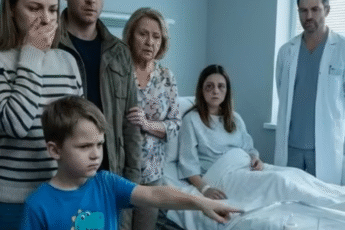
Samuel Peterson’s voice, though weak, echoed with the weight of iron in the sterile hospital room. The billionaire industrialist lay on a high-tech bed, his body withered by illness but his eyes still burning with an unquenchable fire. Around the bed, like vultures, stood his three children.
“Father, this is some kind of comedy,” Victor, the eldest, broke the silence. His voice, usually so confident and commanding in boardrooms, now trembled with poorly concealed anger. “You gathered us, the notary, your doctor, just to stage this spectacle?”
“This isn’t a spectacle, Victor. This is my will,” Samuel’s voice was faint, but each word resonated.
“A will?” interjected Alex. He paced the room restlessly, from the window to the minibar, nervously fiddling with his cuffs. “Dad, are you in your right mind? Return my good name? A lost day? What is this, some kind of quest?”
“Alex, stop it,” Elena intervened softly. She was the only one sitting by the bed, holding her father’s emaciated hand, her large blue eyes full of tears. “Dad, we don’t quite understand what you mean. We’ll do whatever you want. Just tell us, specifically.”
A tense pause hung in the room, broken only by the rhythmic beep of medical equipment. And at that very moment, at the other end of the clinic, a different but no less significant drama was unfolding.
“You’re Eva Lambert, correct? The new nurse? What are you doing frozen at the entrance? Morning briefing is in three minutes in the staff room. I expect you not to be late.” The woman’s voice was as starched and crisp as her uniform. “And let me remind you, this is not a city hospital; it’s a private clinic.”
I flinched and shyly lowered my eyes. Standing before me was a woman in her fifties, in a pristine white coat with perfect hair. The gaze of her gray eyes pierced right through me.
“Yes, forgive me, I’m on my way.”
“My name is Hope Phillips, Head Nurse. Remember it. And it’s not ‘on my way,’ it’s ‘running.’ You have three minutes,” the supervisor snapped, and with a click of her heels, she disappeared around the corner.
Lord, help me survive this day, I prayed to myself, hurrying after her.
The Medea Private Clinic had greeted me with a cold, ringing luxury. It wasn’t a medical facility in the usual sense, but a palace of glass, marble, and silence, smelling not of bleach but of expensive antiseptic, coffee from the lobby, and, it seemed, money itself. Getting a job here was a privilege. I, having left the perpetually overcrowded, noisy city hospital, felt like a crow that had accidentally flown into a flock of peacocks.
I entered the staff room a second before Hope Phillips slammed the door. The briefing passed in a blur. Doctors with intelligent, important faces and nurses who looked like models from a medical journal discussed surgical schedules, VIP admissions, and new protocols. I feverishly scribbled everything in my notebook, afraid to look up. I knew that getting this job was like winning the lottery. The salary was triple what I used to make, a fact my husband constantly reminded me of.
“And lastly,” Hope Phillips raised her eyes from her tablet. “We have a new employee, Eva Lambert. Please be both welcoming and demanding. Ms. Lambert, today you’ll be working with Valerie on the third floor, VIP wing. Your assignment is Room Seven.”
A short but palpable silence fell over the room. I felt several pairs of curious eyes turn to me.
“Room Seven?” a slender blonde with a ‘Valerie’ name tag squeaked beside me. “Hope, are you sure? On her first day? That’s where—”
“I am sure, Valerie,” the head nurse’s voice turned to ice. “The schedule is approved by the chief physician. Patient Samuel Peterson requires a 24/7 nursing post. You’ll cover for Eva while she gets up to speed. Everyone is dismissed. Lambert, with me. You need your ID badge.”
When we stepped into the hallway, Valerie, who turned out to be a lively chatterbox, immediately took my arm.
“Girl, you’re something else,” she whispered as we walked to the elevator. “Straight from the ship to the ball, into Room Seven.”
“What’s in there?” I tried to keep my voice from trembling. “A difficult patient?”
Valerie snorted, pressing the call button. The elevator arrived instantly and silently, like a ghost. “Difficult? He’s not a patient, he’s a legend. A deity. Samuel Peterson, owner of everything you see in this city and half of what you don’t. Don’t you read the papers?”
“I haven’t had time for papers lately,” I confessed, remembering the endless shifts at the city hospital.
“Right. Well, Peterson has terminal cancer. It’s palliative care now, top-tier, of course. But that’s not even the main thing.” Valerie lowered her voice, though we were alone in the elevator. “The main thing is his family. They’re all there now, they say a notary just visited. Dividing the skin of the, forgive me, un-skinned bear. You can’t imagine the money involved, and there are three heirs. The eldest, Victor, already runs the entire holding company. The middle one, Alex…” Valerie rolled her eyes. “Oh, that Alex. A golden boy, a playboy. They say he’s drowning in debt. And the youngest, Elena, quiet as an angel, all wrapped up in charity. But you know what they say about still waters.”
The elevator stopped smoothly. “So, you’re about to walk into a snake pit,” Valerie concluded. “Did Hope Phillips give you the rundown? The main rule: you’re practically furniture in there. You see nothing, you hear nothing, you only carry out medical orders. Got it?”
“Got it,” I nodded, feeling a cold sweat on my back.
“Alright, this is Room Seven.” Valerie gestured to a massive dark wood door. “I’ll go prepare the IV drip. You need to give him an injection in fifteen minutes. Dr. Glen Archer, his personal physician, should still be in there. He’ll show you everything. Good luck.”
Valerie darted off, leaving me standing before the door, from which muffled voices could be heard. I took a deep breath, trying to calm the tremor in my hands. It’s just a job. I need this place. I can do this.
Meanwhile, behind the door, the drama was intensifying. The three heirs stared at each other, trying to solve their father’s riddle. The doctor stood aside, a silent witness. Finally, Victor, as the eldest, broke the long pause.
“Don’t you understand? It’s obvious. Father is not in his right mind. Dr. Archer!” He turned sharply to the man in the severe suit. The billionaire’s personal physician, a man with an impenetrable face and tired eyes, only shook his head mournfully.
“Victor, I have confirmed repeatedly—”
“What have you confirmed? That he’s of sound mind?” Victor threw his hands up theatrically. “A man who’s about to give everything to some stranger for a mythical discovery? He’s just mocking us!”
“I’m not mocking anyone,” Samuel Peterson said quietly, and everyone fell silent. He gestured, and the pale, bespectacled notary stepped forward.
“You have recorded everything?”
“Yes, Mr. Peterson. In full accordance with your words. The condition is written down verbatim,” the man replied, clearing his throat.
“Children,” Samuel moved his gaze from one to the other. “You know that my entire fortune—stocks, factories, capital—will be divided among you.” Victor’s eyes flashed with cold calculation. Alex licked his lips impatiently. Elena tensed. “But only after,” the billionaire continued, pausing for effect, “one condition is met. I repeat, I bequeath everything, whether to one of you or an outsider, to the one who gives me back what I lost thirty years ago.”
A ringing, astonished silence filled the room.
“And what might that be?” Alex drawled with open mockery, slumping into an armchair. “A gold bar you buried in the backyard? A bundle of bank stocks?”
“Alex!” Victor snapped.
“No,” Samuel answered with surprising clarity, his gaze fixed on something outside the window that no one else could see. “I lost my good name. And the single day that turned my entire life upside-down. Whoever brings me back that day and clears my name will inherit everything.”
With that, he slowly, with visible effort, turned to face the wall.
“This is absurd!” Victor exploded first, striding toward the doctor. “Dr. Archer, I insist on an immediate medical council. I demand he be declared incompetent. This is utter nonsense!”
“Victor,” the doctor sighed wearily. “Your father is completely lucid. His cognitive functions are not impaired. The fact that you don’t like his decision does not make your father insane.”
“Don’t like it?” Victor sneered. “He just disinherited us and is about to squander his life’s work!”
“Please,” Elena began to cry, burying her face in the blanket.
“Leave,” Samuel whispered without turning. “I’m tired.”
“Well done,” Victor started.
“LEAVE!” For a second, Samuel’s voice regained its old power. All three of them flinched. Alex was the first to storm out, cursing under his breath. Victor followed, pale with rage. Elena, with a final, desperate look at her father, slipped out. The notary and the doctor remained in the silence, punctuated by the beeping of the machines.
The door to the room opened so abruptly that I, standing outside with a tray for injections, barely had time to dodge. I took a deep breath, straightened my uniform, and knocked softly on the ajar door.
“Come in,” a tired voice called.
The room smelled of medicine and that heavy atmosphere that hangs where death has already perched on the edge of the bed. Two men in suits stood by the door—the doctor and the notary, evidently. They looked exhausted.
“You’re the new nurse?” Dr. Archer asked, giving me an appraising look.
“Yes. Eva Lambert. I need to administer a painkiller injection on schedule,” I said, trying to sound professional.
“Right, come in,” the doctor nodded. “Mr. Peterson, this is the new nurse, Eva. She’s going to give you your shot.”
The notary quietly gathered his papers. “I’ll be going then. Call if you need anything. A difficult case, certainly.”
“You can say that again,” the doctor sighed. “Goodbye.”
The notary left, and only the doctor, the patient, and I remained. I approached the bed. The billionaire lay with his eyes closed, his face gray and parchment-like. For a moment, I feared he had died right after that ugly scene.
“Mr. Peterson,” I called softly. “I need to give you an injection in your forearm.”
He didn’t answer. I carefully wiped his skin with an alcohol swab, my movements honed by years of practice. Just as I brought the needle close, the man suddenly opened his eyes. I expected to see a clouded, fading gaze, but his eyes were surprisingly sharp, tenacious, and incredibly alive. But he wasn’t looking at me. His gaze was fixed on my neck.
I became flustered. The thing was, on a thin silver chain, hidden under my uniform collar, hung my old locket. It must have slipped out when I leaned over him. A small, time-tarnished silver oval engraved with a lily of the valley.
“Where did you get that?”
I straightened up, involuntarily covering the piece with my hand. “I’m sorry?”
“The locket,” the patient whispered, his hand on the blanket attempting to rise but falling back limply. “Where is it from?”
“Mr. Peterson, please calm down, you mustn’t get agitated,” Dr. Archer intervened quickly, stepping closer.
I blushed. Samuel’s gaze bored into me, demanding an answer. “It was a gift from my late mother.”
The billionaire turned pale, and a single tear slowly rolled down his cheek. “Glen,” he whispered, his eyes never leaving the locket. “Leave. And you, nurse, give the injection and leave me.”
“But, Mr. Peterson—”
“Leave me.”
I quickly and almost painlessly administered the medicine. Samuel didn’t flinch or say another word.NextStay
“I’ll be in the hallway if you need me,” Dr. Archer said quietly and beckoned me to follow.
My first shift at Medea turned into a real ordeal. The clinic operated by its own unfamiliar laws. Here, everything was subordinate not so much to medicine as to the comfort of VIP patients. One had to not just follow orders but anticipate wishes, be invisible yet omnipresent, smile when you wanted to howl from fatigue and tension. Valerie, for all her chattiness, was a demanding mentor.
“No, Eva, not like that. We place the IV on this side, so the client doesn’t see the needle if they wake up. And why isn’t the pillow fluffed? You must fluff it every two hours, even if he’s asleep.”
“But that disturbs his sleep.”
“It violates protocol. Get used to it. They pay for the illusion of a perfect world here.”
But my thoughts were far from pillows. They kept returning to two things: my husband’s cold, indifferent gaze that morning, and the burning, pain-filled eyes of the billionaire who saw my locket. What had he seen in that cheap silver trinket?
My mother had passed away three years ago from pneumonia. I held her hand until the very end, and just before she passed, Natalie took the locket from her neck and placed it in my palm. “Wear it, daughter. It will protect you,” she had whispered. I had always considered it just a talisman, a final connection to the person dearest to me.
I entered Room Seven several times that day. Samuel Peterson either slept under the effect of medication or lay with his eyes closed, pretending to sleep. But I could feel him tense up the moment I crossed the threshold.
My shift ended at 8:00 PM. I practically crawled out of the clinic, feeling squeezed dry like a lemon. The bus ride home seemed endless. I leaned my forehead against the cold glass. I desperately wanted to go home, but my husband, Mark, was waiting for me there.
Once, I had loved him to the point of trembling knees. A successful lawyer, handsome, charming—he seemed like a prince. But over the last six months, my husband had turned into an icy statue, a stranger.
“Eva, you need to find a real job. Your city hospital is a joke. We can’t afford a mortgage.”
“Eva, why is dinner from a box again? I work like a dog, and you can’t even cook a proper meal?”
“Eva, I’ll be late. A meeting.”
The “meetings” grew longer, and the nights grew colder. And then there was the text exchange I saw by accident when he fell asleep without turning off his phone. Kitten, waiting for you. It was incredible. And a reply from someone named Arthur. You’re my god. But my husband’s name was Mark.
I cried into my pillow all night so he wouldn’t hear, and said nothing in the morning. What was there to say? I felt my husband lying to my face, and that lie was destroying me from the inside. I took the job at Medea not for the money, but to escape a crumbling marriage, my own powerlessness, and the man who had betrayed me.
I opened the door with my key. The apartment met me with silence. Mark was home; his expensive shoes were carelessly thrown in the entryway. He was sitting in the kitchen, glued to his laptop.
“I’m home,” I said quietly, taking off my shoes.
“You’re late. Dinner’s cold,” my husband replied without looking up. No “How was your first day?” No “Are you tired?” Nothing.
“I was held up. It was a very tough shift.” I went into the kitchen and sat opposite him. “Mark, we need to talk.”
“Again?” he snapped the laptop shut irritably. “I have no energy for your scenes. I’m tired.”
“I’m also tired of us living like roommates. Tired of your coldness, of the fact that you—”
“That I work day and night so you can play Florence Nightingale in your elite charity ward?” Mark looked up at me, his eyes filled with nothing but boredom and irritation.
“I’m not playing,” I flared up. “It’s actually hard work. And I went there because you kept blaming me for earning too little.”
“Because it’s true! I have a major deal on the line, you know.”
“A deal?” I felt a lump rise in my throat. “Or another ‘meeting’? Who is Arthur?”
My husband froze. Just for a second, but I saw it. His shoulders tensed, and his eyes, for a moment, became genuinely angry. But he quickly regained control. “What? Who’s Arthur? What are you talking about?”
“I saw your phone, the texts. You call that a ‘deal’?”
Mark gave me a long, cold look. “You went through my phone. I see.”
“Mark,” I had no strength left to shout. I just looked at him with despair.
“Listen,” he came over and knelt, taking my hands. “I’m really going through a tough time. This deal, everything depends on it. I’m on edge. So yeah, I snapped. Maybe I was looking for a release, but it doesn’t mean anything, you understand? It’s just stress.”
“You don’t love me,” I whispered. It wasn’t a question.
“Don’t start. I’m so tired. By the way, I have to go on a business trip tomorrow morning, for this deal.”
“A business trip?” I repeated.
“Yes, to Chicago. Urgent. Five days, maybe a week. Things will settle down, I’ll come back, and we’ll talk calmly. Okay?” He patted my cheek patronizingly. I instinctively pulled away.
“Fine, go,” I said, getting up. “I’m going to take a shower. I have an early shift tomorrow.”
“That’s a good girl.” He opened his laptop again, already forgetting about me.
I stood under the hot water, tears streaming down my face. When I came out, Mark was already rummaging in the closet, pulling out a travel bag. “Have you seen my gray cashmere jacket?”
“In the closet, in the garment bag,” I answered mechanically. He tossed the jacket on the bed. “Great, no clean handkerchief.” I went to the dresser and took out a fresh, ironed one. The outer pocket of the jacket was bulging. Obeying some strange impulse, I stuck my hand in to place the handkerchief and my fingers brushed against something hard and leather-bound.
I went into the spare bedroom we now used in turns and closed the door. My hands were shaking. It was a passport. I opened it. A photo of Mark, my husband, the successful lawyer Mark Lambert. But the name in the passport was different: Arthur Walker. The date of birth matched. The place of birth, everything else, except the name. My heart hammered. So my husband is not who he says he is? I sank onto the bed. The familiar face was transforming into the mask of a terrifying stranger.
In the hallway, the lock clicked. Mark had left without even saying goodbye.
The next day, I arrived at work with a heavy heart, not having slept a wink.
“Oh, Lambert!” Valerie greeted me. “Looks like Medea chewed you up and spit you out yesterday. Tough after the city hospital, huh?” A couple of other nurses giggled.
“No, I just didn’t get enough sleep,” I answered quietly.
“Uh-huh,” Valerie hummed. “Well, don’t fall apart. Tonight should be quieter. Room Seven was peaceful all night. Peterson mostly slept.”
I nodded. Right. See nothing, hear nothing. I took my tray and headed down the familiar corridor.
I entered quietly. Samuel Peterson was awake, looking out the window. “Good morning, Mr. Peterson. How are you feeling?”
He turned his head slowly. His gaze was different today—not piercing and demanding, but tired and surprisingly clear. “Good morning, Eva.” It was the first time he had used my name. “I’m feeling tolerable.”
I silently began my work, measuring his blood pressure, changing a catheter, giving the necessary injections. He endured it all patiently. When I was finished and packing up, he said quietly, “Wait. Don’t go.”
I froze. “Yes, Mr. Peterson? Do you need anything?”
“No. Sit down, please.” He gestured to the chair. I hesitated. “Don’t be afraid,” he smirked crookedly. “I’m not going to ask about the locket. I want to tell you something. I don’t have much time.”
I perched on the edge of the chair, compelled by something in his voice.
“I don’t know why I’m telling you this,” he began. “Maybe because you have such kind eyes. Or maybe because you’re not my family, and you don’t care.” He paused. “Everyone thinks I’ve always been this tycoon. It’s a lie. Thirty years ago, I wasn’t rich. I was just an engineer at a factory, a young romantic full of ambition. I had a wife, Lydia, and a little son, Victor.” I flinched. Victor, the one who threatened to sue his father.
“I loved my wife more than life itself,” his voice trembled. “I also had a young lab assistant under my command, Valerie. Bright, beautiful. And she fell in love with me, hopelessly, she thought. But I swear, I gave her no reason. I was faithful to my family.” He coughed, and I gave him a glass of water. “One day, there was a major accident at the factory,” he continued. “A pipeline burst. A worker died. An investigation began. I was blamed as the department head, but I was innocent. It was a setup. Someone had tampered with the pressure gauges, but all the evidence and testimony suddenly pointed at me. I was facing prison. Ten years, at least.”
“My God,” I whispered.
“Yes. But the evening before I was supposed to be arrested, Valerie came to my house. Lydia was away with our son. Valerie sat right where you are and said she had dirt on the factory director, papers proving his embezzlement. She promised she could fix everything, pressure the director to shift the blame to someone else. But there was a price.” He paused, breathing heavily. “The price was me,” he whispered. “Valerie said, ‘Leave Lydia for me, and I’ll make you a king.’”
I listened, holding my breath.
“Of course, I refused,” Samuel clenched his fists. “I threw her out, said I’d rather go to jail than betray my family. But two days later, something strange happened. Key witnesses against me suddenly retracted their statements. A drunkard worker with no family took the blame. He got a suspended sentence and then just vanished from town.”
“And you?”
“I was reinstated. Six months later, the director, the one Valerie had dirt on, suddenly retired for ‘health reasons.’ I was appointed chief engineer. I always suspected it was her doing, that she went ahead with her plan anyway, thinking a saved man would come crawling to her. But I had no proof. I kept quiet. Told myself I was doing it for Lydia and Victor.” He closed his eyes. “I was a coward. I chose prosperity over honor. And fate punished me for it.”
“What happened then?” I whispered.
“A year later, Lydia was gone. A car crash. Officially, it was an accident. The driver, a good man named Tony, lost control on a slippery road. But I always believed it was set up. I’d had a conflict with a competitor, Constantine Shaw. A ruthless man. Just before the accident, I saw Shaw and Valerie talking on the street, quietly, intensely. I didn’t think much of it then. But after Lydia was gone…” The billionaire fell silent. “I lost everything that day,” he finally said. “Not the day of the accident, but the day I agreed to remain silent. I built an empire, but I’ve lived these thirty years branded a coward and a silent accomplice. And what about Tony’s children, Alex and Elena? Their mother had died giving birth to Elena. They were orphans. I took them in, raised them as my own. They don’t know the truth. Another lie in my life.”
Now I understood. Victor’s rage, Alex’s recklessness, Elena’s sorrow—they were all victims of this old, terrible story.
“That’s why I made such a will,” Samuel finished. “I want someone, anyone, to dig up the past, find the truth, and clear my name. Give me back the day I should have acted like a man.” He looked exhausted. Then his gaze fell on my neck again. The locket had slipped out. “My Lydia,” he whispered, “had one exactly like it. I had it custom-made by a jeweler, with lilies of the valley, her favorite flowers. I gave it to her on the day our son Victor was born. It disappeared after her death. I thought it was stolen from the wreckage.”
I turned pale. Frame by frame, I remembered the locket’s history. My mother, already gravely ill, had called me to her side. “Daughter,” she’d said, placing the locket in my palm. “Take this.”
“But Mom, it’s yours.”
“My cousin, your Aunt Irene, gave it to me.” I barely knew her. Mom said they’d had a difficult past. “‘Irene gave it to me many years ago,” Mom had whispered, “and said the strangest thing: ‘Natalie, hide it. This locket belonged to an innocent woman. It must atone for our guilt.’”
At the time, I thought it was just a metaphor, a family legend. Now, I looked at the dying billionaire who had just told me the terrible secret of his life, and I felt an icy horror creep up my spine. My Aunt Irene. A strange locket. What did it all mean? But I said nothing to him. I rose and headed for the door. “I see you need to rest.”
“Yes,” he closed his eyes again. “Thank you for listening, Eva.”
I walked out of the room on numb legs. The world, which had been cracking at the seams yesterday, had completely collapsed today, burying me under the rubble of someone else’s terrible secrets, which, as it turned out, were also my own.
While I was returning home, my husband Mark was not in Chicago. Of course, he wasn’t in meetings. Mark, or rather Arthur Walker, the man he had recently been pretending to be, was in the penthouse of the city’s most expensive hotel, a glass of fine cognac in his hand.
“Still looking at that hospital?” a petulant, childlike voice came from the bedroom. Elena Peterson emerged from under the covers.
“I’m looking at our target,” Arthur said without turning.
“I don’t want to be a target,” Elena pouted. “I want you to be with me. Your plan is brilliant.”
He finally turned. “Listen to me. Your father is dying, and your brother Victor has already bribed Dr. Archer. He plans to have your father declared incompetent and take everything. Alex will blow through his share in a week and come begging to Victor. What will be left for you?”
“I’ll have you,” Elena whispered, her eyes full of love.
“You need to find out from your father what this ‘key’ Alex was talking about is. Maybe it’s a safe combination? You need to be with him, cry, tell him you love him more than anyone. Get the information out of him.”
“But I can’t do that to Dad.”
“You can,” Arthur’s voice hardened. “You want us to be together, don’t you?” He kissed her, and Elena, driven by resentment for her brothers and blind faith in this man she’d known for only six months, melted in his arms.
“Okay,” she whispered. “I’ll talk to Dad tomorrow.”
“My clever girl,” Arthur smiled, looking over her head at the distant lights of the clinic, where his unsuspecting wife was finishing her shift.
I found no peace. I spent the evening in the kitchen, holding the cold passport of Arthur Walker in one hand and the lily of the valley locket, warmed by my palm, in the other. My world had shrunk to these two objects: my husband’s blatant lie and a family’s secret. Irene, my late mother’s cousin, a woman I’d seen maybe five times in my life. Whose guilt was this locket meant to atone for?
The decision came with the gray, hopeless dawn. I had to go to my aunt. Right now.
The suburban town of Riverside greeted me with a drizzling rain and broken roads. Her old cottage looked abandoned. Finally, the door creaked open. A thin, haggard woman with a shock of unkempt hair stood on the threshold.
“Aunt Irene?” I asked uncertainly.
“Eva! What are you doing here?” Her voice was laced with fear.
“I’m sorry to come without calling, but I really need to talk to you.”
She hesitated, then let me in. The inside smelled of dampness and mothballs. “Aunt Irene, do you remember giving this to my mother years ago?” I pulled the locket from under my sweater. Her reaction was strange. She recoiled as if from an electric shock, clutching her heart and collapsing onto a stool, staring at the lilies with mute terror.
“Put it away! Why did you bring it here?”
“Aunt Irene, who is Lydia Peterson?” I decided to go all in.
Her eyes widened. “Where did you—”
“I work at a clinic, caring for a patient named Samuel Peterson. He’s very ill. He recognized this locket.”
Irene clutched her heart. “Sam… he’s dying? Oh God, this is the end.”
“Aunt Irene,” I knelt before her. “You told my mother this locket must atone for guilt. Whose guilt? What happened thirty years ago?”
She raised a crazed, tear-filled gaze. “You don’t understand anything. My name isn’t Irene. I mean, it is now, but back then…” Her voice broke. “Back then, my name was Valerie.”
My legs gave out from under me. Valerie. The same lab assistant who was in love with Samuel.
“In love?” Irene laughed bitterly. “I was obsessed with him. I worshiped him, and all he saw was his Lydia. I would have done anything for him.”
“So you arranged the accident?” I whispered, afraid of the answer.
“No, of course not!” she shrieked. “I swear to you. Yes, I framed the director. I wanted Sam to be exonerated, to see what I was capable of for him. But then there was Shaw, Constantine. He also wanted the chief engineer position and hated Sam. When Sam threw me out, Shaw came to me and suggested we get rid of Lydia. I refused! I’m not a murderer. In fact, I went to Shaw, tried to talk him out of it. I screamed at him. Sam saw us together on the street and must have gotten the wrong idea. And two days later, Lydia crashed.” She sobbed, her body shaking. “Sam threw me out after the funeral, called me a murderer. He said he’d find the truth and bury me with Shaw. But the truth was never found. Shaw covered his tracks perfectly. I was left alone. By the way, life punished him recently. Shaw is now in prison for financial fraud. But that doesn’t make me feel any better.”
“And the locket?” I asked quietly.
“I was at the crash site,” she raised a tear-streaked face. “I found it in the bushes. I took it, out of spite, maybe envy. And then it started to burn my hands. I couldn’t throw it away, couldn’t wear it. I changed my name, moved here, and gave the locket to your mother, my cousin. She was the purest soul I knew. I thought maybe her purity could atone for my sin.”
I looked at this broken woman, speechless. My family, my kind, gentle mother, had been the keeper of this terrible, dirty secret. “I have to go,” I stood up. “Mr. Peterson needs to know it wasn’t you.”
“No!” she grabbed my arm. “Please, keep quiet. He won’t believe me anyway. He’ll destroy me. Keep quiet for your mother’s memory.”
I gently freed my arm and left.
Returning to the city, I went to the clinic, though it wasn’t my shift. The oncology ward was buzzing. A little girl named Lily, whose room was near Samuel’s, had taken a turn for the worse. I saw her father, Max, in the small staff café. I’d seen him in the hallway before, always near Lily’s room. He was sitting at a table, head in his hands. He looked up as I approached.
“I’m sorry,” he mumbled. “I’m probably in your way.”
“No, not at all,” I said. “You’re Lily’s dad, right? I’m Eva.”
“Max,” he extended a hand. We sat in a slightly awkward silence. “How is she?” I asked softly.
“The doctors say she’s holding on. Lily’s a fighter.” He looked at me closely. “What about you? You look like… like everything’s lost.”
The accuracy of his assessment startled me. “Almost,” I admitted honestly. “Actually, yes.”
“Work?” he asked sympathetically.
“More like my entire life,” I answered briefly.
“It happens,” Max nodded with understanding. “I own a couple of auto repair shops. You know what I do when it feels like everything’s falling apart? I go fix a car. Or wash one. Something simple. With my hands. Where everything depends only on you. Black is black, white is white. A nut gets tightened. It helps.”
I looked at him and was amazed. There seemed to be no falsehood in him, no intrigue or lies. Just a man who desperately loved his daughter and fixed cars. “Thank you,” I said sincerely. “That’s good advice.”
“Stop by anytime. I practically live here now,” he offered a tired smile.
I nodded and left. For the first time in the last twenty-four hours, it was a little easier to breathe. This quiet, genuine support was what I had been missing so desperately.
Meanwhile, the battle for the Peterson inheritance was escalating. “Dr. Archer, I don’t understand what you mean by ‘no grounds’!” I heard Victor’s voice as I passed the staff room. “My father is hallucinating! I’m not paying you to state he’s in remission. I’m paying for a diagnosis. Find one! A tumor pressing on his brain, psychosis from the medication, find something! Or I’ll find another doctor. And you’ll find a new job at a public clinic.” The door slammed shut.
Alex wasn’t idle either. At the far end of the clinic’s parking lot, he met with a nondescript man in a trench coat—a private detective named Peter. “I want all the dirt on Victor,” Alex whispered, handing over a thick envelope. “Tax fraud, mistresses, kickbacks. I’ll destroy him.”
“It will be done,” Peter said, taking the envelope. “But I also dug up some things on your sister, just in case. Her new beau, a certain Mark Lambert, also known as Arthur Walker, is linked to a network of shell companies. A very slippery character. So if I were you—”
“I don’t care about Elena and her boyfriend,” Alex waved him off. “Keep digging on my brother.”
Meanwhile, my husband, Mark, sensed my distance. I wasn’t answering his calls, just sending curt texts. He suspected I was hiding something, especially since when he secretly returned to our empty apartment, he found neither me nor the passport. He opened his laptop. He had long ago installed spyware on my phone and personal computer. He pulled up my shift schedule, then my personal notes about my aunt and Samuel. He leaned back in his chair. You fool, he whispered with a smile. You just handed me the key to everything.
He decided to wait for me. When I entered, exhausted after talking with Max and visiting my aunt, the light in the kitchen flicked on. My husband sat at the table. In front of him lay the passport of Arthur Walker.
“So, where have you been?”
“I went to see my aunt in the suburbs.” My heart sank.
“Aunt Irene, or Aunt Valerie?” I froze. “By the way, how is Constantine Shaw doing?” he drawled. “You’re probably thinking about divorce, or planning to tell me about this passport?”
“Mark, I—”
“Quiet.” He held up a hand. “I know everything. But for everyone else, I’m still Arthur Walker. And I’ll be honest with you, I’ve been seeing Elena Peterson for some time now. And I’m sure we’ll soon have all her father’s money. And you know who’s going to help us? You.”
“Me?” I couldn’t believe my ears. “Are you insane?”
“No. Listen to me very carefully.” He stood and came close. “You have a great story about a lost love and an innocent Valerie. You’ll go to Samuel and tell him this story. But you’ll tell it on my behalf,” he smirked. “You’ll say that I, Arthur Walker, his future son-in-law, conducted a massive investigation and found the fugitive Valerie. And I found proof of Shaw’s guilt. You’re just a nurse, passing on his gratitude.”
“I won’t do it. It’s all a lie.”
“Oh, you will.” He grabbed my arm, squeezing it painfully. “Because otherwise, I’ll go to Samuel and tell a very different story—about how your aunt conspired with Shaw. I’ll destroy her, have her imprisoned for complicity in murder. And then I’ll tell everyone at Medea who you really are. The niece of a killer. You have twenty-four hours. Either we both win, or you and your aunt go down. Choose.” With that, he released my arm and stormed out.
The next morning, I was practically running through the halls of Medea. My husband’s ultimatum pounded in my temples. 24 hours. I went into the nurses’ station and saw a tearful Valerie. “What happened?”
“Lily, the little girl. She got worse, suddenly. They’re moving her to the ICU.”
Forgetting my own problems, I rushed to the elevator. Outside the ICU, Max stood motionless, staring at the closed door. The doctors were fighting for his daughter’s life, and he, a strong man, could do nothing but wait. I looked at his genuine, incomparable grief, and at that moment, Mark’s blackmail, Valerie’s lies, Samuel’s billions—all of it shrank and lost all meaning. I turned and walked down the hall.
When I arrived for my shift, Samuel’s room was like a disturbed beehive. Everyone was there. Victor stood by the window, his face darker than a thundercloud. Alex paced nervously. Elena sat by the bed, crying. And next to her, with a hand on her shoulder, stood my husband. He looked at me with an icy, victorious smirk.
“Here, Father,” Victor brandished a stack of papers. “The council’s conclusion. Dr. Archer, confirm.”
The pale doctor stepped forward. “Mr. Peterson, given your condition, we are forced to conclude cognitive impairment. Immediate competency evaluation is recommended.”
“What?” Samuel seemed weaker than ever. “Glen, you betrayed me.”
“Dad, it’s for your own good,” Elena interjected, prompted by my husband. “You’re sick.”
“I’m sick, but not insane!” Samuel growled. “I see right through all of you!”
“Enough of this,” Mark stepped forward. “Mr. Peterson, we won’t let you destroy this family. Elena, sign the papers.”
And at that moment, the old billionaire, gathering his last inhuman strength, sat up in bed. His eyes flashed with their former authoritative fire. “EVERYONE OUT!” He pointed a finger at the door. “Eva, you stay,” he commanded, silencing everyone with a single look.
One by one, they left. As he passed me, my husband whispered, “Remember our deal.”
The door closed. I was alone with the dying patient.
“Come here,” his voice was weak again. “Closer. I see you have something to share.”
Trembling, I approached the bed and knelt, unable to stand. “I have to tell you something.” And I told him everything, from my aunt’s deception to Shaw and the locket. When I finished, a heavy silence hung in the room.
“I knew it,” he whispered, a tear rolling down his withered cheek. “I always knew it wasn’t Valerie. I felt it was Shaw. But I was so blinded by grief, so angry, that I believed in her betrayal.” He turned to me. “But now, you have returned that day to me, along with my honor. You’ve proven that I wasn’t a coward whose silence led to my wife’s death. My Lydia died because of another man’s villainy. Not by my fault.” He took my trembling hand. “Thank you.”
At that exact moment, the door burst open. My husband stood on the threshold, his face contorted with rage. “She’s lying! It was me who uncovered the case! It’s my achievement!” Behind him peered a stunned Victor, Alex, and a crying Elena.
But Samuel was unshakable. “I heard everything,” he said quietly, looking at Mark. “Every word. I’ve suspected for a long time that this wall was bugged.” He nodded toward a ventilation grate where Victor had recently installed a listening device. “I knew someone would use it, but I didn’t think that someone would be vile enough to blackmail a nurse.”
Mark turned pale. “Get out,” Samuel’s voice turned to steel. “You won’t get a penny.” Then he looked at his children. “You all knew of my suffering, but you didn’t care. You only thought of money. You are unworthy heirs.” He turned to me. “I bequeath my entire fortune, all stocks, factories, capital, to Eva Lambert.”
Everyone froze.
“But not just for yourself,” he continued. “There is one condition. You will become the administrator of my children’s shares. You will decide who deserves what, and how much. You will also head the foundation in my late Lydia’s name.” He looked at me with such immense tenderness and pain that my breath caught. “And now for the main thing. Your so-called Aunt Valerie,” he paused, gathering his last strength. “Is not your aunt. She is your mother. When we parted, she was already pregnant with you. She told me nothing, gave birth to you, but being single, she feared judgment and left you with her childless sister. Valerie changed her name so the past couldn’t find her.”
“That’s not true,” I stammered. “How do you know?”
“I found out a few hours ago,” Samuel said. “A private detective helped. Peter has actually been working for me all along. I hired him to watch my children and anyone who got close to them. He dug up everything. About your husband, and about your real mother. He brought me your real birth certificate. Eva Peterson.”
I nearly fainted. So I was this man’s daughter, and my beloved late mother was my adoptive mother. The locket was the symbol of our torn family, passed from one of my father’s beloved women to the other.
At that moment, Elena, unable to bear it, burst into the room. Hearing the last sentence, she understood everything. “Dad, I’m sorry!” she sobbed, throwing herself at the bed. “It was all Mark! He confused me! He told me you didn’t love me, that my brothers would destroy me. He forced me!”
Mark, seeing his game was lost, bolted from the room. As it later turned out, he had managed to transfer some funds from Elena’s personal foundation to his offshore accounts, but he didn’t get away. Peter, on Samuel’s dying order, passed all the information about the fictional Arthur Walker to security. He was detained at the airport.
Samuel Peterson passed away a few hours later, but he went peacefully. For the first time in thirty years, the businessman found peace, holding the hand of Eva, his newfound daughter.
Two years passed. Samuel’s will, contested and re-verified dozens of times, was executed. The industrial empire, Peterson Group, came under my management. Victor and Alex, after long and humiliating legal battles, received large but one-time severance shares, which I allocated to them as my father had requested. They were completely removed from the business. To the surprise of the business world, I proved myself not just as a nurse but as a brilliant, albeit unconventional, manager. I didn’t chase excess profits; the first thing I did was direct huge resources to opening a new, state-of-the-art clinic—not an elite Medea, but a clinic named after Lydia Peterson, providing affordable, high-tech care.
Lily, thankfully, recovered. A complex operation, paid for by Max, and experimental therapy eventually worked. The illness retreated. Max, initially reserved and grateful but keeping his distance, gradually opened his heart. Our shared concern for Lily and a mutual understanding of what is real in life grew into something more. Soon, deep mutual respect became the foundation for a strong love. Max and I married in a small, warm circle. The wedding wasn’t loud, but it was beautiful and heartfelt. My biological mother was there; we had reconciled, though not immediately. She watched me, her eyes filled with a lifetime of regret and a glimmer of new hope. Our family, fractured and scattered by decades of secrets, was finally beginning to heal