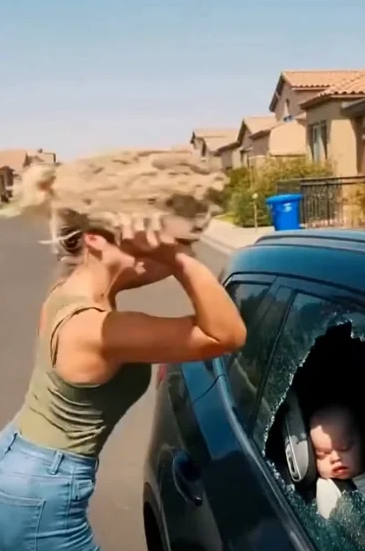
The asphalt of Austin, Texas, didn’t just radiate heat; it seemed to be angry at the world. It was a Tuesday in late September, the kind of day where the thermometer pushed past 102 degrees and the air felt heavy enough to choke on.
I was running. Again.
My name is Patricia Suarez, though everyone calls me Patty. I’m sixteen years old, and my life is currently measured in missed minutes and second chances. I clutched a stack of AP History textbooks against my chest, feeling the sweat trickle down my spine, soaking the back of my white uniform blouse. My shoes—loafers I’d bought at a thrift store three years ago—slapped against the pavement with a frantic rhythm.
Slap, slap, slap.
I checked the cracked screen of my phone. 7:52 AM. First bell was at 8:00. I was six blocks away.
The words of Principal Holloway echoed in my head, bouncing around with the heat. “Miss Suarez, the scholarship fund is for students who demonstrate excellence in attendance as well as academics. One more tardy, and we will have to give your spot to someone on the waiting list.”
The waiting list. A list of kids who probably had cars, or parents who drove them, or alarm clocks that didn’t reset when the power flickered out in their apartment complex.
“I can’t lose this,” I whispered to the empty street, my throat dry as sandpaper. Losing the scholarship meant going back to public school. It meant losing the only real shot I had at a college grant. It meant working double shifts at the laundromat with my mom for the rest of my life.
I turned onto Magnolia Avenue. Usually, this street was bustling, but the heat had driven everyone indoors. The sidewalks were empty. The metal shutters of the shops were pulled down tight against the sun.
That’s when I heard it.
At first, I thought it was a cat. It was a weak, mewling sound, barely audible over the hum of a distant air conditioning unit. I kept running, my eyes fixed on the traffic light ahead. But the sound came again.
Eh-hhe… eh-hhe…
It wasn’t a cat. It was a human sound. A jagged, rhythmic gasp for air.
I stopped. My momentum nearly carried me forward, but my feet planted on the concrete. I ripped the earbuds out of my ears and spun around. The street was silent except for the shimmering heat haze rising off the parked cars.
“Hello?” I called out. My voice cracked.
Silence.
Then, the sound returned. Fainter this time. It was coming from a sleek, obsidian-black Mercedes G-Wagon parked illegally in a loading zone under the direct, punishing glare of the sun. The car looked like a tank, armored and impenetrable. The windows were tinted so dark they looked like oil slicks.
I stepped closer. The heat radiating off the black metal hit me like a physical wave.
I pressed my face against the rear passenger window, cupping my hands around my eyes to block out the glare. At first, all I saw was my own reflection—frizzy hair, panicked eyes, a bead of sweat rolling down my nose.
Then, my eyes adjusted to the gloom inside.
My heart stopped.
There was a car seat. And in the car seat, a baby. He was tiny, maybe ten months old. He wasn’t crying loudly because he didn’t have the energy left. His face was the color of a beet, a terrifying, dark red. His hair was plastered to his skull. His head lolled to the side, and his mouth was open, gasping like a fish out of water.
“Oh my God,” I hissed.
I banged on the glass with my fist. “Hey! Is anyone there? Hello!”
The glass felt hot enough to burn my skin. The baby didn’t react. His eyes were half-closed, rolling back slightly.
Panic, cold and sharp, spiked in my chest, warring with the heat. I looked up and down the street. “Help! Is this anyone’s car?!”
No one. Just the empty, baking sidewalk.
I grabbed the door handle. Locked. I tried the front. Locked.
I looked at the baby again. His chest was barely moving. I remembered the news report from last summer—a toddler in Dallas. Twenty minutes. That’s all it took in this heat. The inside of that car had to be a hundred and thirty degrees, maybe more. He was cooking.
I looked at my phone. 7:56 AM.
If I ran now, I could make it. I could make it to homeroom right as the bell rang. I could keep my scholarship. I could pretend I never saw this. Someone else would come along. The owner was probably just in the Starbucks around the corner, right?
But then the baby’s hand twitched. A small, weak spasm.
He was dying. Right now, in front of me, he was dying.
“I’m sorry,” I whispered to the universe, to Principal Holloway, to my mom.
I dropped my textbooks on the dirty sidewalk. I looked around frantically for a rock, a pipe, anything. The street was clean. Too clean.
Then I saw it. A landscaping project at the base of a decorative tree. Large, jagged river stones.
I scrambled over, grabbing a rock the size of a cantaloupe. It was heavy, rough against my palms. I ran back to the Mercedes.
I hesitated for a split second. This was a hundred-thousand-dollar car. If I was wrong—if the AC was on and I just couldn’t hear it—I would be arrested. My family would be sued. We had nothing. They would take the little we had.
Inside, the baby’s head slumped forward, chin to chest. He stopped moving.
“No,” I gritted out. “No, no, no.”
I gripped the rock with both hands. I squeezed my eyes shut for a heartbeat, swung my arms back, and smashed the stone into the rear passenger window with everything I had.
CRASH.
The sound was sickeningly loud, like a gunshot. The safety glass didn’t shatter into dust; it held together in a spiderweb for a second before caving in. The car alarm exploded into life—HONK-HONK-HONK-HONK—a deafening siren that echoed off the buildings.
I didn’t wait. I reached through the jagged hole. A shard of glass sliced into my forearm, a sharp sting that I ignored. I fumbled for the lock.
The door swung open, and the heat that rushed out hit me in the face like the exhaust from a jet engine. It smelled of hot leather and sour milk.
I unbuckled the car seat with trembling fingers. The plastic buckle was scorching hot; it burned the tips of my fingers, but I snapped it open. I scooped the baby up.
He was a dead weight. His skin was dry and burning hot, like touching a stove. He wasn’t sweating anymore. That was bad. That was really bad.
“It’s okay,” I gasped, clutching him to my chest, my uniform instantly soaking up the heat from his body. “I got you. You’re out.”
He let out a tiny, dry wheeze.
“Hey! What the hell are you doing?”
I spun around. A man in a suit was yelling from a second-story balcony across the street.
“He was dying!” I screamed back, holding the baby up. “Call 911!”
I didn’t wait for him to answer. I looked at the school in the distance, then at the blue “H” sign I had passed three blocks back. St. David’s Medical Center. It was closer than waiting for an ambulance in this traffic.
I started running.
Holding the books had been hard. Holding a limp, unconscious baby while sprinting in 100-degree heat was torture. My lungs burned. My legs felt like lead. The alarm of the Mercedes was still blaring behind me, fading into the distance.
“Stay with me,” I panted, looking down at the boy. His face was turning a grayish-purple. “Don’t you dare close your eyes. Come on.”
I hit the intersection of 5th and Lamar. The light was red. I didn’t care. I ran into traffic, dodging a delivery truck that slammed on its horn.
A silver sedan screeched to a halt right in front of me. The driver, an older woman with gray curls, rolled down the window. “Child! What is wrong?”
“Heatstroke!” I yelled, pulling the back door open without asking. “Hospital! Now!”
The woman didn’t ask questions. She saw the purple baby. She saw the blood running down my arm from the glass cut.
“Get in!”
I dove into the backseat. Before I had the door closed, she was accelerating.
“Keep him cool,” the woman commanded, aiming her AC vents toward the back. “Talk to him.”
“Hey, buddy,” I whispered, rocking him, my tears dripping onto his forehead. “My name is Patty. We’re going to get ice cream, okay? We’re going to get you cold.”
He didn’t respond. His breathing was shallow, rapid little hitches that sounded like a ticking clock.
The drive took two minutes, but it felt like two years. The car screeched up to the Emergency Room entrance. I didn’t wait for the car to stop completely. I threw the door open and sprinted toward the sliding glass doors.
“Help!” I screamed, my voice shredding in my throat. “I have a baby! Heatstroke!”
The lobby froze. People lowered their magazines. A security guard stood up.
But it was the triage nurse who moved. She vaulted over the desk.
“Trauma One!” she yelled, grabbing the baby from my arms. “Code Blue, Pediatric! I need a team!”
I stood there, empty-handed, my chest heaving, watching them swarm the tiny body. They put him on a gurney and ran.
“Doctor! Dr. Thorne!” the nurse screamed down the hallway.
A man emerged from a swinging door. He was tall, wearing blue scrubs and a white coat that looked disheveled. He had dark circles under his eyes, graying hair, and an air of authority that vanished the second he looked at the gurney.
Dr. Elias Thorne. The Chief of Emergency Medicine.
He stopped. He stopped dead in the middle of the trauma bay.
The nurses were hooking up IVs, stripping the baby’s clothes off. Dr. Thorne took one step forward, then another, moving like a man walking into a nightmare.
He looked at the baby’s face. He looked at the unique, hand-knitted bootie dangling from the baby’s left foot.
A sound tore out of him—not a word, but a primal, gutted noise that silenced the entire ER.
“No,” he whispered. He grabbed the side of the gurney, his knuckles turning white. “Leo?”
The nurse looked up, confused. “Doctor? We need orders. Core temp is 106.”
Dr. Thorne’s knees buckled. He didn’t fall, but he sagged against the metal railing, his professional mask shattering into a million pieces. Tears, instant and heavy, flooded his eyes.
“That’s my son,” he choked out, his voice rising to a scream. “That’s my son! Leo!”
Chaos erupted.
“Get another attending!” a nurse shouted. “Get Dr. Evans! Thorne is compromised!”
Dr. Thorne was shaking, touching the baby’s face with trembling hands. “Leo, please. Daddy’s here. Please, please.”
I backed away until my back hit the wall. I slid down it, sitting on the cold linoleum floor. I looked at my hands. They were covered in blood—mine and the grime from the car.
I looked at the clock on the wall. 8:25 AM.
I had missed homeroom. I had missed the bell.
“I lost it,” I whispered to no one. “I lost the scholarship.”
The next hour was a blur of shouting and weeping.
Another doctor took over Leo’s care, packing his small body in ice, pushing fluids. Dr. Thorne was ushered out of the trauma room, held upright by two colleagues. He was sobbing openly, a sound that made everyone in the waiting room look away in discomfort.
I sat in a plastic chair, shivering. The sweat on my uniform had turned cold in the aggressive hospital AC. A nurse had bandaged my arm—seven stitches—but I barely felt the needle.
Police officers swarmed the lobby. Two of them approached me.
“Miss Suarez?” the taller officer asked. He held a notepad. “We need to know exactly what happened. The owner of the Mercedes reported the vehicle damaged and an attempted kidnapping.”
“I didn’t kidnap him,” I said, my voice dull. “I saved him. He was cooking.”
“Just tell us the story.”
I told them. The heat. The cry. The rock.
Midway through my statement, the automatic doors flew open. A woman rushed in. She was beautiful, dressed in expensive yoga clothes, but her face was twisted in sheer terror. Elena Thorne.
“Elias!” she screamed, spotting her husband sitting with his head in his hands near the trauma bay. “Where is he? Where is Leo?”
Dr. Thorne stood up and grabbed her. They held onto each other like two people drowning.
“He’s stable,” I heard him say, his voice wrecked. “They got his temp down. He’s… he’s going to make it, El. He’s going to make it.”
She collapsed against him, wailing. “The nanny… she said she turned around for one second at the park… the stroller was gone… oh my God, Elias, I thought he was gone forever.”
The police officer near me stopped writing. “The park?” he murmured to his partner. “That’s three miles from where the car was found. Whoever took him must have panicked and ditched the car.”
“Or they left him there to die,” the partner said grimly.
The nurse who had bandaged me walked over to the huddle of doctors and the weeping parents. She pointed across the room. At me.
Dr. Thorne turned. His eyes were red, swollen, and terrifyingly intense. He looked at me—really looked at me—for the first time. He saw the scuffed shoes. The bloody uniform. The bandage.
He walked toward me. His wife followed, wiping mascara from her cheeks.
I stood up, instinctually intimidated by his presence. “I’m sorry about the car window,” I stammered. “I know it’s expensive. I can… I can try to pay for it over time.”
Dr. Thorne stopped two feet from me. He looked at my hands. He looked at my terrified face.
He didn’t speak. He dropped to his knees.
Right there on the dirty hospital floor, the Chief of Medicine fell to his knees in front of a sixteen-year-old girl from the south side.
He took my uninjured hand in both of his. His hands were shaking.
“You broke a window?” he whispered.
“Yes, sir. I had to. The door was locked.”
“You could have burned the whole car to the ground,” he said, his voice cracking, “and I would have thanked you.” He pressed his forehead against my hand. “You saved his life. You saved my life.”
Elena Thorne grabbed me in a hug that knocked the wind out of me. She smelled like lavender and fear. “Thank you,” she sobbed into my neck. “Thank you, thank you, thank you.”
I stood there, awkward and stiff, patting the wealthy woman’s back.
“I have to go,” I said softly. “I really… I have to get to school. Maybe if I explain, they won’t expel me.”
Dr. Thorne looked up. He stood slowly, wiping his face. The authority was coming back into his posture, but it was softer now.
“Expel you?”
“My scholarship,” I explained, looking at my shoes. “I was on my last warning for tardiness. Being late today… it triggers an automatic review. I’m out.”
Dr. Thorne frowned. “What school?”
“St. Jude’s Academy.”
A strange expression crossed his face. “Principal Holloway?”
“Yes, sir.”
Dr. Thorne pulled out his phone. “Holloway had a triple bypass last year. I was his surgeon.” He looked at me with eyes that burned with a fierce promise. “You aren’t losing that scholarship, Patricia. In fact, I think we need to have a serious conversation about your future.”
The next few days were a whirlwind that I couldn’t have imagined.
The police investigation revealed the truth: car thieves had targeted the Mercedes while the nanny was distracted at the park, not realizing a baby was in the back. When the baby started crying a few miles away, they panicked, parked the car in a random spot, and ran, leaving Leo to the elements.
They would have gotten away with murder if I hadn’t been running late.
The story hit the news cycle hard. “Teen Hero Smashes Luxury Car to Save Doctor’s Son.” My face, looking stunned and exhausted, was on the front page of the Austin Statesman.
But the real change happened in Principal Holloway’s office.
I sat in the stiff leather chair on Friday morning, my mother next to me. Mom was wearing her best Sunday dress, her hands twisting nervously in her lap.
Principal Holloway sat behind his desk. He didn’t look stern today. He looked humbled.
“Miss Suarez,” he began, clearing his throat. “I received a phone call from Dr. Thorne. And the Mayor. And… well, half the school board.”
He slid a piece of paper across the desk.
“We have decided to expunge your tardiness record,” he said. “Given the extraordinary circumstances.”
I let out a breath. “So I can keep the scholarship?”
“Better,” a voice said from the doorway.
We turned. Dr. Thorne was standing there. He wasn’t wearing scrubs. He was wearing a suit, holding a sleeping Leo in a carrier.
He walked in and placed the carrier on the desk. Leo cooed, waving a chubby fist. He was pink, healthy, alive.
Dr. Thorne looked at my mother, then at me.
“Patricia,” he said. “My wife and I have set up a trust. We call it the Leo Thorne Foundation.”
“I don’t want money for saving him,” I said quickly. “I didn’t do it for a reward.”
“I know,” Dr. Thorne smiled. It was a genuine smile, one that reached his eyes. “That’s why you deserve it. This isn’t a reward. It’s an investment.”
He looked at Principal Holloway.
“The Foundation will cover the remainder of Patricia’s tuition at St. Jude’s,” Dr. Thorne announced. “It will also cover her undergraduate tuition at the university of her choice, and, should she choose to pursue it… medical school.”
My mother gasped, covering her mouth. “Doctor… that is… that is too much.”
“It’s not enough,” Dr. Thorne said firmly. “I watched the security footage from the street, Patricia. I saw you run into traffic. I saw you hold him. You have the instincts of a healer. You saw a problem, and you didn’t wait for permission to fix it.”
He walked over and extended his hand.
“The world is full of people who watch,” he said. “We need more people who break the glass.”
I stood up. I shook his hand. It was warm and steady.
I looked down at Leo. He blinked up at me, his brown eyes wide and curious. He didn’t remember the heat. He didn’t remember the darkness of the tinted windows. He just knew he was safe.
“Thank you,” I whispered.
I walked out of the school that day into the bright, hot Texas sun. The heat was still there, shimmering off the asphalt, heavy and oppressive. But for the first time in a long time, it didn’t feel like a weight on my shoulders.
I touched the bandage on my arm. It would leave a scar. A jagged white line.
Most people try to hide their scars. But I knew I would roll up my sleeves. I would let everyone see it. Because that scar was the receipt for a life saved. And it was the key to a future I had only ever dreamed of.
If you want more stories like this, or if you’d like to share your thoughts about what you would have done in my situation, I’d love to hear from you. Your perspective helps these stories reach more people, so don’t be shy about commenting or sharing.