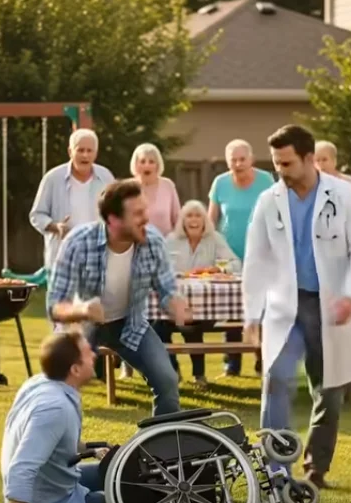
The concrete hit my palms first, then my shoulder, then my head. It wasn’t hard enough to knock me out, but it was hard enough that the world tilted sideways and stayed there, the backyard spinning as if I were intoxicated, even though I hadn’t touched the beer cooler. Fifty people were staring. Some were laughing. A few were filming on their phones.
My brother, Tyler, stood over me, his chest heaving, his face red with a mixture of righteous anger and three Bud Lights.
“Stop faking for attention,” he said, loud enough for everyone to hear, loud enough for the neighbors three houses down to hear. “The act is getting old, Marcus.”
I lay there on the sun-baked concrete of my aunt’s patio in Naperville, Illinois. My wheelchair was tipped on its side two feet away, one wheel still spinning slowly in the July heat. My right leg was twisted at an angle that sent lightning bolts of pain up my spine—the kind of pain I’d learned to breathe through over the past twenty-six months, the kind that made my vision white out at the edges.
The family reunion continued around me as if I were a piece of lawn furniture that had fallen over. Someone turned up the country music. A kid ran past, chasing a Wiffle ball. The smell of burgers on the grill mixed with cut grass and the sharp, coppery taste of blood in my mouth from where I’d bitten my tongue.
“Get up, Marcus,” Tyler said, and I could hear the satisfaction in his voice, the vindication. “Everyone’s watching. Time to drop the charade.”
I tried to push myself up, but my arms shook. The concrete had scraped my palms raw. I could see tiny pieces of gravel embedded in the flesh of my left hand, blood welling up around them like garnets.
“Look at him,” Tyler announced, turning to address our assembled relatives like a prosecutor delivering his closing argument. “He’s been milking this wheelchair thing for two years, ever since the ‘accident’ that nobody actually saw.”
“I was there,” my mom said from somewhere in the crowd. Her voice was weak, uncertain, the voice of someone who’d been beaten down by two years of family gatherings exactly like this one.
“You found him at the bottom of the stairs,” Tyler corrected her sharply. “That’s not the same as witnessing it. For all we know, he threw himself down on purpose.”
The crowd murmured in agreement, in consideration. “That makes sense, doesn’t it?” my cousin Jake, twenty-three and still living with his parents, stepped forward. “Dude, I saw him walking at the Jewel-Osco on Roosevelt Road last month. He was in the cereal aisle.”
The murmuring got louder as heads nodded. Of course. I knew it. Always suspected.
“That was physical therapy,” I managed from the ground, my voice coming out smaller and weaker than I wanted. “I told everyone about the outpatient program at Rush.”
“Sure, it was,” Tyler interrupted. He kicked my wheelchair, and the aluminum frame rang like a bell. “Meanwhile, you’ve been collecting disability checks and living in Mom’s basement rent-free for two years, playing video games, ordering DoorDash on her credit card. Living the dream while the rest of us work for a living.”
“Because I can’t work.”
“Because you won’t work,” Tyler’s face was so close I could smell the beer and barbecue sauce. “There’s a difference, little brother.”
My Uncle Richard, Dad’s younger brother, who sold insurance and drove a Lexus and preached about personal responsibility at every holiday, pulled out his Samsung Galaxy. “I’m recording this,” he announced, holding it up like he was documenting a crime scene. “For evidence. We’ve all been enabling this behavior for too long. It’s time someone stood up for the truth.”
I looked around for support, for anyone. My mom stood near the picnic table, wringing her hands. My Aunt Linda, Mom’s sister who’d organized this reunion and insisted I come, stood with her arms crossed, lips pursed in judgment. My grandmother sat in her lawn chair under the oak tree, fanning herself with a paper plate, watching me like I was a disappointing television show. Nobody moved to help.
“The doctor said—” I started.
“The doctor said ‘maybe’!” Tyler was on a roll now, playing to the crowd. “‘Maybe’ you’ll walk again. ‘Maybe’ it’s permanent. Maybe, maybe, maybe. You’ve been dining out on ‘maybe’ for twenty-four months while Mom bankrupts herself trying to fix you.”
“He does look awfully comfortable in that chair,” my grandmother said, loud enough for everyone to hear. “Like he’s been practicing.”
“Because I’m in it twelve hours a day! Not by choice!”
Tyler grabbed my wallet from the pocket of my jacket where it had fallen. He held it up like evidence and opened it. “See this? Disability card. Eight hundred and thirty-seven dollars a month. Plus, Mom pays for everything else. Rent, food, medical supplies, special equipment.”
“I have medical bills!” My throat was closing up; my hands were shaking, and it wasn’t just from the fall.
“You have excuses!” He threw my wallet at me. It hit my chest and fell open, my driver’s license staring up at me—the photo from before, when I could stand for the DMV camera without support. “The gravy train ends today, Marcus. Right here, right now.”
The crowd started clapping. Actually clapping, as if Tyler had just delivered a speech from a sports movie about overcoming adversity.
“Tyler, that’s enough,” Mom finally stepped forward, but her voice had no force behind it.
“No, Mom. He’s bleeding you dry,” Tyler’s voice softened when he talked to her, all gentle and concerned. “Physical therapy three times a week. That modified van you bought. You took out a second mortgage for him, on a house you’ve lived in for thirty years. You’re sixty-two years old, and you’ll be paying that off until you’re eighty.”
Mom’s face went red. She didn’t deny it. I hadn’t known about the second mortgage.
“I didn’t ask her to,” I said.
“You didn’t stop her, either!” Tyler pointed at me, his finger like a weapon. “You just kept taking, kept playing the victim while everyone else sacrificed for you.” He crouched down, got right in my face. “Stand up right now,” he said quietly, “or I’m calling the police for disability fraud. You’ll go to jail, Marcus. And honestly, that might be better for everyone.”
“I can’t.” The pain in my leg was getting worse, the kind of pain that meant I’d torn something, displaced something. It was going to cost thousands of dollars and weeks of additional therapy to fix.
“Stand up!”
The entire family started chanting it. “Stand up! Stand up! Stand up!” Fifty voices, maybe more. The neighbors had come over to watch. Kids were recording on their phones. My Aunt Linda was clapping in rhythm, leading the chant like a cheerleader.
I stayed on the ground because I couldn’t do anything else. Because my right leg hadn’t had full sensation in twenty-six months. Because the rods in my spine made certain movements impossible. My leg throbbed with every heartbeat.
Tyler grabbed my shirt, hauled me halfway up. “I’m done watching you manipulate everyone! You’re a liar and a con artist, and—”
“—and that’s my patient you’re assaulting.”
The chanting stopped. Everything stopped. Tyler’s grip on my shirt loosened but didn’t let go.
A man stepped forward from the crowd. He was in his mid-fifties, wearing khakis and a navy polo shirt, with wire-rimmed glasses, and carrying a can of Diet Coke as if he’d just been standing there the whole time enjoying the show. Which, I realized, he had been. His expression was perfectly calm.
Tyler dropped me. I hit the concrete again. “Who the hell are you?” he demanded.
“Dr. James Chen,” the man said, taking a sip of his soda. “Marcus’s orthopedic surgeon, among other things.”
The crowd went completely silent. You could hear the burgers sizzling on the grill, a dog barking three yards over, the country music still playing from someone’s Bluetooth speaker.
“I’m also his physical therapist, his pain management specialist, and I consult with his neurologist, Dr. Sarah Patel, at Northwestern Memorial. I’ve been treating Marcus since approximately forty-seven hours after his accident, twenty-six months ago.”
Aunt Linda laughed, a nervous, shrill sound. “Well, Doctor, you must be very proud. Your patient can apparently walk just fine when nobody’s looking.”
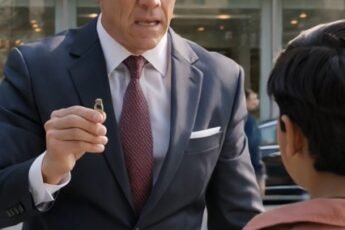
Dr. Chen smiled, but it didn’t reach his eyes. “Actually,” he said, pulling out his iPhone, “I have something everyone should see.” He held it up. An X-ray filled the screen. “This is Marcus’s lumbar spine, specifically his L4 and L5 vertebrae.” He zoomed in. “See these metal rods? Four of them. And these screws? Fourteen total. That’s from his spinal fusion surgery, performed by me fourteen months ago at Rush University Medical Center. The surgery took seven hours. The recovery took six months.”
Nobody spoke. Tyler had gone very still.
“The reason Marcus can stand during physical therapy,” Dr. Chen continued, “is because we are painstakingly re-training his body to handle short distances with a walker. Currently, he can manage approximately fifty yards before the nerve damage causes pain severe enough to require immediate rest. Imagine someone driving nails into your leg while simultaneously shocking you with a cattle prod.” He swiped to another image. “Here’s his sciatic nerve, right side. See this area here?” He pointed to a place on the screen that looked darker, damaged. “That’s permanent nerve damage from the fall. It’s why his right leg has limited proprioception—the ability to sense where your body is in space—and why it sometimes just gives out. No warning.”
My cousin Jake had backed away from the circle, disappearing toward the house.
“The orthotic brace he wears, the one that costs four thousand dollars and isn’t fully covered by insurance, provides stability, but it’s not a cure. There is no cure. This is his life now,” Dr. Chen’s voice remained perfectly level, clinical. “Every day is painful. Every step is uncertain. Every moment in that wheelchair is a reminder of what he’s lost.” He looked directly at Tyler. “But sure, he’s faking.”
Dr. Chen held his phone higher. Then he swiped again. “This is a video I recorded approximately seven minutes ago.” He pressed play.
Tyler’s voice came through the speaker: “Stop faking for attention!” The sound of me hitting the concrete, the laughter, the chanting—all of it. Dr. Chen let it play for thirty seconds, then stopped it.
“I recorded everything,” he said calmly. “The assault, the verbal abuse, the crowd participation, the public humiliation of a man with a disability by his own family.” He looked at my Uncle Richard. “You’re not the only one gathering evidence today, Richard.” Uncle Richard’s phone was still up, still recording. His hand was shaking now.
Tyler stumbled backward. “I was just— we all thought— the evidence seemed—”
“You thought wrong,” Dr. Chen’s voice went cold. “You didn’t think at all. You didn’t ask questions. You didn’t request medical records. You didn’t consult with his doctors. You just assumed he was lying because it was easier than accepting that sometimes terrible things happen to good people and there’s no one to blame.”
He knelt beside me. “Rate your pain, Marcus. One to ten.”
“Eight,” I whispered. “Maybe nine.”
He examined my leg with gentle, professional hands. His expression darkened. “Possible ligament damage. We’ll need imaging.” He looked up at the crowd. “Someone get his wheelchair. Now.”
My mom moved first. She righted the chair and wheeled it over, crying silently. Dr. Chen helped me back into it with careful precision. The crowd stood frozen. Some were crying now. Most stared at their feet.
“I came here today because Marcus asked me to,” Dr. Chen said, his voice carrying across the yard. “He knew this confrontation was coming. He’s heard the whispers, seen the looks. His brother has been building to this for months—the Facebook posts questioning his disability, the comments at Christmas, the jokes at Easter.”
Tyler’s mouth opened, but no sound came out.
“Marcus wanted me here because he knew his family didn’t believe him. And he was right,” Dr. Chen looked around at every single person. “So he asked me, his doctor, the man who cut open his back and installed metal in his spine, to attend this reunion to watch and to document.” He pulled a business card from his wallet and handed it to Tyler. “That’s my lawyer’s contact information. Her name is Jennifer Woo. She’s a partner at Kirkland & Ellis, and she specializes in disability rights litigation. I’ll be filing a police report tomorrow for assault of a person with a disability, along with a civil lawsuit.”
Tyler stared at the card like it might bite him.
“My testimony as his treating physician will be, I suspect, fairly compelling in court. I have two years of medical evidence that proves beyond any doubt that Marcus is disabled.” He turned to Uncle Richard. “I also have your video, the one you recorded ‘for evidence.’ Thank you for that. It shows conspiracy to intimidate a person with a disability and group harassment. It’s now part of my evidence file.”
Uncle Richard’s face had gone gray.
“Everyone who participated in that chant is on camera,” Dr. Chen continued. “Everyone who laughed. Everyone who stood by and watched.” He paused. “I wonder how that’s going to play in court, or on the news. Because this story… a disabled veteran—yes, Marcus served four years in the National Guard before his accident—assaulted by his family because they thought he was faking… that’s the kind of story local news stations love.”
“He’s not a veteran!” Tyler started.
“Army National Guard, 2016 to 2020. Honorable discharge. His medical records are part of the VA system, which makes this a potential federal case.” Dr. Chen’s smile was razor-sharp. “Did you know assaulting a disabled veteran can carry enhanced penalties? I didn’t either, until my lawyer explained it to me last week when Marcus asked me to attend this gathering.”
Dead silence. The burgers were burning on the grill.
Dr. Chen handed me my wallet and then moved behind my wheelchair. “We’re leaving now. Marcus has an appointment at the ER, which I’ll be documenting as assault-related injuries. The medical bills will be attached to the civil suit. His orthotic brace is damaged—that’s another four thousand dollars. His wheelchair has a bent frame—three thousand more. We’ll add it all up.”
He started pushing me toward the driveway. Behind us, fifty family members stood in that same circle, realizing that the nephew they just humiliated had just recorded every single one of them committing multiple offenses.
“Wait!” Tyler’s voice cracked. “Wait, Marcus! I’m sorry! I didn’t know!”
I didn’t turn around. Dr. Chen kept pushing. We reached the modified Honda Odyssey with the wheelchair ramp that my mom had indeed taken out a second mortgage to buy. He helped me into the passenger seat, then stored the wheelchair in the back.
Tyler ran up to my window and banged on it. “Marcus, please! I’m sorry!”
I looked at him through the glass, at my brother who I’d shared a bedroom with for fifteen years, who’d been my best man at my wedding before the divorce, who had just pushed me out of my wheelchair because he decided I was faking. I rolled down the window.
“You want to know the worst part?” I said quietly. Tyler nodded desperately. “I called you three times after my surgery. Left voicemails. Sent texts. Invited you to doctor’s appointments so you could hear the prognosis directly. You never responded. You decided I was lying without ever asking for proof. You chose to believe I was a con artist instead of believing I was hurt.”
“I just thought—”
“No,” I said. “You didn’t think. That’s the problem.” I rolled up the window. Dr. Chen pulled out of the driveway.
The emergency room at Northwestern Memorial was busy. The X-rays showed a torn lateral collateral ligament in my right knee. Another surgery, scheduled for Wednesday. Another six weeks of recovery. Another setback.
While we waited, I asked Dr. Chen, “Why did you really come today?”
He was quiet for a moment. “Because I’ve treated patients with spinal injuries for twenty-seven years,” he finally said. “And I’ve watched families destroy themselves over it. It’s easier to believe they’re faking than to accept that life is random and cruel. I came to document the truth. What they do with that truth is their choice. But at least now, they can’t claim ignorance.”
The police report was filed Monday morning. Detective Luis Gonzalez from the Naperville Police Department called me Tuesday afternoon. “Mr. Thompson, I’ve reviewed the evidence. This is pretty clear-cut. Your brother pushed you out of your wheelchair, causing additional injury. That’s aggravated battery against a person with a disability. A Class 2 felony.”
Tyler was arrested Wednesday morning and posted bail that afternoon. The civil suit was filed Friday. Jennifer Woo, the lawyer, sat across from me in her downtown office. “We’re suing Tyler for battery and intentional infliction of emotional distress. But there’s a larger case here. Your uncle, your aunt, everyone who participated in that chant—they created a hostile environment. They conspired to harass and intimidate you. That’s actionable under disability rights law.”
“You want me to sue my entire family?”
“I want you to send a message,” Jennifer said, leaning forward. “Disabled people are abused by family members who think they’re faking more often than you’d think. And it almost never ends well, because the person with the disability is isolated, financially dependent, and scared. They stay quiet. But you have something most of them don’t: medical documentation, a surgeon willing to testify, and video evidence. You have the ability to change the narrative.”
“I just wanted them to believe me.”
“They believe you now,” Jennifer’s smile was sharp. “Now we make sure they never forget it.”
The story broke on the local news that weekend: “Disabled Veteran Assaulted by Brother at Family Reunion; Doctor Recorded Everything.” The footage went viral. Dr. Chen had edited out everyone’s faces except Tyler’s and mine, but it was enough. The push, the fall, Tyler’s words, the chanting. By Wednesday, national news had picked it up.
Tyler’s life imploded. His employer, a construction company, fired him within a week. His girlfriend left him. His friends stopped calling. The video followed him everywhere.
My mom called me three weeks after the reunion. “He’s living in his car,” she said. “Lost his apartment. Can’t find work. Marcus, he’s your brother. Can’t you do something?”
“Like what? Talk to the prosecutor?”
“Yes! Ask them to drop the charges! Tell them it was a misunderstanding!”
“It wasn’t a misunderstanding, Mom. He made a mistake.”
“He assaulted me in front of fifty people while I was already disabled. That’s not a mistake. That’s a choice.”
“So you’re just going to destroy his life? Your own brother?”
I thought about that for a long time. “No,” I finally said. “I’m going to let him experience the consequences of his actions. There’s a difference.” She hung up.
The settlement came four months later. Tyler pleaded guilty to aggravated battery and got two years’ probation, community service, and anger management. The civil suit settled for $127,000—medical bills, pain and suffering, punitive damages. Tyler would be paying it off for the rest of his life.
I saw him six months later by accident, at the same physical therapy clinic. He was there for court-ordered community service, volunteering in the rehab wing.
“I meet a lot of people like you,” he said quietly. “People with spinal injuries, nerve damage, chronic pain. People who look fine on the outside but are fighting every day just to exist.” He looked at me finally. “I’m sorry, Marcus. I’m so, so sorry. I didn’t understand. I didn’t try to understand. I just decided you were lying because it was easier.”
“I know.”
“Do you think… do you think you’ll ever forgive me?”
I thought about that question for a long time. About twenty-six months of pain. About fifty people chanting. “I don’t know,” I finally said. “Ask me again in a year.”
A year later, Tyler asked me again. We were at a different clinic, one in Evanston. He had moved there, too, and was working as a paid aide, rebuilding his life. “Do you forgive me?” he asked.
And this time, I knew the answer. “I forgive you for not understanding, for not asking questions, for believing I was lying without proof,” I said. “I don’t forgive you for pushing me out of that wheelchair, for humiliating me, for choosing cruelty when you could have chosen compassion. I’m not sure I’ll ever forgive you for that.”
Tyler nodded slowly. “That’s fair, too.”
“But,” I continued, “I see you trying. I see you working with other patients. I see you learning. That matters. You’re not the same person who pushed me, and I’m not the same person who got pushed. We’re both different now.”
“Better?”
“Different,” I said, wheeling toward the exit. “But maybe different is enough.”
Three years after the reunion, my mom called. “The family wants to have another gathering,” she said carefully. “Thanksgiving. They’re hoping you might come.”
“Will anyone apologize?”
Silence.
“That’s what I thought.”
“Marcus, they feel terrible about what happened.”
“Feeling terrible isn’t the same as apologizing. It’s not the same as acknowledging what they did. It’s not the same as changing.”
“Can’t you just—”
“No,” I said firmly. “I can’t just ‘get over it.’ They destroyed me in front of fifty people. And now they want me to come to Thanksgiving like nothing happened?”
“So you’re saying no?”
“I’m saying they need to apologize. Really apologize. Specifically. ‘I’m sorry I chanted. I’m sorry I laughed. I’m sorry I called you a liar.’ Every single person who participated owes me that.”
“That’s a lot to ask.”
“It’s the minimum to ask,” my voice was steady. “I was their family, too. They were supposed to protect me. Instead, they attacked me. If they can’t own that, then they haven’t changed. And I have no interest in sitting at a table with people who think my disability is negotiable.”
My mom was quiet for a long time. “I’ll tell them,” she finally said.
Three people apologized. Out of fifty. My Aunt Karen, not Linda, the one who’d stood in the back crying during the chanting, sent a handwritten letter. My cousin Sarah, Jake’s younger sister, sent me a card and a donation to a disability rights organization.
And Tyler. He showed up at my apartment with a folder in his hands. “I’ve been working with Dr. Chen,” he said, holding out the folder. “These are letters from twelve people I’ve worked with, people like you. I wanted you to see that I’ve changed, that I understand now.”
He looked at me, and his voice cracked. “I’m sorry I pushed you. I’m sorry I called you a liar. I’m sorry I led that chant. I’m sorry I chose cruelty over compassion. You were suffering, and I made it worse. I’m so sorry.”
I looked at my brother, at the man who destroyed me and who had spent two years rebuilding himself. “Come in,” I said.
We talked for three hours. When he left, he turned back. “I don’t expect you to forgive me,” he said. “I know I can’t undo it. But I want you to know I’m different now.”
“You’re different because of you,” I corrected. “Because you chose to change. But Tyler, don’t make me a redemption story. Don’t make my disability the thing that taught you empathy. That’s not fair to me.”
He nodded slowly. “You’re right. I’m sorry.”
After he left, I opened the folder and read all twelve letters, each one from a person Tyler had helped, each a small piece of evidence that people can change. That cruelty doesn’t have to be permanent. I didn’t know if I’d ever fully forgive him, but I could see him clearly now. Not as the villain in my story, but as someone who’d made a terrible choice and spent years living with the consequences. Maybe that was enough. Maybe it had to be.