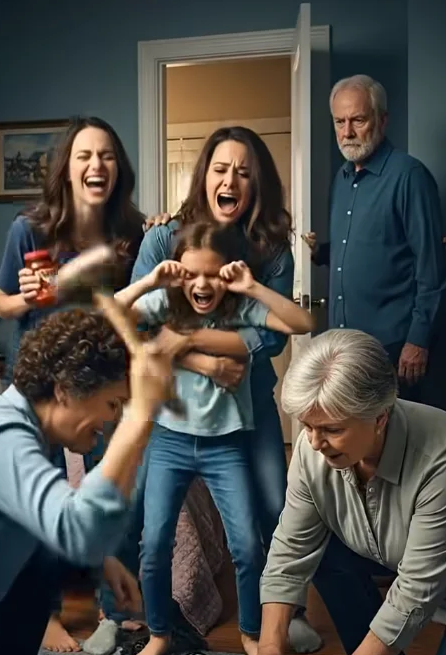
The jar of artisanal chili paste slipped from my sister’s fingers, landing with a dull thud on the plush carpet, but the sound was instantly drowned out by a scream that shredded my soul.
It wasn’t a cry of surprise. It was the primal, jagged shriek of a five-year-old child who has just been introduced to true agony.
I stood in the doorway of my childhood bedroom, the air suddenly thick with the metallic scent of adrenaline and the sharp, vinegar tang of peppers. My sister, Miranda, stood over the bed where my daughter, Sophie, was thrashing, her tiny hands clawing at her own face.
And Miranda was laughing.
It wasn’t a nervous titter. It was a full-throated, belly-shaking laugh, as if she were watching a comedian land a perfect punchline.
“Mommy! Mommy, I can’t see! It burns!” Sophie screamed, her voice breaking into a sob that choked her.
I lunged forward, the world narrowing down to the red, swollen skin of my daughter’s face. I reached for her, pulling her small, convulsing body against my chest, trying to stop her from rubbing the paste deeper into her eyes. “I’ve got you, baby. I’ve got you.”
“Oh, lighten up,” Miranda said, wiping a tear of mirth from her eye. “It’s just a prank. She looked so peaceful, I couldn’t resist.”
I spun on her, a growl rising in my throat that didn’t feel human, but before I could tear her apart, the room was suddenly crowded. My parents, Claudia and Raymond, rushed in, followed by a handful of engagement party guests holding wine glasses.
“What is happening?” my father demanded.
“She did it!” I screamed, pointing at Miranda with a shaking hand. “She rubbed chili paste into Sophie’s eyes while she was sleeping! Look at her!”
“I did not!” Miranda gasped, her demeanor flipping instantly from amusement to victimhood. She grabbed my mother’s arm. “I came in to check on her and found her like this! She must have gotten into the jar herself! I was laughing from… from shock! It was hysteria!”
“That’s a lie!” I shouted. “The jar was downstairs! A five-year-old didn’t bring it up here!”
I grabbed my phone from my pocket. My hands were shaking so hard I could barely unlock the screen. “I’m calling 911. She needs a hospital.”
My mother moved with the speed of a viper. She snatched the phone from my hand and, without a second of hesitation, smashed it against the hardwood floor. The screen shattered, the backlight flickering and dying.
“Don’t you dare,” Claudia hissed, her face inches from mine. “You will not ruin your sister’s engagement party with your drama. Miranda is innocent. This was an accident.”
“Are you insane?” I yelled, clutching Sophie tighter as she whimpered against my neck. “Look at my child!”
“Everyone out,” my father commanded, turning to the guests. “Just a misunderstanding. A childhood accident. Please, go back downstairs.”
He ushered everyone out. Miranda followed them, casting a look back at me. It wasn’t fear. It was a smirk. A cold, victorious smirk that said, I can do anything, and they will always choose me.
Then, my father looked at me one last time. “Calm down. We’ll discuss this in the morning.”
He closed the door. And then, the terrifying, distinct sound of a deadbolt sliding home echoed through the room.
We were locked in.
I spent the next six hours in a hell made of beige wallpaper and the smell of lavender detergent.
The guest room, my former sanctuary, had become a prison cell. I rushed Sophie to the en-suite bathroom. For forty-five minutes, I held her head under the faucet, flushing her eyes with cool water while she screamed and begged me to make it stop.
“It hurts, Mommy. Why is it dark? Why can’t I open them?”
“I know, baby. I know. I’m here.” I was crying silently, my tears mixing with the tap water running over her face.
I tried the window. Painted shut. I tried the door again. Solid oak, installed by my paranoid father years ago “for security.” I pounded on it until my knuckles bled, screaming for my Aunt Sylvia, for anyone. But the party music downstairs had been turned up. They were drowning us out.
I sat on the floor, rocking my daughter as her exhaustion finally overtook her pain. She passed out in my arms, her eyelids swollen shut, angry red welts tracking down her cheeks where the paste had run.
I didn’t sleep. I sat there in the dark, listening to the murmurs of the party dying down, listening to the cars drive away. My rage, initially a hot, explosive thing, began to cool. It hardened. It calcified into something sharp and heavy in my chest.
They thought this was over. They thought they could contain this.
At 7:00 AM, the lock clicked.
My mother opened the door, holding a tray of blueberry pancakes. The smell turned my stomach.
“Good morning,” she said, her voice bright and brittle, as if she hadn’t held us hostage all night. “I thought we could have a nice family breakfast before you head out. Miranda is very upset about your accusations, but she’s willing to forgive you.”
I didn’t scream. I didn’t attack her. I stood up, lifting Sophie—who whimpered as the light hit her swollen eyes—into my arms.
“Move,” I said.
“Now, don’t be like that,” Claudia sighed, blocking the doorway. “Your father and I have discussed it. If you make a scene, if you try to involve the police… well, we’ll have to tell them about your instability since Garrett died. We’d hate for you to lose custody because you’re unfit.”
The threat hung in the air, naked and ugly. They would take my daughter to protect their image.
I looked at my mother—really looked at her—and realized I didn’t have a mother. I had a warden.
“I understand,” I lied. My voice was dead flat. “Let me pass.”
She stepped aside, satisfied.
I walked downstairs, past Miranda eating a croissant at the kitchen table, past my father reading the paper. I didn’t look at them. I walked out the front door, strapped my daughter into her car seat, and drove straight to the Emergency Room.
The doctor was horrified. “Chemical burns to the corneas,” he said, his voice tight with controlled anger. “Extensive inflammation. She’s going to need a specialist. If you hadn’t flushed them so thoroughly…” He trailed off.
“Who did this?” he asked, pen hovering over his clipboard.
“My sister,” I said clearly. “My sister, Miranda Mercer.”
Two police officers arrived an hour later. I gave my statement. I told them everything—the chili, the laughter, the smashed phone, the locked door.
But by the time they interviewed my family, the story had changed. Miranda was the weeping victim. My parents were the concerned grandparents dealing with a grief-stricken, hysterical daughter who was hallucinating persecution. There was no physical proof Miranda had been in the room. The smashed phone was “accidentally dropped.”
The District Attorney declined to file charges. “It’s a ‘he-said-she-said’ within a family unit,” the officer told me over the phone, sounding apologetic. “Without independent witnesses or video, we can’t get a conviction beyond a reasonable doubt.”
I hung up the phone. I looked at Sophie, who was wearing dark sunglasses inside the house because the light hurt too much.
The law couldn’t help me. Fine.
I opened my laptop and logged into my bank account. I had the life insurance money from my late husband, Garrett. I had been saving it for a house, for college.
Now, it was a war chest.
I picked up the phone and dialed a number a colleague had given me.
“Dr. Montgomery?” I asked when the voice answered. “I need to hire you. I need you to find every skeleton in my family’s closet. And I don’t care how much it costs.”
Dr. Montgomery was not what I expected. He was a small, unassuming man who looked more like a librarian than a private investigator, but his eyes were sharp as flint.
“I specialize in forensic accounting and deep-dive background checks,” he told me a week later, sliding a thick manila envelope across the table of the coffee shop. “You were right. Your sister isn’t just a brat. She’s a liability.”
I opened the file. It was a roadmap of destruction.
“Miranda didn’t just have ‘trouble’ in college,” Montgomery explained, pointing to a document. “She was expelled from her first sorority for hazing. She forced a pledge to drink cleaning fluid. Your parents paid the girl’s family fifty thousand dollars to sign an NDA and not press charges.”
He flipped a page. “And her employment history? She wasn’t ‘laid off’ from that marketing firm. She was fired for harassment. She created a fake profile to cyberbully a coworker who got a promotion she wanted. Again, your parents paid for a silent exit.”
“And my parents?” I asked.
“That’s the interesting part,” Montgomery smiled, a thin, predatory expression. “They act rich. They live rich. But Raymond retired early, and Claudia spends like she’s royalty. They’ve been draining their retirement accounts to cover Miranda’s legal messes and credit card debt. They are house-poor and cash-flow negative. One big hit, and they crumble.”
I stared at the numbers. They were vulnerable.
“One more thing,” Montgomery said. “I found a witness.”
My head snapped up. “Who?”
“Your Aunt Sylvia. She saw your mother smash the phone. She tried to intervene, but your father escorted her out. She’s been calling your old landline for weeks trying to reach you.”
I felt a lump form in my throat. Sylvia. My father’s sister. The only one who had ever shown me kindness.
I met Sylvia the next day. She collapsed into tears the moment she saw Sophie’s glasses.
“I was a coward,” she sobbed. “I let them push me out. I knew something was wrong. I’m so sorry.”
“You can make it right,” I told her, taking her hands. “I’m going to sue them, Sylvia. Not for money. For justice. I’m going to expose everything. Will you testify?”
Sylvia looked at Sophie, tracing the rim of her dark glasses. Then she looked at me, her jaw setting. “Tell me when and where.”
The planning phase took six months. I needed Sophie to be stable. I needed my job to be secure—I worked triple time, earning a promotion to senior auditor to ensure I was untouchable. I documented every doctor’s visit, every nightmare, every therapy session where my daughter drew pictures of “Auntie Monster.”
When I finally filed the lawsuit, I didn’t go small.
I sued Miranda for Battery, Assault, and Intentional Infliction of Emotional Distress.
I sued Claudia and Raymond for Negligence, False Imprisonment, and Conspiracy.
I sued for compensatory damages. I sued for punitive damages.
The process server delivered the papers to Miranda at her bridal shower.
According to the report, she threw a glass of champagne at him.
Three days later, my phone rang. It was my father.
“Have you lost your mind?” Raymond roared. “You are suing your own family? Do you have any idea how much this is going to cost us in legal fees?”
“I imagine it will cost everything,” I said calmly. “You should probably sell the boat.”
“We will bury you,” he hissed. “We will counter-sue for custody. We will paint you as a lunatic.”
“Go ahead,” I said. “I look forward to discovery. I look forward to the deposition where you have to explain under oath why you locked an injured five-year-old in a room for six hours.”
I hung up.
The war had begun. But they didn’t realize that while they were fighting to save their reputation, I was fighting for my daughter’s life. And I had absolutely nothing left to lose.
The legal battle was a slow, grinding machine designed to break the weak. My family’s lawyers were aggressive. They filed motion after motion to dismiss. They dragged up my grief counseling records from when Garrett died, trying to frame me as unstable.
But they made a fatal error: they underestimated a mother’s documentation.
During discovery, my lawyer, a shark named Mr. Sterling, deposed my mother.
“Mrs. Mercer,” Sterling asked, pacing the conference room. “Did you or did you not take the plaintiff’s phone on the night of June 24th?”
“I… I might have moved it,” Claudia stammered. She looked ten years older. The stress was eating her alive.
“We have a sworn affidavit from Sylvia Mercer stating she watched you throw it against a wall. We also have the forensic data from the phone itself, recovered from the trash, showing the internal gyroscope recorded a violent impact at 9:42 PM. Would you like to revise your statement?”
Claudia went pale. “I… I don’t recall.”
“You don’t recall destroying a phone while your granddaughter screamed in the background?”
Then came Miranda’s deposition. She was arrogant. She rolled her eyes. She smirked.
“It was a joke,” she said, examining her fingernails. “Sophie is a drama queen. Just like her mother.”
“A joke?” Mr. Sterling projected a photo onto the wall. It was a close-up of Sophie’s eyes taken in the ER. The cornea was clouded, the skin blistered. “This is the result of your joke. Permanent scarring. 20/40 vision in the left eye, best corrected. Night terrors.”
“She probably rubbed it in herself,” Miranda scoffed.
“We have the sorority records, Miranda,” Sterling said softly.
Miranda froze.
“The girl who drank the cleaning fluid? We have her deposition too. She establishes a pattern of behavior. A pattern of finding joy in the pain of others. The judge has allowed it into evidence.”
Miranda looked at her lawyer, panic finally flickering behind her eyes. Her lawyer looked at his notes, realizing he was captaining a sinking ship.
The settlement offers started coming in. Ten thousand. Fifty thousand. One hundred thousand.
“Tell them no,” I told Sterling.
“Elena,” he said gently. “This is a good offer. It covers the medical bills.”
“It’s not about the money,” I said. “I want them in court. I want a jury to hear it. I want it on the public record.”
The trial began on a rainy Tuesday in November.
The courtroom was packed. My family had tried to keep it quiet, but small towns talk, and the “Chili Paste Case” had become local legend.
I took the stand first. I stayed calm. I described the smell of the peppers. I described the laugh. I described the lock clicking shut. I didn’t cry. I let the facts be the horror.
Then, Sophie’s therapist testified. Then, the ER doctor.
Finally, Miranda took the stand. Under cross-examination, she crumbled. She screamed at Mr. Sterling. She called me a jealous cow. She called her own fiancé, Quentyn, a spineless loser for looking at her with doubt.
In front of twelve jurors, she took off her mask and showed them the monster underneath.
The jury deliberated for four hours.
They found Miranda liable for Battery and Intentional Infliction of Emotional Distress.
They found my parents liable for False Imprisonment and Negligence.
The damages awarded were staggering. Not just compensatory, but punitive. The jury wanted to send a message.
As the verdict was read, my father put his head in his hands. My mother stared straight ahead, catatonic. Miranda looked at Quentyn, reaching for his hand.
Quentyn stood up, pulled his hand away, and walked out of the courtroom without looking back.
I walked out of the courthouse holding Aunt Sylvia’s hand. I felt light. Not happy, exactly. But the heavy stone in my chest was gone.
But as I reached my car, my father blocked my path. His face was red, veins bulging in his neck.
“Are you happy?” he screamed, spitting the words. “You’ve ruined us! We have to sell the house! Quentyn called off the wedding! You’ve destroyed this family!”
I looked at him, feeling absolutely nothing.
“No, Raymond,” I said, using his name for the first time in my life. “I didn’t destroy this family. I just turned on the lights. You’re the ones who couldn’t survive the glare.”
I got in my car and locked the doors. As I drove away, I checked the rearview mirror. He was still standing there, screaming at the air, a small, angry man who had lost his kingdom.
Three years have passed since the verdict.
The fallout was absolute. My parents sold their house to pay the judgment. They live in a two-bedroom apartment on the other side of town now. Their country club membership is gone. Their “friends” evaporated the moment the money did.
Miranda declared bankruptcy. Without Quentyn’s money or my parents’ safety net, she is working retail at a mall in Dayton. I heard from a mutual acquaintance that she tells anyone who will listen that she was the victim of a corrupt legal system and a vindictive sister. She hasn’t changed. She never will.
I used the judgment money to set up a trust for Sophie. She’s eight now. The physical scars on her face have faded to almost nothing, though she still wears glasses for reading. The emotional scars are healing, too. The nightmares only come once every few months now.
She knows that her grandparents and aunt are “in timeout” because they made bad choices. She has Aunt Sylvia and Uncle Preston, who spoil her rotten every Sunday.
Yesterday, Sophie asked me a question while we were baking cookies.
“Mommy?”
“Yes, baby?”
“Do you miss them? Grandma and Grandpa?”
I stopped mixing the batter. I thought about the lock clicking shut. I thought about the smashed phone. I thought about Miranda laughing.
“I miss who I wanted them to be,” I told her honestly. “But I love who we are without them.”
I am thirty-four years old. I have burned my family tree to the ground, and I have used the ash to fertilize a new life for my daughter.
I wrote this story because somewhere out there, another “responsible daughter” is holding her tongue. Another mother is being told to keep the peace at the expense of her child’s safety.
Don’t.
If they hurt your child, burn it down.
My phone buzzed on the counter. It was a notification from my security system. Motion detected at front door.
I pulled up the camera feed. Standing on my porch, looking older and frailer, was my mother. She was holding a Tupperware container—probably pie—and looking at the camera with a pathetic, pleading expression.
Sophie looked at the screen over my shoulder. “Who is that?” she asked, though I knew she recognized her.
I looked at my daughter. I looked at the woman who had watched her grandchild scream in agony and worried about the party guests hearing it.
“Nobody,” I said.
I pressed the button on the intercom.
“Leave,” I said through the speaker, my voice calm and cold as ice. “Or I’m calling the police. Again.”
My mother flinched as if I’d slapped her. She stood there for a long moment, then turned and shuffled away.
I turned back to the cookies. “Now,” I smiled at Sophie. “Who wants to lick the spoon?”
Sophie beamed. “Me!”
We are safe. We are free. And that is the only victory that matters.