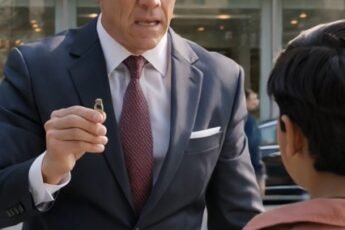
At my dad’s second wedding, the tag on my chest read, “Housekeeper.” His new wife smirked, “You’re just staff here. No chair, no plate, no place.” My brother chuckled. “Food is for family.”
I stood tall, slid off the family ring, and said, “Then I’m no longer your family.” Their smiles vanished, but that was only the beginning.
You’re standing in a luxury ballroom at the Ritz-Carlton, watching your father toast his new marriage. You’re wearing the same black dress as the catering staff because the name tag on your chest doesn’t say daughter, it says housekeeper. When you approach the buffet, your own brother blocks your path and announces, loud enough for three tables to hear, “Food is for family only.” Would you walk away quietly, or would you burn it all down?
Three months ago, that humiliation became the catalyst for the most calculated corporate takedown in San Francisco history. While they were labeling me the help, I was secretly controlling forty percent of their company through shell corporations. While they were denying me a seat at the table, I was preparing to take their seats in the boardroom. My name is Victoria Sterling. I’m thirty-two, and this is the story of how being called housekeeper led to me putting my brother in handcuffs and my father in bankruptcy.
Let me paint you a picture of the Sterling Empire. Sterling Industries, two hundred and eighty million dollars in assets and a gleaming forty-five-story tower in downtown San Francisco. My father, Richard Sterling, built it from nothing—or so he loves to remind everyone. I graduated from Harvard with my MBA in 2016. Instead of joining the family business like my brother, Alexander, I founded Nexus Advisory. By 2023, we were handling corporate restructuring for midsized tech companies, generating forty-five million in annual revenue. Not bad for what my father called “Victoria’s little hobby.”
“Your little hobby doesn’t compare to real corporate work, Victoria,” Richard had said when I proposed a joint venture six months earlier. He’d laughed, shuffling my presentation—projecting thirty million in savings for his company—into his trash bin without opening it.
The first real sign of the end came at Thanksgiving dinner. As Alexander bragged about a fifty-million-dollar acquisition, Richard raised his glass. “At least Alexander gives me grandchildren and real value to the Sterling name,” he announced. “Some people contribute to the legacy. Others just exist on the periphery.” His eyes found mine across the mahogany table.
What they didn’t know was that I’d already purchased eight percent of Sterling Industries through my first shell company, Evergreen Holdings LLC. The shares were bought from a disgruntled board member, Eleanor Blackwood, who Richard had pushed out. She was more than happy to sell to an anonymous investor who shared her vision for corporate accountability.
The second blow came in January, completely by accident. While waiting in the executive conference room, I noticed a folder marked Sterling Estate Planning – Confidential left on the table. I shouldn’t have looked, but I did. The new will was crystal clear. Alexander would inherit one hundred percent of Sterling Industries. Cassandra, my father’s new wife, would receive thirty million in cash and the Napa vineyard. My name appeared exactly once, in the disinheritance clause: Victoria Sterling shall receive no portion of the estate as she has chosen to pursue interests contrary to the family’s values and has failed to contribute meaningfully to the Sterling legacy.
Failed to contribute meaningfully. The words blurred. Eight years of building my own company, two hundred employees who depended on me, none of it meaningful enough. I photographed every page. That evening, I sat in my apartment, staring at those photos. Most people would have cried. Instead, I opened another browser tab and logged into my seventh shell company account. If I wasn’t family enough to inherit, then I’d simply buy what was never going to be given.
By February, the stakes had become impossibly clear. Sterling Industries was orchestrating a massive merger with Pinnacle Corp., a deal that would make Alexander CEO of a nearly billion-dollar company. The threat wasn’t subtle. “After the merger,” Alexander had said at a Chamber of Commerce event loud enough for me to hear, “we’ll make sure certain consultancies never work in this city again.”
Then, the encrypted email arrived from Marcus Coleman, a senior accountant at Sterling I’d been in contact with for months. Subject: URGENT. They’re destroying evidence. Alexander ordered all records of the Meridian Holdings transactions destroyed. The fifteen million they stole from employee pensions—it’s all going to disappear. I’ve hidden copies, but if they find out I’m the whistleblower, I’m finished. They’ve already threatened my daughter’s scholarship to Stanford. Please tell me you have a plan.
A plan? I looked at my wall of sticky notes mapping out Sterling’s corporate structure. Yes, I had a plan, but it would cost me everything if it failed.
My father’s wedding to Cassandra was on March 15th. The shareholders’ meeting to approve the Pinnacle merger was on March 18th. Seventy-two hours. That’s all I’d have between watching my family publicly humiliate me and my chance to reveal the truth. Most hostile takeovers took months. I’d have a weekend.
The dress fitting at Neiman Marcus was a preview of the humiliation to come. “We don’t need you in photos,” Cassandra announced the moment I walked in. “You’ll be managing the coat check. Much more suitable for your skill set.”
Alexander lounged in a velvet chair. “Just wear something simple,” he said without looking up. “Like staff would. Nothing designer. It would look desperate on you anyway.”
Richard emerged from his fitting, his new tuxedo impeccable. “Don’t embarrass us with your presence, Victoria. Blend into the background where you’re comfortable. Know your place.”
“You’re lucky to even be invited,” Cassandra added, admiring her thirty-thousand-dollar dress.
I maintained eye contact with my father. “You’re absolutely right. I should know my place. I’ll make sure I’m exactly where I need to be.” As I left, my phone buzzed. A FedEx notification: my formal whistleblower complaint had been delivered to the SEC. They would be attending the shareholders’ meeting as observers.
My Pacific Heights apartment transformed into a war room. Seven laptop screens displayed the structures of my shell companies: Evergreen Holdings, Cascade Ventures, Marina Bay Investments… together, they controlled forty percent of Sterling Industries.
“The Sterling family votes are about to get very interesting,” said my lawyer, Jennifer Walsh. “You’ve spent five years and forty-seven million acquiring these positions. They never saw it coming.”
The centerpiece of our evidence sat in a locked briefcase: a USB drive from Marcus Coleman containing three years of forensic accounting. Fifteen million dollars siphoned from employee pension funds through Meridian Holdings, a shell company Alexander thought was untraceable.
Eleanor Blackwood, now a fifteen percent shareholder and my silent mentor, invited me for tea. “Your father doesn’t know I’ve been helping you buy shares,” she said, stirring her Earl Grey. “Five years ago, when he orchestrated my husband’s bankruptcy, I swore I’d find the right person to take him down. You’re that person.” She slid a folder across the table. Three years of email exchanges between Richard and Alexander, forwarded from Sterling’s own servers. Discussions about handling board members who asked too many questions. “Revenge,” she smiled, cold and satisfied, “is a dish best served at a wedding reception, don’t you think?”
The night before the wedding, Marcus Coleman handed me a locked briefcase. “Two thousand pages,” he whispered. “Three years of Alexander’s fraud, documented in excruciating detail.” The crown jewel: a recorded Zoom call where Alexander explicitly told his personal banker to “make the pension money disappear into Meridian before the audit.”
“Alexander taught me everything about forensic accounting,” Marcus managed a weak smile. “He created his own destroyer.”
March 15th, 2024. The Ritz-Carlton. My name tag was waiting in elegant calligraphy: Victoria, Housekeeper. The wedding coordinator couldn’t meet my eyes. “Mrs. Morgan-Sterling specifically requested this arrangement. You’re to stand by the service entrance.”
Richard walked past me during his entrance, his eyes sliding over me like I was furniture. Cassandra followed, pausing to stage-whisper to her maid of honor, “Staff should stay in the service area. We don’t want any confusion about who belongs here.”
The CEO of TelaraLink Corporation stood three feet away. The federal judge who’d overseen Sterling’s biggest lawsuit sat in the front row. The publisher of the San Francisco Chronicle took photos. All of them witnessed it.
The reception was worse. Four hundred and fifty place settings. No seat for me. When I approached the buffet, Alexander materialized. “Food is for family only,” he laughed. “Honestly, Victoria, know your place.”
That’s when something crystallized inside me. I stood straighter, looked him in the eyes, and smiled. A real smile. In seventy-two hours, he’d be in handcuffs.
The moment arrived during Richard’s toast. “Family,” he declared, his eyes finding me by the service door, “is about contribution. It’s about adding value. Some people simply exist on the periphery.”
The room applauded. Alexander raised his glass to me with a mocking salute. I walked forward, every step deliberate. Conversations died. Richard’s smile faltered as I approached the head table. I reached up and removed my grandmother’s ring—the last person in the family who’d believed in me. I set it on the table in front of Richard with a soft click.
“Family,” I said, my voice carrying with the same clarity as his toast, “doesn’t call you staff. You’re right, Father, I should know my place.” I looked from him to Alexander, a cold smile on my lips. “If I’m just staff, then you’re just another company to take over.”
Richard’s face went white. I was already walking away, out the main entrance, not the service door. In the parking lot, I pulled out my phone and typed five words to Jennifer Walsh: Execute Project Revelation. Full acceleration. Her response was immediate. Understood. SEC notified. All systems go. They had exactly seventy-one hours and twenty-three minutes left of their empire.
March 18th, 9:00 a.m. The forty-fifth-floor boardroom was Alexander’s kingdom. “The Pinnacle acquisition will position us as the dominant force in West Coast logistics,” he proclaimed.
The double doors opened. I walked in, flanked by five lawyers from Walsh and Associates. The room fell silent.
“What the hell are you doing here?” Richard stood, his face reddening. “This is a closed session! Security!”
“I’m here as the designated representative of forty percent of Sterling Industries shareholders,” I announced.
The hundred-inch screen behind Alexander changed. My legal team had taken control. The ownership structure of Sterling Industries filled the screen: seven shell companies, all leading back to one name. Victoria Sterling.
“That’s impossible,” Alexander stammered.
“Evergreen Holdings, eight percent. Cascade Ventures, seven percent. Marina Bay Investments, six percent. Should I continue?” I moved to the center of the room. “Forty percent total ownership accumulated over five years from shareholders who were tired of your mismanagement.”
Eleanor Blackwood stood up slowly. “I motion to pause the merger discussion and address this new stakeholder concern.”
“Good morning, board members,” I said, taking the podium. “I believe you know me as the housekeeper. Before we discuss the merger, we need to address a more pressing matter: twenty-three million dollars missing from employee pension funds.”
The screen exploded with evidence. Forty-seven slides of meticulously documented fraud.
“This is fabricated!” Alexander shouted, but his voice cracked.
“Every document has been authenticated by three independent sources,” Jennifer Walsh interrupted. “Mr. Coleman from accounting can attest to their authenticity.”
Marcus stood up. “I’ve been documenting this fraud for three years. Every transfer, every forged authorization. I have copies.”
I kept clicking through slides. An email from Alexander to his banker. Security footage of Alexander accessing pension systems at two a.m. The smoking gun: the recorded Zoom call.
“That’s an illegal recording!” Alexander protested.
“Actually,” a man stood up, his SEC badge gleaming, “we can. I’m James Mitchell, Securities and Exchange Commission. We’ve been investigating Sterling Industries for six months based on Ms. Sterling’s whistleblower complaint.”
The color drained from Alexander’s face as two FBI agents entered the boardroom. “Alexander Sterling,” one said, “you’re under arrest for embezzlement, wire fraud, and violation of pension regulations.”
“Dad!” Alexander looked desperately at Richard. “Do something!” But Richard couldn’t even stand. He slumped in his chair as the agents cuffed his son.
Eleanor Blackwood stood. “I motion for an immediate vote of no confidence in Richard Sterling as CEO and Chairman.” The vote was swift and brutal: eighteen for removal, three against. “Furthermore,” she continued, “I nominate Victoria Sterling for an independent board seat.” This time, the vote was eighteen to five.
As the FBI led Alexander out, he turned back. “You destroyed us! Your own family!”
“No,” I replied, gathering my papers. “You destroyed yourselves. I just made sure everyone could see it.”
Richard remained frozen in his chair as board members filed out. The housekeeper had cleaned house.
The legal dominoes fell fast. Alexander faced a forty-seven-count indictment and a minimum of fifteen years in prison. The SEC imposed a seventy-five-million-dollar fine on Sterling Industries. Three class-action lawsuits were filed before markets closed.
That afternoon, I met with the interim CEO. “Every penny stolen from the pension fund will be restored,” I stated. “Full restitution, plus interest.”
Justice isn’t revenge; it’s accountability. Marcus Coleman, the whistleblower, was offered the position of Chief Financial Officer. Cassandra filed for divorce within forty-eight hours, but her prenuptial agreement, designed to protect the family wealth, now protected Richard from her. She got nothing. Alexander’s wife filed for sole custody. His country club revoked his membership. The golden boy now sat in federal detention, bail denied. Richard, a ghost in his own life, became a pariah.
The Sterling Industries scandal sent shock waves through San Francisco. CEOs called me, not to condemn, but to hire Nexus Advisory. My company’s revenues exploded. Harvard Business School wanted to make the takedown a case study. The Wall Street Journal ran a front-page story: The Housekeeper Who Cleaned House: How Victoria Sterling’s Patient Revolution Reformed Corporate America. The employees of Sterling Industries created a plaque that now hangs in the lobby: To Victoria Sterling, the Board Member Who Saved Our Future.
The apologies came in waves, each more desperate than the last. Richard’s five-page email, a rambling mixture of self-pity and sudden enlightenment. Alexander’s letter from detention, a clumsy attempt at manipulation. Cassandra’s Instagram messages, a bizarre pivot to “girl power.” I forwarded them all to my lawyer, unanswered. Apologies without change are just manipulation.
Family isn’t DNA. It’s respect, loyalty, and love. I’ve learned that my chosen family—Eleanor, Marcus, Jennifer, my employees—matters more than the blood relations who tried to break me.
The family ring I returned to Richard? I had it auctioned for charity. It raised thirty thousand dollars for a women’s shelter. It had been in the Sterling family for four generations, but it took leaving the family for it to finally do some good. I’m Victoria Sterling. I’m the housekeeper who cleaned house. And I’ve never been more proud of my name. Not because of who gave it to me, but because of what I made it mean.