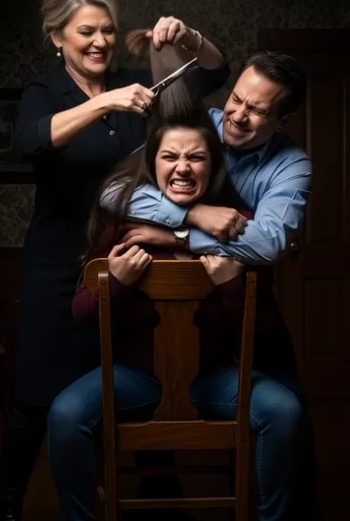
A day before my thesis defense, my husband grabbed me while my mother-in-law shaved my head, telling me to “know my place.” They thought I’d stay home in shame. But I walked onto the stage — and when my father rose from the front row, the real story began.
I lived among the ghosts of the past, and that suited me just fine. My small world smelled of old books, archival dust, and strong black tea. The stacks of monographs piled on the floor of my two-bedroom condo in Southeast D.C. were more vital to me than fashion magazines, and the faded photographs from the turn of the 20th century interested me far more than the noise on social media. At thirty years old, I was almost at the finish line of my life’s goal: the final stage of writing my dissertation on the history of Black entrepreneurship along D.C.’s U Street corridor during the Great Migration. This work was my passion, my heir, my escape from the gray reality of a working-class apartment building.
My husband, Amari, didn’t understand this escape. To him, a thirty-two-year-old senior mechanic at an auto body shop, the world was simple and material. The car must run, dinner must be on the table, and his wife must greet him with a smile. He condescendingly referred to my research as a “hobby.”
“What’s up, historian?” he’d say, walking into the kitchen where I, surrounded by books, tried to squeeze in a chapter between chores. “Choking on centuries of dust again? You’d be better off frying up some catfish.”
Silently, I would stand up and go to the stove. Arguing was pointless. I loved him, or at least the version of Amari I remembered from the first few years of our marriage—the cheerful, strong guy who admired my intelligence and proudly bragged to his friends that his wife was going to be a scholar. But the years passed, and admiration turned into irritation, especially after we moved into the condo he inherited from his father, right next door to his mother, Mama Nyla.
Mama Nyla, a former manager of a D.C. Department of Motor Vehicles (DMV) office, was a straightforward, blunt woman. For her, the world was divided into the right and the wrong. The right thing was for a woman to be in the kitchen, raising children, and obeying her man. Everything else was wrong. And my dissertation was the height of wrong.
“She’s too smart, son,” she’d tell Amari when she thought I wasn’t listening. “Men don’t want those kinds. Her little books won’t take her anywhere good. She sits there ruining her eyes while my Amari is hungry.”
I tried to ignore it. I was used to isolation. My own family was complicated. My mother died when I was fifteen, and my father, Major General Elias Vance, was a severe and reserved man. He raised me like a soldier, without sentimentality. Our relationship was always tense, full of misunderstandings. We almost stopped speaking entirely after I married Amari, a simple working man, against my father’s wishes. But a month before my father’s sixtieth birthday, I decided to call him. The conversation was awkward, but finally, he asked unexpectedly, “How is your work coming?”
“The dissertation, Dad,” I corrected. “I’m finishing it. The defense is soon.”
“That’s good,” he said after a pause. “You have to see things through to the end.”
That brief chat gave me strength. For the first time in years, I felt that maybe, just maybe, he was proud of me.
That particular day was especially heavy. My academic adviser returned the third chapter with a ton of corrections, and I knew I was in for an all-nighter. I was sitting in the kitchen trying to concentrate when Mama Nyla walked in. She lived in the neighboring unit and let herself in without knocking, using her own spare key.
“Still with those little books,” she declared from the doorway, dropping a bag of groceries on the table. “And the kitchen floor still isn’t swept.”
“Good afternoon, Mama Nyla. I was just about to clean up,” I replied politely.
“‘Was about’?” she mimicked. “While you’re ‘about to,’ we’re going to be covered in filth. A woman needs to set her house in order first and then get to her nonsense.” She walked into the living room, ran her finger ostentatiously over the bookshelf, and glared at the dust. “Amari will come home exhausted from work, and the house is a mess. You don’t appreciate him, Imani. You don’t appreciate him at all. Another woman would kiss his feet for marrying you and letting you live in this condo.”
I clenched my fists under the table. Every word was a sharp jab. I knew arguing was useless. “I’ll clean everything up now,” I said quietly.
“Yes, you do that favor,” Mama sneered, then turned the TV on full blast to a cheesy daytime talk show. Concentration was impossible now. I closed my laptop, got up, and grabbed the mop and bucket. Her mother-in-law watched me with a satisfied smile. She had won this little battle. As I mopped the floor, one thought cycled through my head: Just a little longer. Just hold on until the defense, and then everything will change. I would earn the degree, find a job at the university, become financially independent, and be able to leave this perpetual criticism, this humiliating control.
I didn’t know yet that my husband and mother-in-law were preparing a very different future for me, one with no place for my dissertation or my dreams.
The tension in the house grew daily, becoming almost palpable, like a thick fog. Every page I wrote, every night I spent among my books, was viewed by Amari and his mother as a personal insult. They seemed to have formed a silent alliance to prove the uselessness of my pursuits.
Mama Nyla now came over every single day, and her visits turned into planned sabotage. She would start vacuuming loudly right as I tried to call my adviser or embark on a general cleaning of the kitchen, emptying every cabinet onto the table where I was working. “Oh, don’t mind me,” she would say with an innocent air. “I’m not bothering you. I just want to bring some order.”
When Amari returned from work, he no longer asked about the dissertation’s progress. Instead, he started listing his complaints from the door. “My boss drove me nuts today,” he’d complain, throwing his jacket onto a chair. “I come home and there’s no decent dinner and no friendly wife. Just you and your papers.”
“Dinner is on the stove. You just have to heat it up,” I would reply, my voice low.
“Heat it up?” he’d say, indignant. “I have to prepare my own dinner? I work all day at the shop, and you’re here at home staring at the ceiling!”
“I’m not staring at the ceiling, Amari. I’m working,” my voice trembled with restrained offense.
“That’s not work,” he cut in. “That’s foolishness. Work pays the bills, and you’re only spending money on your books and trips to the archives.”
It was unfair. I received a small post-graduate stipend and earned extra money writing articles for historical journals. With that, I covered my modest needs and part of the household expenses. But Amari and Mama Nyla preferred to ignore it. In their worldview, I was a burden.
One night, desperate from their constant criticism, I locked myself in the bathroom and called my father. “Dad,” I started, just wanting to hear a familiar voice.
“Hello, daughter,” his voice was as strict as ever, but with a touch of warmth. “Is something wrong? You sound strange.”
“No. Everything’s fine. I’m just tired, working a lot.”
“The dissertation, I suppose.”
“Yeah, the pre-defense is soon. It’s a key stage.”
“The important thing is not to give up. I believe in you.”
I was speechless. At thirty years old, it was the first time I had ever heard him say that. “I believe in you.”
“Dad,” I said, swallowing the lump in my throat, “would you… want to come to my defense?”
There was silence on the line. “Why?” he finally asked. “I don’t understand any of that. I’d be like a stranger.”
“I would just really like you to be there,” I exhaled.
He fell silent again. “Fine,” he said at last. “If it’s important to you, send me the date and location. I’ll be there.”
Emerging from the bathroom, I had tears in my eyes, but not from despair—from hope. I had an ally, distant and clumsy at showing emotion, but real. The next day, Mama Nyla outdid herself. She arrived with a large pot of beef stew. “Here,” she declared, shoving it into the refrigerator. “I cooked for you for the whole week because I see my Amari is getting thin on your sandwiches.” I was stunned. She ignored the fact that I had prepared a complete three-course meal just yesterday.
That evening, as Amari ate the stew with appetite, praising it, Mama Nyla landed her next blow. “I spoke with the neighbor, Miss Val,” she began. “Her niece, a nice girl, works as a cashier at Safeway. She’s looking for a cheap place to rent.”
I tensed up, sensing trouble. “And I thought,” my mother-in-law looked at me with a look that promised nothing good, “we have a practically empty room, the one Imani uses for her papers. Why don’t we rent it out for a while?”
I choked on my tea. Renting to a stranger in our two-bedroom condo where I barely had room to work? It was too much. “Mama Nyla, that’s impossible,” I said firmly. “It’s my study. I work there.”
“‘Study’?” she scoffed. “You make me laugh. You spread garbage around and call it a study.”
“Mom, seriously, that’s not convenient,” Amari intervened, seeming genuinely surprised.
“It’s not convenient to put your pants on your head,” Mama cut in. “Helping a good person, that is convenient. I already promised Val’s niece that we’d think about it.”
“You can tell her we thought about it and said no,” I said with an icy tone.
Mama Nyla pressed her lips together. She was not used to being rejected. “We’ll see about that,” she hissed. “We’ll see how you talk when Amari gets tired of carrying you.” She got up from the table and slammed the door as she left.
Amari looked at me with a guilty expression. “Imani, I’m sorry. I didn’t know she would come up with that.”
“The problem isn’t what she comes up with, Amari,” I replied tiredly. “It’s that you allow it.”
I went to my study but couldn’t work. I felt like I was in a besieged fortress. I knew the enemies wouldn’t retreat. They would test the defenses again and again until they found the weak spot. And the weakest spot was my own husband.
The long-awaited letter from the university arrived on a dreary Tuesday. I was sorting through the mail when I saw the official envelope with the Georgetown University emblem. My hands trembled as I opened it. Inside, printed on thick paper, was what I had been waiting for for five years: my dissertation defense was scheduled for March 15th. Tears of relief rolled down my cheeks. I immediately called my adviser, Professor Sandoval, who congratulated me. “I never doubted you, Imani,” he said. “The work is solid.”
The next call was to my father. “Dad, they gave me a date. March 15th.”
“Received,” he responded, brief as a military report. “I’ll be there.” Despite his usual restraint, I heard pride in his voice.
I decided to celebrate. I bought a bottle of decent wine and baked her special apple pie. I wanted to share my joy with my husband, still hoping he could be happy for me. Amari came home tired and in a bad mood.
“I have news for you,” I said cheerfully.
“What is it?” He threw his keys on the credenza. “Don’t tell me you bought another expensive book.”
“No.” I handed him the letter. “They scheduled my defense.”
He skimmed it. His face showed nothing. “Oh,” he said. “Got it. The 15th is a Friday. I’ll have to ask for time off work to go.”
“It’s not mandatory that you go,” I said quietly, the offense tightening in my throat.
“What do you mean ‘not mandatory’? My wife is defending her dissertation. We have to keep up appearances. What will people say?”
Keep up appearances. What will people say? That was all that mattered to him. At that moment, Mama Nyla walked in. “What defense? What are you talking about?”
“Mom, hi. Imani got a date for her defense,” Amari said in an almost apologetic tone.
Mama Nyla took the letter and read it carefully. “Doctor of Sciences,” she hissed, pure venom in her voice. “Well, aren’t you a big shot now? And what good is it? Will you bring more money into the house?”
“Possibly,” I replied calmly. “Doctors earn better.”
“Better?” she snorted. “And who will feed your husband while you’re running off to conferences? Listen to my advice, Imani. Stop this foolishness. You’d be better off having another child. Amari needs an heir. A woman’s duty is to her family, not to science. Science is a man’s business.”
This was no longer passive aggression. It was a direct insult. “Mama Nyla,” I stood up, my voice steady, “this is my life, and I will decide how to live it.”
“Oh, so that’s how you talk now?” Her mother-in-law stood up too, her face flushed red. “You’ve learned to be rude to your elders! She gives orders to me, your mother! Put her in her place!”
Amari stood between us, confused and miserable. “Mom, Imani didn’t mean that. She just snapped.”
“This isn’t your house,” I said clearly and quietly. “It’s your son’s house. I am as much an owner here as he is.”
Mama Nyla choked on a gasp of indignation. She looked at me with pure hatred, grabbed her handbag, and left. A heavy silence remained.
“Why’d you do that?” Amari finally said. “Couldn’t you just keep quiet?”
“No, Amari,” I replied, staring him down. “Not anymore.”
I understood that day that they had crossed the point of no return. For the first time, I had openly opposed his mother, and he had not supported me. He chose neutrality, which was, in reality, betrayal. The celebratory dinner was ruined. The bottle of wine remained unopened. I knew my mother-in-law wouldn’t let it go. She would take her revenge, and it would be cruel.
After the scandal, Mama Nyla went into hiding. Amari walked around the house gloomier than a raincloud. He pretended nothing had happened, but the tension was thick enough to cut with a knife. He felt guilty, but admitting it was beyond his strength. Instead, he found solace in small criticisms. “Why aren’t my shirts ironed?” he’d ask in the morning. “The fridge is empty again,” he’d declare at night.
I kept quiet, saving my energy. All my thoughts were focused on preparing for the defense. One Saturday morning, Mama Nyla walked in with a falsely sweet smile. “Hello, honey. I thought maybe we fought for nothing,” she cooed. “I decided to help.” She put a bucket of water and a mop on the floor. “I’m going to clean up here. You, my little Imani, you work. Don’t let me distract you.”
I was instantly alert. Such sudden kindness was not typical of her. “Thank you, Mama Nyla, but you don’t have to.”
“No, no,” she waved her hands. “You focus on your science.”
Amari, getting ready to go fishing, was pleased. “See, Imani? And you said she’s the type to hold a grudge. Thanks, Mom.” He left, leaving me alone with her.
Mama Nyla threw herself into cleaning with enthusiasm, making noise with the bucket, pushing the mop hard, and humming loudly. Concentrating was impossible. I sighed and decided to take a break and go to the market. “I’ll be back soon,” I told her.
“Go on, go on,” she smiled. “I’ll watch everything here.”
I left, and that was my biggest mistake.
I returned in about an hour. The apartment was suspiciously silent. Mama Nyla was gone. I went to my study and froze in the doorway. Chaos. My desk was a wreck, books piled haphazardly, papers scattered. But that wasn’t the worst of it. The large pile of drafts, handwritten notes, and rare archival copies that I had collected for years had all disappeared. On the table, only a single folded note remained.
I took it with trembling hands. “My little Imani,” it read in her looping script. “I was cleaning and I found a whole lot of unnecessary garbage on your desk. I decided to help you get rid of the mess. I threw it in the dumpster. You’re welcome. Your loving mother-in-law.”
I felt the floor give way beneath me. I ran to the hallway dumpster, but it was too late. The trash had already been picked up. Everything was lost. Years of labor, unique, irreplaceable materials. I collapsed onto the hallway floor and sobbed. This wasn’t just revenge. It was murder. The murder of my dream.
When Amari returned from fishing, cheerful and satisfied, he found me in a terrible state. “Imani, what happened?”
I silently handed him the note. He read it, and his face changed. “‘Mom,” he muttered. “She couldn’t have. She must not have understood.”
“She understood everything, Amari!” I screamed, a mix of pain, rage, and despair in my voice. “She did it on purpose so I couldn’t defend, to destroy me!”
“I’ll talk to her,” he pulled out his phone.
“No,” I stopped him. “Don’t humiliate yourself.” I stood up. There were no more tears. “I want her never to cross this threshold again,” I said quietly. “Never.”
He looked at me, scared. He understood this wasn’t hysteria. It was an ultimatum. “Okay,” he said. “I’ll talk to her. I’ll forbid her from coming over.” He stepped into the hallway to make the call. I heard his muffled voice, at first firm, then softening. I heard him say, “Mom, why did you do that?… I know you wanted the best… No, she’s not leaving. I’ll talk to her. She’ll calm down.”
I understood everything. He had betrayed me again. He hadn’t forbidden anything. He had apologized. He sought compromise where there could be none. I thought about the time I had left: three weeks to recover at least some of the lost materials. It was nearly impossible, but I had to try. Not for him, not for her, but for myself and for my father, who had promised to attend. I couldn’t let him down. I would work day and night. I would do the impossible, and after the defense, I would leave this house full of lies and betrayal forever.
The next three weeks became an endless, grueling marathon. I slept three or four hours a day, ate on the go. The apartment became a chaos that no one seemed to care about anymore. Amari, feeling guilty, tried to help with chores, but mostly he tried to avoid me. Mama Nyla didn’t come over, but her invisible presence was felt in everything. “Mom is really worried,” he said one evening. “She says she didn’t mean to, that she wasn’t thinking.”
“Tell her not to worry,” I cut in without looking up from my laptop. “Tell her to think better next time before she throws away someone else’s years of work.”
“You’re too hard on her,” he reproached.
“And she wasn’t hard on me?” I gave him a heavy look. “Amari, let’s agree. Until the defense, we don’t talk about your mother.”
I worked like a woman possessed, contacting colleagues, requesting scans, and spending hours in online libraries. Professor Sandoval was furious when he heard what happened. “It’s barbarism!” he thundered. “Sue her for property damage!”
“It’s not worth it,” I replied tiredly. “I just want to finish this.”
“Can you do it?” he asked.
“I can,” I said firmly. And I did. Days before the defense, I sent him the final version. I was exhausted, but satisfied. All that time, my father’s calls supported me. He called every few days, briefly asking, “How’s it going? Do you need help?” Upon hearing, “I’m managing,” he’d say, “Hold tight,” and hang up. Those laconic, military-style conversations were worth more than hours of consolation. He believed in me.
The day before the defense, I bought a new dress, simple and elegant, dark green. I did my hair. My beautiful brown hair, which hadn’t been styled in weeks, fell in soft waves again. I wanted to look dignified. This was my battle, and I was armed. That evening, Amari approached me with a wilting bouquet of carnations. “These are for you,” he mumbled. “I know I was wrong, but maybe after tomorrow, we can try to start over.”
I looked at his handsome but weak face and felt nothing. “Let’s talk about that tomorrow,” I said.
I went to bed early but couldn’t sleep. I rehearsed my speech, confident in my work, but a sticky anxiety wouldn’t let go. I sensed that Mama Nyla wouldn’t give up that easily. I didn’t know that my worst nightmare was already at the door.
I woke up long before dawn due to a strange anxiety. I lay in the darkness, unable to understand the cause of my unease. I quietly got up and went to the kitchen for water. When I turned on the light, I gasped. Amari and his mother were sitting at the table. They weren’t sleeping. They were waiting for me.
“What… what are you doing here?” I whispered.
Mama Nyla slowly stood up with a sinister smile. In her hand, she held electric hair clippers. “We came to set things straight,” she said quietly.
Amari also stood up. He didn’t look at me. “You think too highly of yourself, Imani,” he said in a dull, unfamiliar voice. “You think you’re too smart.”
“Men don’t want those kinds,” Mama added, advancing. “They want simple homemakers, and you forgot your place.”
“What are you talking about?” I backed up against the wall, my heart in my throat.
“We’re going to remind you,” she grinned. “So you don’t think you’re hot stuff, so you know who’s in charge in this house. You won’t be showing off your beautiful hair to strangers on the academic board. No need to be showing off, Miss Smarty-Pants.”
Then, I understood everything. It was so savage, so monstrous, that my brain refused to believe it.
“Yes,” Amari nodded, finally looking at me. There was neither love nor pity in his eyes, only cold, clumsy envy. “Mom is right. Enough!” He lunged at me.
I screamed, trying to escape, but he was stronger. He grabbed me, twisted my arms behind my back, and pressed me against the wall. “Hold her steady,” Mama commanded. She approached from behind, and I felt the cold metal against the back of my neck. The buzzing started.
“No, please, no!” I screamed, but my cry was drowned out by the roar of the clippers. I felt the first strand of my long brown hair, my pride, fall to the floor. Then the second, the third. Mama worked fast, expertly, shaving it close to the skin, reciting, “There, so you know your place. So you remember you are a woman, and a woman’s duty is to cook, not to defend a dissertation.”
I sobbed, my body shaking with silent weeping. Amari held me, his hot, ragged breath on my neck. In minutes, it was over.
“Done,” she said, satisfied. “Much better. Looks like a modest woman now.”
Amari released me. I slid slowly down the wall to the floor, afraid to lift my head, feeling naked, humiliated, trampled.
“Look at yourself,” she ordered. Amari roughly took me by the chin and forced me to look up. “I said, look at yourself!” He dragged me to the hallway mirror.
A strange, ugly being stared back, a face swollen with tears, pathetic tufts of hair pointing in every direction, and huge eyes wide with horror.
“Well,” Mama Nyla chuckled from behind. “Are you still going to your defense now? Will you shame yourself in front of the professors?”
I was silent. “That’s what I thought,” she nodded. “Stay home. Cry, and Amari will comfort you.”
They thought they had broken me. They went to the bedroom, leaving me alone on the hallway floor. I lay on the cold floor, trembling. I looked at my reflection and felt the pain and despair give way to something else: a cold, icy hatred, tense as a wire. They were wrong. They hadn’t broken me. They had awakened the beast in me.
I didn’t know how long I sat on the cold hallway floor. The minutes blurred into a viscous mass of horror. Every time I glanced at the mirror, a new wave of nausea rose in my throat. They had achieved their goal. They had trampled me.
From the bedroom came Amari’s soft snoring. He was sleeping. After what he did, he just lay down and slept. That realization was perhaps worse than the shaving.
I slowly got up, my legs feeling like cotton. I went to the kitchen and looked at the clumps of my hair scattered on the linoleum. I remembered how Amari had loved it. “Your hair smells like sunshine and wind,” he used to whisper. Where was that boy? Who was this cruel stranger sleeping in my bed?
I knelt and picked up the clumps one by one, like fragments of my broken life. The tears had dried. I thought about the defense. Mama Nyla was right. How could I go like this? The thought of my father was the most unbearable. He would come, sit in the front row, and see me humiliated, crushed. He who despised weakness would be ashamed.
The temptation to abandon everything was almost irresistible. They had won. I would become what they wanted: a quiet, submissive, broken woman who knew her place. But then I looked at my desk, the final version of my dissertation. Five years of my life. It wasn’t just research; it was me, my mind, my soul, my will. Would I allow them to destroy that, too?
I stood up, went to the desk, and took the heavy volume. I remembered Professor Sandoval’s words: “Imani, you have real research talent. Don’t bury it.” I remembered my father’s voice: “I believe in you.”
No. I wouldn’t surrender. I would go to the defense exactly as I was. Let everyone see what they had done to me. It wouldn’t be my shame. It would be theirs.
I walked to the mirror and looked at myself again. Yes, disfigured. But in the reflection’s gaze, there was no longer fear. There was hatred, cold and clear as steel. And that hatred gave me strength. I was no longer a victim. I was a warrior going to her final, decisive battle.
Pain, strangely enough, clarifies when it reaches its peak. It burns away the superfluous. Fear, doubt, self-pity. Only survival and action remain. I felt that breaking point within me. The tears dried. The trembling stopped. Despair was followed by a chilling, resonant fury.
I looked at the clock. 3:30 in the morning. Less than ten hours until the defense. I would prepare not just to defend my dissertation, but to defend my life.
First, I collected the hair from the floor, storing it in a bag as evidence. I washed my face, brushed my teeth. Then I went to the bedroom. Amari was sleeping, a traitorous angel. The love was gone. Only cold curiosity remained. How does someone fall so low?
I opened the closet quietly. I needed to cover my head, not out of shame, but so as not to distract from my speech. My fingers touched something soft and cool: a silk scarf I had bought years ago and never worn, a deep emerald green, the color of strength, of rebirth. I went to the mirror and tried to tie it. After a few attempts, it looked perfect. It framed my face, hid the disaster, and highlighted my eyes with a resolved, dangerous fire.
This is better, I thought. I felt like a different person. The old Imani, quiet and compliant, died that night. A new woman was born, one who knew the price of betrayal and was ready to seek revenge. I pulled out my phone. Dad. I had to tell him. He answered on the first ring.
“Imani, what is it?” his voice was alarmed.
“Dad,” my voice broke. “They…” I told him everything. On the other end, dense, tangible silence.
“I hear you,” his voice was low and terrifying, the sound of an irrevocable command. “Are they still in the apartment?”
“Yes, they’re sleeping.”
“Listen to me closely, daughter. Take your documents, your laptop, and get out of there now.”
“Where do I go?”
“I’m sending a car for you. It will be at your building in forty minutes. The driver will take you to a hotel. I’ll arrange everything. You sleep a few hours, get ready, and go to the defense.”
“Dad, I can’t go like this.”
“You will go like this,” his voice was steel. “Did you understand, Imani? You will go and defend your work. You will not let those… people break you. I will be there in the front row. I want to be proud of my daughter.”
I was stunned. I expected anger, reproach, not this rapid, precise military support.
“Did you understand?” he repeated.
“Yes, Dad.”
“Good. And your husband and his mother? I’ll talk to them later. Don’t you worry.” He hung up.
A certainty hard as granite came over me. I was not alone. Quick and quiet, I gathered the essentials. Before leaving, I stopped at the bedroom door and looked at the sleeping Amari. He was dead to me. I wrote a short note: I left. Don’t look for me. I left it on the kitchen table and walked out without looking back, closing the door on my past life.
Outside, a black car with official D.C. plates was waiting. The Willard Intercontinental Hotel greeted me with silence and the smell of fine wood. The driver escorted me to the fifth floor and gave me the key card. “General Vance requested that you rest. Everything is taken care of.”
The room was spacious and elegant. A huge bed, a panoramic window overlooking the morning city. I threw my bag on the floor and went to the window. The sun was rising. I felt reborn. The past night seemed like a terrible dream. I took a long, hot shower, washing away not only the dirt, but the sticky humiliation. I ordered breakfast and coffee. I didn’t sleep. My father’s plan was brilliant. He removed me from the toxic environment, gave me space to recover, isolated me from my enemies. He acted like a strategist. I thought about him, my stern father. My whole life, I believed he didn’t love me. But he just didn’t know how to show feelings. At the critical moment, he was the only one who stood by my side.
Around 10:00, I began to prepare. The dark green dress fit perfectly. The emerald scarf looked stylish and unique. I looked at myself in the mirror: a woman I didn’t recognize, but one who was beautiful, strong, confident, and unbreakable. I rehearsed my speech one last time. The words flowed easily. I thought about what was happening in my former apartment: Amari waking up, his confusion, his panic. Mama Nyla’s hysteria, accusations, threats. I smiled. Their world of control was collapsing, and they themselves had destroyed it.
The same car picked me up. I was not going to an execution. I was going to my triumph. I entered the main building half an hour early. People were already in the hallway. Seeing me, many fell silent, following me with curious glances. My unusual attire attracted attention. I wasn’t ashamed. I walked with my head held high.
At the auditorium door, Professor Sandoval was waiting. He looked at me with concern. “Imani Jameson,” he said. “I heard your husband called. He said you were sick.”
“As you can see, I’m perfectly fine,” I smiled calmly. “It’s my new look, Professor Sandoval. I decided to change my image for my new life.”
He looked at me intently, and in his wise eyes, I read understanding. “Well,” he said, “bold. Very bold. Good luck with the defense.”
I entered the hall. At the long table were the members of the committee. In the auditorium, dozens of spectators. And in the front row, center stage, was him: my father, in his Class A uniform with all his decorations, sitting ramrod straight, staring at me. In his gaze, there was no pity, only calm, firm support. I feared nothing more.
I went to the podium and looked out at the hall. “Distinguished chair, esteemed members of the dissertation committee, dear colleagues,” my voice sounded even and confident. “Allow me to present…” I began my presentation, and in that instant, I knew I had already won.
I spoke, and with every word, my voice grew firmer. I narrated the customs and life in the D.C. of the 1930s, immersing myself in my favorite era, forgetting the night before. Now only I, my work, and the audience existed. I saw how the committee was listening attentively, how Professor Sandoval nodded approvingly, how my father didn’t take his eyes off me.
When I finished, a brief silence fell, followed by loud, sincere applause. The complex, tricky questions began, but I was prepared. I answered clearly, demonstrating mastery of my subject.
In the middle of the scientific debate, the door opened. Amari and Mama Nyla had come to savor my failure. They expected to see a submissive, tearful, ashamed woman. They saw a confident scholar easily batting away attacks from expert professors. Their faces stretched in astonishment, but the real shock was yet to come. Their eyes swept the room and fell upon the figure in uniform in the front row. Mama Nyla brought a hand to her chest. Amari turned pale. They recognized him. Major General Vance, my father. They thought I was an orphan, defenseless, alone. And there he was, real, imposing. He wasn’t looking at me. He was looking at them.
Mama Nyla tugged on her son’s arm. They tried to leave quietly, but it was too late. My father saw them. His expression didn’t change. He just kept staring. And in that gaze, there was such cold fury that they must have frozen inside.
The defense continued. Opponents spoke, then the adviser—all positive. Professor Sandoval said, “This is not only a good dissertation; it is the work of a true scholar with an unbreakable will and courage.” He gave me a meaningful look.
The committee retired to deliberate. In ten minutes, they returned, and the chair announced, “By the unanimous decision of the dissertation committee of Georgetown University, the degree of Doctor of Historical Sciences is awarded to Imani Jameson.”
The hall erupted in applause. People stood up, congratulating me. I received them, smiling, but watching my father out of the corner of my eye. He waited. When the wave of well-wishers subsided, he stood up. He didn’t go to me. He walked toward the exit where Amari and Mama Nyla were huddled.
“Good afternoon,” he said quietly, but his voice boomed in the quiet hall. “I am Imani’s father, Major General Vance. And you are, I assume, her husband and mother-in-law.”
Amari mumbled something.
“It seems to me,” my father continued, still quiet, “that we need to talk about education, family values, and aggravated assault charges.”
Mama gasped.
“Son,” he looked at Amari, “do me a favor and accompany me. We have a short man-to-man talk waiting.” He placed his heavy hand on Amari’s shoulder. At that moment, two burly men in sharp civilian suits appeared. They materialized out of nowhere. “Let’s go,” one said courteously but firmly. They took him by the elbows and led him out. He walked without resistance, like a lamb to the slaughter.
My father turned back to Mama Nyla, who looked ready to faint. “With you, madam, the conversation will be later,” he said. “After your son tells us everything. In the meantime, go home and wait.”
He turned and walked toward me. Mama Nyla was left alone in the middle of the hall. Everyone looked at her with curiosity, disdain, and judgment. It was her gallows, and she ascended it alone.
Mama Nyla stood in the middle of the university hallway like a statue. People passed by, giving her curious glances. She felt naked, humiliated, crushed. Her brilliant plan had backfired completely. She wanted to see my shame, but she saw my triumph. She wanted to break me, but she saw an unbreakable wall behind me: the general father, that uniform, that icy stare. It was all real.
And now that terrible man had taken her son, her Amari, into the unknown. Panic squeezed her heart. She ran to the exit, but there was no car on the street, no Amari, no general. She collapsed onto a bench, dialing her son’s number with trembling fingers. No answer. She suddenly understood what she had done. In her blind hatred for me, she had destroyed her own son. She thought of me. That quiet, insignificant girl she had despised turned out to be strong, unbreakable. She won not with screaming or hysterics, but with intelligence and dignity. And for Mama Nyla, that was the ultimate humiliation.
Meanwhile, in a cozy cafe near the university, I sat at a table with my father. He had taken off his uniform and looked less imposing, just a tired older man.
“Congratulations, Doctor,” he said, raising his teacup. “I’m proud of you.”
I smiled. “Thank you, Dad, for coming and for everything.”
“A family defends itself,” he nodded.
“What will happen to Amari?” I dared to ask.
“Don’t worry. They won’t physically harm him. They’ll just talk. They’ll explain the basics of proper masculine conduct, what happens to a man who raises a hand to a woman, especially a general’s daughter. I believe he will understand.”
“And his mother?”
My father’s face darkened. “With her, it’s a legal conversation. My assistant is preparing the paperwork. We will sue her for emotional distress and harassment. We won’t ask for jail time. We will ruin her. We will take everything from her so she remembers the lesson until the end.”
I was silent. Cruel, but fair. “Dad, maybe not,” I said softly. “Let God judge her.”
“God is in heaven,” he cut in. “On earth, there is law and honor. She insulted our family’s honor. She must pay.” He covered my hand with his. “Imani,” he said, softer now, “I know I was a bad father, too preoccupied with service. I didn’t give you attention. I blame myself for your marriage to that man. I didn’t see it in time, but I want to correct that. Let me protect you.”
“You already have,” I whispered. We sat there, and for the first time in years, it was good and calm between us.
Across the city, in a gray, anonymous office, Amari was sitting in a chair across from two serious men. They didn’t threaten or yell. They asked questions calmly, methodically, and that calm terrified him more. They asked about his life with me, his income, the condo. He stammered, he lied. They pulled out bank statements and showed them to him in silence. His lies crumbled. Then they asked about the night before. He understood. They knew everything.
“You understand, young man,” one of them finally said, “that your actions fall under several sections of the penal code? Illegal deprivation of liberty, assault, threat to life—those are serious penalties.” Amari sat hunched over, speechless.
“But General Vance is merciful,” the other continued. “He doesn’t want to ruin your life just yet. He transmits a condition to you: immediate divorce. You leave all property to Imani Jameson, and you never, ever approach her or her family again. Ever. If not, this conversation will continue officially, in another place, with different people. Did you understand?”
Amari nodded feverishly. “Good,” the first one said. “You may go.” He stood up on legs of cotton and walked out. He was free, but he felt like his life was over. He had lost everything, and he alone was to blame.
When he left the bland office building, night was already falling. He didn’t go home. His mother was there, and seeing her now was impossible. He went to a friend’s house and drank cheap brandy all night. For the first time in years, he truly thought. He reviewed his life with me and saw an ugly picture: he, childish, selfish, weak, hiding behind his mother. He envied my success instead of being proud. And in the end, he committed the worst act.
In the morning, he went home. He had to talk to his mother. “What happened?” she asked at the door. “What did he do to you?”
“He talked to me, Mom,” he replied, walking in.
“And so what? He threatened you? He lectured you? And you got scared?” her voice full of contempt. “A coward!”
“Yes, Mom. I got scared,” he looked her straight in the eye. “Do you know why? Because he’s right. We acted like the worst kind of people.”
“Don’t you dare say that!” she shrieked. “I defended the family! I was putting an arrogant woman in her place!”
“You disfigured a person!” he yelled. “You ruined not only her life, but mine! Because of you, I lost everything! My wife, my home, my respect!”
“Wife?” she laughed. “You’ll find a hundred more simple, obedient ones.”
“I don’t want simple! I wanted her!” he slammed his fist on the wall. “And you took her away from me!”
They screamed for hours. For the first time, he didn’t yield. He unleashed all the pain, guilt, and hatred for her suffocating love that had accumulated for years. Finally, she broke down and cried. “What do we do now, son?” she whimpered.
“We?” He smiled bitterly. “There is no ‘we’ anymore, Mom. There is you, and there is me. And I have to live somehow.”
The next day, he filed for divorce. I learned from the lawyer my father had provided that the process would be quick. Amari wasn’t claiming anything. A week after the defense, I returned to the condo. It was mine alone now. Amari and Mama Nyla had moved out. It was empty, silent, but the air was easy to breathe. I remodeled, threw away old furniture that reminded me of the past. I worked a lot, taught at the university, and wrote articles. My father visited often. We drank tea in the new kitchen and talked about history, politics, life. I was rediscovering him.
Mama Nyla tried to contact me several times, calling, begging for forgiveness. “My little Imani, I understood everything,” she cried. “Forgive this silly old woman.”
I listened without believing a word. “I forgive you, Mama Nyla,” I would say, “but I don’t want to see you in my life.” And I would hang up.
I knew I had done the right thing. I had defended myself, protected myself, and restored justice. I was free. Free to build my life as I wanted, without fear or humiliation. I had won, and the victory was sweet, like springtime air after a long winter.
Two years passed. Spring in D.C. was early and warm. I was on the balcony of my new townhouse, watching my father teach my two-year-old son, Kofi, to fly a kite. I had given birth a year after meeting my new husband, Kellen, an architect I met at a conference. Our relationship was calm and happy, based on mutual respect and trust. My life had completely transformed. I was an associate professor, writing recognized books, independent and happy. The house with Kellen overflowed with light, laughter, and love.
I rarely remembered Amari and his mother, like a bad dream. I knew they lived together in that same condo. Amari never recovered. He lost his job, lived on odd mechanic jobs, and drank heavily. Mama Nyla aged, hunched over. Her bossy nature remained, but she had no one left to boss around. Her son was broken, and relatives had distanced themselves. She was isolated.
One day, while strolling with my father and son in Rock Creek Park, we ran into her. Mama Nyla was sitting on a bench alone, feeding pigeons. She saw us, and her face contorted. She recognized me, then General Vance. Her gaze fell on the laughing child holding his grandfather’s hand.
“Is that… your boy?” she whispered as we passed.
“Yes,” I replied calmly. “My son. And this is my father, his grandfather.”
Mama Nyla looked at the general, the happy child, and me. In her eyes, I saw not hatred, but something worse: black, abysmal envy. Envy for the life I had built, for the happiness she had taken from herself. She didn’t say anything. She just turned away.
I walked along the path, holding my husband’s hand. Nearby, my son ran, laughing loudly. I looked up at the clear spring sky and thought that life is astonishing. Sometimes, to find true happiness, you have to cross the worst hell. I had crossed it and emerged victorious.