It was supposed to be a normal family dinner. Roast chicken, loud conversation, a bottle of wine that was probably already half gone before we arrived. Nothing dramatic. Just a Sunday. But that night didn’t stay ordinary. That night changed everything.
The smell hit before we even stepped into the dining room—garlic, rosemary, and something faintly burnt that my mother would call “perfectly caramelized.” Voices carried through the walls, overlapping laughter and the clink of silverware. My husband, Evan, squeezed my hand. “Ready?”
“As I’ll ever be,” I said.
Between us, my eight-year-old daughter, Chloe, clutched a tray she’d refused to let me hold. The foil cover crinkled under her small fingers. She’d been up since morning, a whirlwind of flour and determination. Three failed batches, one perfect one. She had frosted them with the intense focus of a royal decorator. She was so proud, she could barely stand still.
We walked in. Conversations slowed, just for a second. My mother beamed, that practiced hostess smile that could double as a weapon. “There you are! We thought traffic swallowed you whole.”
“Almost,” I said. The table was full. My parents at the ends like bookends, my sister Monica across from us, her daughter Sienna already halfway through her mashed potatoes. Chloe stood beside me, tray in hand, vibrating with anticipation, waiting for someone to notice.
“She made dessert,” I said, smiling down at her. “All by herself.”
A chorus of polite, meaningless noises followed. “Oh, how sweet.” “How ambitious.” “How adorable.” The kind of compliments that bounce off the surface and disappear before they hit anything real.
Chloe carefully peeled back the foil. The cupcakes looked a little uneven, a little lopsided, but they smelled amazing. Vanilla and sugar and something hopeful. No one moved.
Sienna, my ten-year-old niece, wrinkled her nose. “Are they gluten-free?”
I blinked. “No, should they be?”
“Mom says I’m not doing gluten this week,” Sienna announced with the gravity of a life-altering decision.
Monica smiled, as if this were a profound lifestyle announcement. I looked at Sienna’s plate. “That roll you’re eating isn’t exactly gluten-free.”
A tight laugh from Monica. “Well, Mom made that. It’s different.”
My mother nodded quickly, too brightly. “Sweetheart, it’s lovely that you tried. But we have so much food already. Let’s just set these aside for now, all right?” She lifted the tray before I could answer, her movements careful and gracious, and carried it toward the kitchen.
And just like that, the conversation started up again, louder this time, brighter. Chloe sat beside me. She folded her napkin into neat little squares and stared at her plate, her lower lip trembling just slightly. I told myself to stay calm, to pick my battles, to let this one go.
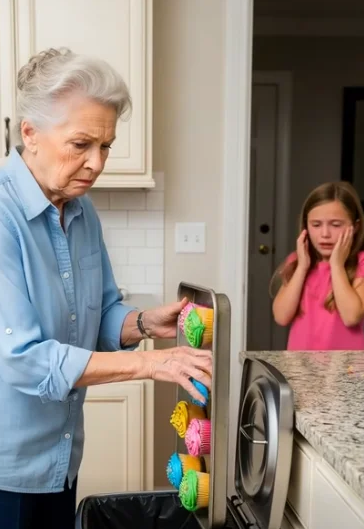
But when I stood a few minutes later and said I was grabbing more napkins, no one looked up. The kitchen smelled like lemon cleaner and crushed hope. The trash can lid was half-open. I saw the frosting first—white smears against the black liner. Crushed paper cups. A drift of sprinkles like confetti at a funeral.
It took me a second to breathe. Another to realize I wasn’t alone.
Chloe stood in the doorway. Her eyes went straight to the trash, then to me. She didn’t speak. Didn’t cry. She just froze, her face a mask of quiet devastation. Something inside me twisted into a tight, painful knot. I opened my mouth to say something, anything—it’s okay, we can make more, they weren’t good enough for them anyway—but she’d already turned away, walking back down the hall on silent feet.
When I returned to the table, she was sitting perfectly still, her fork untouched. Her face was blank in that way only kids can manage when they’re trying desperately not to cry. Monica was talking again, something about the importance of holding children to “higher standards.” My mother nodded as if she were in agreement with a divine truth. Every word scraped against my chest.
Chloe’s hands were trembling under the table. I could feel the vibration through the wood. Did no one else notice? Or maybe they did, and pretended not to. I looked straight at my sister.
“Monica,” I said lightly, “you sure you don’t want to try one of Chloe’s cupcakes before they’re all gone?”
Her fork paused midair. For a split second, her eyes flicked toward the kitchen. Just once. Just enough. Then she smiled, too bright and brittle. “I think I’ve had enough sugar for the year. She’ll get better when she’s older.”
The laugh that followed was thin. Nervous. Around the table, everyone went back to pretending nothing had happened. And that’s when it hit me. The unspoken lie was the family’s real dessert.
Chloe picked up her napkin and pressed it to her mouth, pretending to wipe something away. But her hand stayed there too long, shaking. When she lowered it, her face was dry. Her eyes weren’t. And that’s when the room went from loud to unbearable. That’s when something in me shifted, quietly, like a gear locking into place. I picked up my wine glass. My voice came out steady. Too steady.
“I’d like to make a toast,” I said.
Every fork froze. Every voice stopped mid-word.
“To the last time you see us again.”
The silence afterward had weight, the kind you could feel pressing down on your skin. Evan looked at me, startled, a question in his eyes.
“We’re leaving,” I said, answering it. He stared like I was speaking another language, but he stood anyway. His chair scraped loudly against the floor. Chloe stood, too, slipping her small hand into mine without looking up.
My mother’s face went pale. My father looked utterly confused. Monica just stared, mouth slightly open, as if waiting for a punchline that never came.
We walked out. Down the hall with the framed family photos—the perfect smiles, the vacations, the pretend harmony. All lies, really. Just snapshots that skipped the truth. The front door closed behind us. Not with a slam. Just a soft, final click.
Outside, the air was cold and clean and sharp enough to taste. Chloe climbed into the back seat. Evan followed, still silent. I started the car. My hands were shaking, just a little.
Chloe stared straight ahead. She didn’t say a word. She didn’t have to. Her silence filled the car like sound does in a church: complete, echoing. And somewhere between that house and the first stoplight, I knew something had broken in our family. Something that wouldn’t get fixed. Not this time.
If you’d asked my mother, she’d have said our family didn’t do unfairness. We had standards. Which, in our house, was a code word. It meant, if you weren’t perfect, you were wrong.
I was the firstborn, two years older than Monica, which made me the family prototype. The rule was clear from the beginning: if I did something well, it was expected. If Monica did the same thing, it was wonderful. She learned early that her mistakes were allowed to be cute. Mine were personal disappointments.
My mother’s favorite saying was, “If it’s worth doing, it’s worth doing properly.” It sounded like wisdom. It felt like surveillance.
Once, in fourth grade, I spent two hours on a math worksheet. I made one tiny eraser mark in the corner. She looked at it, sighed dramatically, and said, “You can’t hand it in like that. Start over.” I did. Then I cried on the second copy because the paper tore where I’d pressed too hard with the pencil. She handed me a new sheet without a word. That’s how you learn endurance, her silence said, one ruined homework page at a time.
If a towel hung slightly uneven on the rack, she’d walk past and say, “Do it again until it’s right.” If a dish wasn’t rinsed perfectly before going into the dishwasher, “Sloppy work reflects sloppy thinking.” My father would clear his throat as if he might intervene, but he never did. His silence was his vote of agreement. In that house, quiet meant approval of my mother’s methods.
That pattern settled over us like wallpaper, so ordinary you stopped noticing. Monica’s efforts were met with patience, mine with correction. When she forgot a step in a recipe, Mom would smile and say, “She’s still little.” When I forgot, it was, “You know better.” And when chores went sideways, the solution was always the same: “Jody, you’re the older one. Fix it for her.” So I did. I became the family’s safety net before I was old enough to understand what that cost.
Praise was rationed. Monica’s smallest triumphs were celebrated. Mine were obligations already assumed. Even as a child, I told myself it was fair. Older meant more responsibility. It took years to realize it really meant, someone has to hold the line, and it won’t be us.
By our teens, the divide had hardened. If Monica finished a project neatly, Mom called it “wonderful.” If I finished mine, she’d find one edge to trim, one detail to redo. And my father, a steady, kind man who was absent in all the moments that mattered, let the imbalance stand. I didn’t fight it. You learn not to. You convince yourself that striving earns peace, that excellence guarantees belonging.
Then came adulthood, proof that the training sticks. Monica married early and had Sienna. Three years later, I had Chloe. Different towns, same hierarchy. Whenever we visited, I saw the old script replayed. Sienna’s every crayon drawing was museum-worthy. Chloe’s efforts came with gentle, cutting notes. “Be polite, dear.” “Careful now.” “Do it properly.”
At first, I thought it was just a habit, the kind of harmless over-attention grandparents give. Then I noticed the pattern was reversed. Sienna was older, yet Chloe was the one constantly being corrected, measured, reshaped. If it had truly been about age or teaching, it would have gone the other way. That was the moment the logic fell apart. It was never about guidance. It was about control—the quiet kind, delivered with a smile and perfect diction.
Watching Chloe fold in on herself after each small suggestion was like seeing a photograph fade while you were still holding it. She’d start the visit lively and confident, then retreat by degrees until she was all apology and quiet deference. And every time, my mother looked pleased, as if she’d restored order to a chaotic universe.
By then, I was a working adult—careful, solvent, the one who “had it together.” Success didn’t free me; it just gave my family new ways to depend on me. Every month, I transferred money toward my parents’ mortgage, “just while they caught up.” If Monica needed help with a bill, the call came through Mom. “You know she’s doing her best, dear.” And I’d send more, because that’s what good daughters do. The unspoken exchange was simple: my stability bought my place at the table. Every payment said, we’re proud of you, as long as you keep paying for that pride.
When holidays came, I bought the roast, the wine, the gifts, all under the heading of “high standards.” It took me years to hear what those words really meant: our way or the wrong way.
After the dinner with the cupcakes, all of it replayed in my mind: the homework, the towels, the careful corrections delivered as kindness. The lines hadn’t changed, only the audience. “It’s lovely that you tried.” “We just want to keep everyone safe.” “Better luck next time.” They used to say those things to me. Now they were saying them to Chloe.
And suddenly, I understood. It had never been about effort or love or even family. It was about keeping someone slightly smaller so they could feel slightly taller. For decades, I’d called it “high standards,” but watching my daughter sit there with her hands folded tight, I saw it clearly. It was just control with good manners, and I was finished mistaking it for love.
That night, after we left my parents’ house, I didn’t cry. I didn’t yell, either. I just sat at my desk with my hands still shaking and the taste of that dinner—bitter and metallic—still in my throat. The house felt heavy, like it does after a thunderstorm: quiet, but charged. Evan was in the kitchen, rinsing plates that no one had really eaten from. Upstairs, Chloe’s door was closed.
I turned on the computer. The screen lit the room in a pale, sterile blue. One by one, I opened every tab that tied me to them. The automatic mortgage transfer. The family fund. The quiet little payments that had been running in the background of my life like white noise.
Click. Cancel. Confirm. Each confirmation ping felt like a nail being hammered into place. Final. Irreversible.
Evan came in, a towel draped over his shoulder. He watched the screen for a moment. “What are you doing?”
“Maintenance,” I said. “Just shutting off a few things.”
He frowned, a line of concern creasing his forehead. “Maybe give it a few days. You were upset. You didn’t mean that thing about never seeing them again.”
I kept my eyes on the monitor, the cursor blinking patiently. “I meant every word.”
He didn’t argue, which told me he believed me. That scared him more than anger would have.
The next morning, I braced for the fallout—for tears, confusion, regret. Instead, I found Chloe in the hallway, already dressed, her hair brushed, standing very still. She walked up to me, wrapped her small arms around my waist, and whispered, “Thank you.”
“For what?”
“For saying something. For leaving.”
I didn’t trust my voice enough to answer. We sat on the couch, sunlight slicing through the blinds in thin, golden bars.
“Your cupcakes were great,” I said finally. “There was nothing wrong with them.”
She nodded, tears slipping down her face. This time, they looked like release, not shame.
“You don’t have to be perfect to be proud,” I told her, my voice thick.
She leaned against me. “Can we just stay home next time?”
“Yeah,” I said. “We can.” For the first time in years, the house felt warm. Not big, not bright. Just safe.
By Tuesday, the calls started. I didn’t answer any of them. Blocked numbers filled my screen like weeds. Mom. Monica. Unknown. Unknown again. Then, a new number appeared, one I didn’t recognize. I hesitated, then answered.
“Finally,” Mom snapped. “Do you have any idea how childish you’re being?”
I said nothing.
“We were trying to educate her,” she continued, her voice rising. “That’s what parents do. You’ve humiliated this family.”
“Throwing away what an eight-year-old made isn’t education,” I said quietly. “It’s cruelty.”
“Cruelty? She’ll survive. You survived, didn’t you? It made you successful. You’re welcome.”
“She spent five hours baking those,” I said, my own voice now sharp. “And you threw them away because they weren’t up to your standard. I won’t let her think that’s normal.”
“So, holding a child to standards is abuse now? That’s parenting!”
“No,” I said. “That’s control. And I’m done.” Before she could reply, I ended the call. My hand was steady. My pulse was not.
Two days later, the phone rang again. My father this time. I hadn’t blocked him; I didn’t think I’d need to. His tone was gentle, careful, the way people speak to a lit fuse. “Your mother’s very upset,” he began. “You should call her. Smooth things over.”
“What did she do to you?” I almost laughed. “I told her the truth.”
“She’s just trying to help. You know how she is.”
“Yeah,” I said. “I do.”
There was a pause. Then, as if casually, “By the way, we noticed the mortgage payment didn’t come through this month.”
“That’s right.”
“I understand if you don’t want to for a bit, but could you keep it up for now? We’re a little low on cash. Once things settle, we’ll take it back over.”
“No,” I said. “I’m not your bank anymore.”
He sighed, disappointed but unsurprised. “You wouldn’t have this good job if we hadn’t pushed you. We taught you discipline. That’s why you can help us now.”
“I’m not successful because of you,” I said, the words finally forming after a lifetime of silence. “I’m successful despite you. I survived it. That’s the difference.”
He went quiet. Then, softly, “We did our best. We made you who you are. This is how you thank us?”
“I’m not thanking you,” I said. “I’m breaking the pattern.” I ended the call. The silence afterward wasn’t peaceful. It was cavernous. Still, I could breathe in it.
A week later, I checked my bank account. There it was, sitting at the top of my transaction history like a bad joke. A transfer of twelve thousand dollars to “Janet and Robert Bennett.” My parents. No typo. No accident. Just gone.
I didn’t shout. I didn’t even swear. I just stared at the number until the screen blurred and thought, of course you did.
Years ago, when Chloe was a baby and I was too exhausted to argue about paperwork, I’d given them power of attorney, “just in case.” Apparently, “in case” had finally arrived. I called. My father picked up on the second ring, as calm as a cat in sunlight.
“Honey, don’t make a fuss. We only moved what we needed—the mortgage, a few repairs. We’re your parents.”
“You moved twelve thousand dollars out of my account,” I said, my voice dangerously level.
He sighed, patient and weary, the tone of a man explaining math to a child. “You’ve always helped before. Stop being so dramatic.”
“Not like this.”
There was a pause, a faint shuffle, and then my mother’s voice slid in, sweet as poison. “It’s only money, sweetheart. We just wanted things handled properly. You know we love you.”
That word. Properly. It hit like déjà vu. “You took my money without asking,” I said. “That isn’t love. That’s theft.”
My father’s voice dropped half an octave. “Watch your tone.”
“I have,” I said, “my whole life.” Then I hung up.
By afternoon, the family network had activated. Aunt Paula texted: Your parents are heartbroken. Uncle Ron followed with: They said you cut them off when they’re struggling with the roof. And Monica, ever the poet, posted on social media: Some people forget who taught them everything. No mention of the money, of course.
I didn’t reply. I screenshotted everything, saved the bank statement, and closed the laptop. Two days later, I sat across from Carla Nguyen, my lawyer. “They used an expired power of attorney,” she said, flipping through my documents. “That’s unauthorized.” She sent a demand letter. At her suggestion, I also filed a police report. It was symbolic, really, but the bored thunk of the officer’s stamp felt like punctuation.
Three days later, their lawyer wrote back. Apparently, it was all a “misunderstanding.” They returned six thousand immediately and promised to repay the rest over the next year. A misunderstanding that lasted exactly until someone used the word “unauthorized.” The money appeared in my account like a confession.
The gossip started to turn. Extended family suddenly remembered I’d never been emotional without a reason. The perfect parents were now quietly repaying their own daughter.
That night, my phone rang. Monica. “You made them miserable,” she snapped. “How could you drag the police into this? You could have just helped.”
“So could you,” I said.
There was a silence long enough for both of us to realize the conversation was over. Then, the click. That was our most productive talk in years.
It’s been six months. I haven’t spoken to my parents since the repayments ended. Word is, they sold the house in the spring. They couldn’t keep up the mortgage without my help. They bought a smaller place three hours away—cheaper, quieter, convenient for excuses. Monica and Sienna still visit them sometimes, but not often. Turns out, I wasn’t the only one they leaned on too hard. I’d been sending them eight hundred dollars a month for almost ten years. Mortgage, emergencies, whatever the crisis of the week was. Nearly a hundred thousand dollars disguised as duty. Now that money buys plane tickets, weekends away, and Chloe’s art classes. My finances are finally mine. And so is my peace.
Chloe’s thriving. Evan’s happy. The silence from my parents isn’t loss anymore. It’s freedom with better lighting. One afternoon, Chloe dropped a cup, watched it shatter, and waited, bracing for a lecture.
I just said, “It’s fine. We’ll sweep it up.”
She blinked, then grinned. “That’s it?”
“That’s it.” The look of pure, unadulterated relief on her face hurt worse than any of the old arguments.
Evan walked in and watched us. “You two are getting dangerous,” he said.
“Reckless,” I corrected. “We might even enjoy ourselves.” He smiled, but his eyes softened. “You look lighter.”
Maybe I am. Not happy, not yet. Just unburdened. Like setting down something heavy I didn’t even know I was carrying.