My sister Abigail got pregnant at sixteen, and nobody in our family believed her. Not because she was a known liar, but because our parents had spent her entire nine-month term insisting she was just gaining weight from stress eating. They refused to take her to a doctor, even when her stomach swelled so large she couldn’t fit into any of her clothes. They told inquiring relatives she was “going through a difficult phase” and needed privacy. They pulled her out of public school in January, enrolling her in a homeschool program to keep neighbors from seeing her condition.
And when she finally went into labor on a spring afternoon while our parents were at work, I was the only person there to help her. I was fourteen at the time, completely and terrifyingly unprepared for what happened that day.
Abigail had been complaining about a sharp, persistent back pain all morning, lying curled on the couch with her hand pressed against her enormous, taut belly. Our parents had left hours earlier for their jobs at the municipal office and wouldn’t be home until after six. Around noon, Abigail’s face went chalk-white, and she doubled over, clutching her stomach and making sounds I’d never heard before—deep, guttural groans that came from somewhere primal and terrifying.
I asked if she was okay, and she just shook her head, tears streaming down her face, telling me something was terribly wrong and she needed help right now.
I instinctively grabbed my phone to call our parents, but Abigail stopped me, her hand clamping around my wrist with surprising strength. She said they wouldn’t believe her, that they’d just yell at her for being dramatic, like they always did. She was right. Our parents had spent months in a state of willful denial, treating Abigail’s obvious pregnancy like it was some kind of elaborate, attention-seeking scheme. They’d accused her of stuffing pillows under her shirt, of lying to get sympathy, of trying to embarrass the family with ridiculous claims. No matter how much evidence accumulated, they simply refused to acknowledge what was happening right in front of them.
When Abigail’s water broke, soaking through her sweatpants and onto the floral couch cushions, I understood this was real, and I had absolutely no idea what to do. I’d seen births on television shows, but that didn’t prepare me for the visceral reality of my teenage sister screaming in pain, begging me to help her get to the bathroom because she felt an overwhelming need to push.
I helped her walk the fifteen feet to the bathroom, supporting her weight as she waddled, fluid dripping down her thighs with every agonizing step. She collapsed onto the cool tile of the bathroom floor, unable to make it to the toilet, and that’s where she stayed for the next two hours.
I called 911 three times during those two hours. The first time, I explained my sister was in labor and needed an ambulance immediately. The dispatcher asked routine questions: her age, her due date, how far apart the contractions were. When I said she was sixteen and hadn’t seen a doctor at all during the pregnancy, the dispatcher’s tone changed. She asked why Abigail hadn’t received any prenatal care, and I didn’t know how to explain that our parents had pretended none of this was happening. The dispatcher said an ambulance was on the way, but they were dealing with a major accident on the highway, and it might take thirty minutes or more.
Thirty minutes turned into an hour, then longer. I called back twice more, getting transferred between different people who all asked the same questions again. Meanwhile, Abigail was screaming so loud I was sure the neighbors in our quiet suburban Chicago neighborhood would hear. But nobody came to check on us. She kept saying she couldn’t do this, that something was wrong, that the baby was coming and she didn’t know how to stop it. I knelt beside her on the cold bathroom floor, holding her hand while she squeezed hard enough to leave bruises, watching her face turn red and blotchy from the sheer effort of pushing.
The baby came fast once Abigail started pushing properly. One minute she was screaming that she couldn’t do it, and the next, there was a head crowning between her legs—dark hair, matted and slick. I watched in frozen horror as my sister pushed again, and the entire baby slid out onto the bathroom floor in a rush of blood and fluid.
The baby didn’t cry immediately. It just lay there between Abigail’s legs, its skin a grayish blue and covered in a white, waxy substance, completely silent and still. For one horrifying second, I thought it was dead.
Then the baby gasped and let out a weak, mewling cry that grew stronger with each breath. I grabbed towels from the cabinet and wrapped the baby up, not knowing what else to do. The umbilical cord was still attached, a thick, pulsing rope connecting my sister to this tiny, screaming creature she’d just pushed out of her body. Abigail was crying, asking if the baby was okay, if it was alive, and I told her yes while staring at the impossibly small person in my arms. The baby had my sister’s nose and my mother’s chin. A girl, I realized, when I adjusted the towel around her body.
The ambulance finally arrived twenty minutes after the baby was born. The paramedics came rushing in with bags of equipment, looking startled when they saw the baby already delivered and swaddled. One of them asked if I’d cut the cord, and I said, “No, I didn’t know how.” They clamped it in two places and cut between them with surgical scissors, separating my niece from my sister with three quick snips. They examined the baby under the bright bathroom lights, checking her airways and listening to her heart, pronouncing her healthy despite the circumstances. Seven pounds, three ounces, perfectly formed, and crying with impressive lung capacity.
They loaded Abigail onto a stretcher and took her to the hospital, with the baby wrapped in heated blankets. I rode in the ambulance with them, watching paramedics take my sister’s vitals and ask questions about her medical history that neither of us could answer.
At the hospital, nurses swarmed around Abigail and the baby, wheeling them into different rooms while someone handed me a clipboard of paperwork. I didn’t know basic information like Abigail’s blood type or whether she was allergic to medications. I couldn’t answer questions about prenatal vitamins or ultrasounds or anything else that normal pregnancies involved. I just kept writing “Unknown” in the blank spaces until a nurse took the clipboard away and told me to wait in the hallway.
I called my parents from the hospital waiting room. My mother answered on the third ring, sounding annoyed that I was bothering her at work. I told her Abigail had given birth and they needed to come to the hospital right away.
There was a long silence on the other end of the line. Then my mother laughed—actually laughed—and said I wasn’t funny and she didn’t appreciate me pulling pranks. When I insisted this was real, that Abigail had delivered a baby girl on our bathroom floor, my mother’s voice went cold. She said I was lying, just like Abigail had been lying for months, and she’d “deal with both of us” when she got home.
My father’s reaction was worse. I could hear him shouting through the phone, his voice so loud my mother held the receiver away from her ear. He was furious that we were still pushing this “ridiculous story,” that we were now involving hospitals and wasting emergency services with our attention-seeking behavior. My mother agreed with him. She told me to stop playing games and go home immediately. Then she hung up.
A social worker came to talk to me about an hour later. Her name was Diane, and she had kind eyes that crinkled at the corners when she smiled. She sat down next to me and asked about our family situation in a gentle voice that made me want to cry. I explained everything: how Abigail had been obviously pregnant for months, but our parents refused to acknowledge it; how they’d pulled her out of school and kept her isolated; how they had denied her medical care and called her a liar every time she brought it up.
Diane wrote everything down, nodding sympathetically. She told me Abigail and the baby were both healthy, which was miraculous. No prenatal care meant no way to monitor for complications. They were both incredibly lucky. Then Diane told me she’d called Child Protective Services. Because of Abigail’s age and the complete lack of prenatal care, CPS needed to investigate our home. A caseworker would be assigned to evaluate whether our parents were fit guardians, whether the baby could go home with us, or whether it needed to be placed in foster care. This wasn’t optional, she explained. The state had an obligation to protect vulnerable children—and right now, that included Abigail, the baby, and me.
My parents finally arrived at the hospital three hours later. They stormed through the emergency room doors looking furious, demanding to know what kind of stunt we were pulling. I heard my father’s voice echoing down the hallway before I saw him, shouting about lies and manipulation.
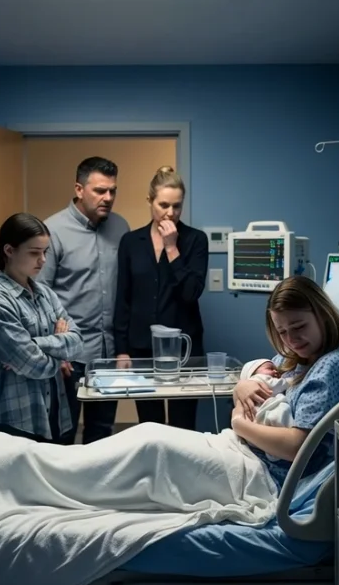
When my parents saw Abigail lying in a hospital bed holding a newborn baby, they both froze. My mother’s face went through several expressions at once: confusion, shock, and something that might have been horror. My father just stared, his mouth opening and closing without a sound.
Abigail looked at them with exhausted eyes and said quietly that she’d tried to tell them. Here was the proof they couldn’t deny anymore.
My mother started crying, strange, gasping sobs that didn’t sound real. She kept saying, “No,” over and over, shaking her head as if she could make reality disappear through sheer denial. My father’s face turned red, and he started shouting again, not at Abigail, but at the hospital staff. He demanded to know who was responsible for this “hoax,” who had been feeding his daughter lies. He refused to believe the baby was real, even when nurses showed him the birth certificate paperwork.
That’s when Diane stepped in, with hospital security behind her. She calmly informed my parents that CPS had been notified. Because they had denied their pregnant teenage daughter medical care for nine months, there would be an investigation into their fitness as guardians. They would not be taking Abigail or the baby home.
My father exploded, shouting that this was his family and nobody had the right to interfere. Diane remained calm, explaining that law enforcement was already aware of the situation. If he continued to be disruptive, security would escort him from the premises. He could either cooperate or leave immediately. My mother pulled at my father’s arm, begging him to calm down, but he jerked away and stormed out. My mother looked between Abigail and me, then followed him without a word.
The silence after they left felt heavy and strange. Abigail stared at the doorway where our parents had disappeared, tears sliding down her cheeks while the baby slept peacefully in her arms.
Diane arranged for me to stay at the hospital overnight, setting up a cot in Abigail’s room. Abigail was too exhausted and overwhelmed to think about names for the baby. She just held her and cried quietly while nurses came and went, checking vitals and bringing bottles of formula. I helped change the baby’s first diaper, fumbling with the tiny tabs, learning alongside my sister.
The CPS caseworker, Leslie, came the next morning. She interviewed Abigail first, asking detailed questions about her pregnancy. Abigail described how our parents had forbidden her from seeing a doctor, removed her from school, monitored her internet usage, and told her repeatedly that she was making up the pregnancy for attention. When Leslie asked about the baby’s father, Abigail’s face went carefully blank. She said she couldn’t talk about that. Leslie pressed gently, but Abigail just shook her head and started crying again.
When Leslie interviewed me separately, I was as honest as possible. Our parents had always been strict, but they’d gotten worse over the past year, obsessed with reputation and appearances. When Abigail got pregnant, it was like their worst nightmare came true, so they just decided it wasn’t real. Leslie asked if our parents had ever been physically violent. I hesitated before admitting that our father had a temper and sometimes grabbed us roughly when he was angry. Nothing that left bruises, nothing I would have called abuse before, but now, under Leslie’s professional scrutiny, I realized maybe it had been worse than I’d acknowledged.
Leslie explained the investigation would take several weeks. During that time, Abigail and the baby would be placed in a temporary foster home run by a woman named Beverly, who specialized in helping young mothers. I had to go home, back to the house with my parents.
The drive home was the longest twenty minutes of my life. My parents were waiting in the living room, their faces carved from stone. My father started shouting about how I’d destroyed our family, how I’d betrayed them by calling 911. This wasn’t about Abigail’s well-being or the baby’s health; this was about their reputation.
I interrupted my father mid-sentence, my voice shaking but firm. I told him Abigail could have died giving birth on our bathroom floor. They’d denied her medical care because they cared more about their image than her life. That wasn’t love; that was neglect.
My father stood up so fast he nearly knocked over a lamp. He took two steps toward me, and I flinched, genuinely afraid he might hit me. My mother grabbed his arm and pulled him back. He stood there, fists clenched, glaring at me with pure rage, then turned and stormed out of the room.
The CPS investigation dragged on for six weeks. I lived at home in an intense, suffocating silence. My father disappeared into his office after work. My mother cooked meals none of us ate. I visited Abigail at Beverly’s house twice a week, watching my sister slowly transform into a mother. She learned how to breastfeed, how to soothe the baby when she cried, how to change diapers with quick efficiency. She named the baby Iris, after our grandmother.
Beverly taught Abigail practical skills our parents never had: how to budget money, how to apply for assistance programs, how to enroll in a program that would let her finish high school while caring for Iris. For the first time in months, my sister smiled genuinely.
Around week four of the investigation, Abigail finally told Leslie about the baby’s father. He was our youth pastor at church, a married man in his thirties named David Keller. He’d groomed her over several months, convincing her their “special relationship” was blessed by God and needed to stay secret. When Abigail got pregnant, David had threatened her into silence, more concerned about his reputation than her well-being.
Leslie immediately contacted the police. What David had done wasn’t just morally wrong; it was a felony. Within twenty-four hours, detectives were interviewing Abigail, collecting her detailed statement. They would need DNA from the baby and from David to build their case.
The arrest happened during Sunday service. Detectives waited until David finished his sermon before approaching him in front of the entire congregation. They announced they had a warrant for his arrest on charges of misconduct with a minor. The sanctuary erupted in shocked gasps as detectives handcuffed David and read him his rights.
News of the arrest spread through our community like wildfire. People quickly figured out the girl was Abigail. The backlash against my parents intensified. People pointed out that if they’d listened to their daughter, if they’d gotten her medical care, David might have been caught months earlier. Instead, their denial had enabled his actions to stay hidden. Community opinion turned sharply against them.
David’s lawyer advised him to take a plea deal. With DNA evidence proving he was Iris’s father, the case was overwhelming. David pleaded guilty and was sentenced to fifteen years in prison. At his sentencing, Abigail gave a victim impact statement, her voice shaking but determined. She described how he had manipulated her and destroyed her childhood, but she ended by saying she forgave him, because that’s what she needed to do to heal.
The CPS investigation concluded shortly after. The report stated my parents had demonstrated severe neglect and failed to protect their daughter. However, it also noted they had no prior history of abuse and appeared genuinely remorseful. The court’s decision was complicated. My parents would retain custody of me, but with supervision, required to attend family therapy and parenting classes. Naomi could choose whether to return home or remain in foster care until she turned eighteen. The decision was entirely hers.
Naomi chose to stay at Beverly’s house. She explained to my parents that she couldn’t trust them anymore, couldn’t feel safe in a home where they had ignored her cries for help. My mother cried and apologized. My father sat silent, his face gray and aged. They didn’t fight her decision.
Life slowly found a new normal. I spent most of my time at Beverly’s house, helping Naomi with Iris. My parents attended their required therapy. In our sessions, they talked about their obsession with appearances and their deep shame that had manifested as denial. The therapist helped them understand that real love meant accepting difficult truths.
Naomi finished her sophomore year and started her junior year the following fall. She began talking about college, maybe studying social work. Two years later, she graduated high school with honors, seven months pregnant again. Not from another traumatic event, but from a relationship with another young father at Beverly’s house. They’d bonded over shared struggles and fallen in love.
I watched Naomi walk across the graduation stage, holding Iris on her hip, her pregnant belly visible under her gown, and felt overwhelming pride mixed with a lingering sadness for everything she’d lost. My parents attended, sitting in the back row. They had completed their required programs, and the supervision had ended. My mother had started volunteering at a pregnancy resource center. My father had joined a men’s group focused on healthy masculinity. They were trying to be better people.
Naomi moved into her own apartment after graduation. She allowed my parents to babysit Iris occasionally, always supervised by me at first, then eventually trusting them alone for short periods. The relationship would never be what it once was, but it existed. That seemed like the best possible outcome.
I think about that day on the bathroom floor often—the moment I delivered my niece while our parents refused to believe any of it was real. The teen pregnancy that surprised everyone wasn’t really about the pregnancy itself. It was about how desperately my parents wanted to believe it wasn’t happening, choosing comfortable lies over uncomfortable truth until reality forced itself into their lives. By then, the damage was done. But we survived. Naomi survived, Iris survived, and sometimes, survival is the most surprising outcome of all.