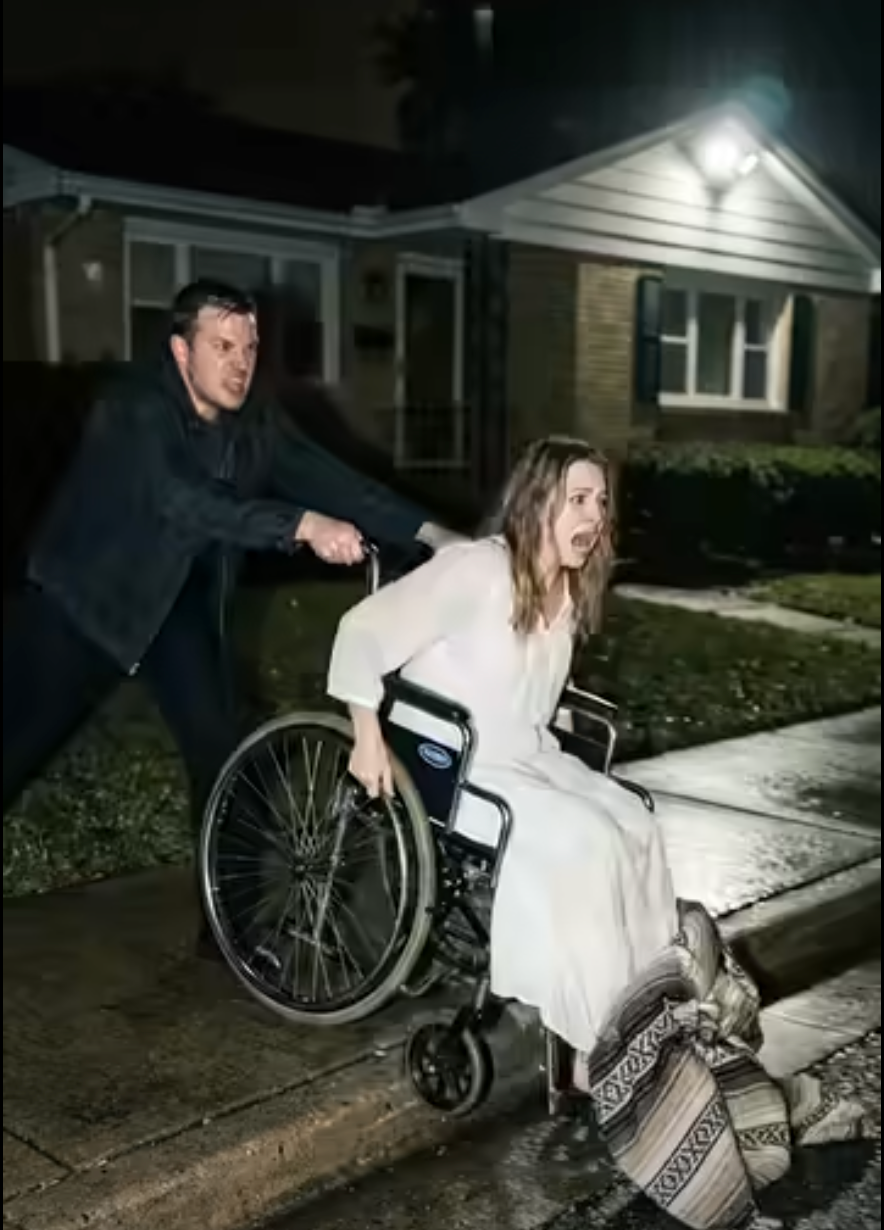
“I’M NOT A NURSE, I’M A HUSBAND!”
Jason’s yell tore through the serenity of the late afternoon. And with those words, he pushed me into the abyss, never realizing that he was the one in freefall.
The luxury sedan crunched to a halt on the gravel driveway of our modern suburban villa. It was a house of glass and steel, cold and sharp-edged, just like its owner.
The driveway was lined with “Welcome Home” signs erected by the neighbors. Jason flashed his trademark smile—the dazzling grin that had once graced the cover of entrepreneur magazines—and waved back at Mrs. Henderson, who was watering her hydrangeas across the street. He leaned in, planting a gentle kiss on my forehead to complete the performance of the devoted husband.
“Smile, babe,” he hissed through gritted teeth, his grip on the handles of my wheelchair unnecessarily tight. “Don’t look so pathetic. It’s bad for the brand.”
The garage door closed, plunging us into darkness, and Jason’s smile vanished like a light switch had been flipped. The air inside the car grew thick with unspoken resentment. I sat silently, my legs covered by a heavy wool blanket despite the warm spring air. Underneath that blanket, I secretly flexed my quadriceps—a ritual I had practiced for weeks in rehab while Jason was too busy canceling visitation hours to play golf.
“I can’t believe I had to cancel the Cabo trip for this,” Jason muttered, unbuckling my seatbelt with aggressive negligence. “You know the lift isn’t installed yet, right?”
I looked up at the daunting flight of granite stairs leading to the front door. As an architect, I had designed this home to celebrate lines and elevation. Now, for a woman supposedly paralyzed from the waist down after a horrific car accident six months ago, it looked like an impregnable fortress.
Jason dragged the wheelchair out of the trunk, unfolding it with a loud clack. He didn’t help me transfer; he just stood there, tapping his foot impatiently. As I struggled to move myself into the chair, I caught a glimpse of his phone screen lighting up with a text from a contact named “Freedom.”
“I can’t get up there, Jason,” I said calmly, eyeing the stairs. “I need the ramp.”
“The ramp looks ugly, Elena! I didn’t order it!” Jason snapped. His handsome face contorted, the mask finally slipping completely. He grabbed the wheelchair handles, not to pull me up, but to spin me around to face the landscaping drop-off, which was a good three feet below the driveway level.
“I’m done. I’m sick of wiping your tears and dragging you around like broken luggage.”
With a violent, decisive shove, he pushed the wheelchair toward the edge.
The chair tipped. I tumbled out, hitting the wet grass and dirt with a heavy thud. The wheelchair crashed down on top of my legs, the sound of metal on bone ringing out.
“I’m not a nurse, I’m a husband!” Jason roared, his shadow looming over me like a dark tower. “Sign the divorce papers or I’ll leave you here to rot!”
He threw a yellow manila envelope onto my chest. “I’m going inside. The boys are coming over for the game. Don’t make a sound.”
He marched up the stairs, opened the heavy oak door, and slammed it shut. The lock clicked with a cold finality. From inside, the sound of a beer can cracking open and raucous laughter drifted out.
I lay in the dirt, wiping a smear of blood from a scratch on my cheek. I looked at the closed door, then at the envelope on my chest. I didn’t reach for the divorce papers. Instead, I reached into my jacket pocket and pulled out my phone.
I opened an app I had quietly installed on the smart home system that morning, just before leaving the hospital.
The screen flashed: “Smart Home System: Activated. Livestream: Public.”
I looked down at my legs, muddy but completely unbroken. I shoved the wheelchair aside. Placing both hands on the ground, I took a deep breath—the breath of freedom.
Slowly, steadily, I pushed myself up to my knees. Then, with a tremble of exertion but no pain, I stood up.
In the gathering twilight, I stood tall, no longer a patient, but a silent avenger in my own front yard. And Jason had no idea that this was only the beginning.
Inside the living room, equipped with its state-of-the-art surround sound, Jason was toasting his beer bottle with two of his college buddies.
“To freedom,” he laughed, leaning back on the Italian leather sofa. “And to prenup loopholes. She actually thinks she’s getting half the assets? She’s just a vegetable now, guys. I get the house, the accounts, everything. She can’t even hold a pen to fight me.”
Outside, leaning against the doorframe, I swiped my finger across my phone screen.
While Jason thought I had been lying helpless in rehab for the last month, I had been working. I was the CFO for his shell companies before the accident. He had forgotten one crucial detail: the full Power of Attorney he had signed over to me three years ago, back when he thought he was going to be indicted for tax fraud and needed someone “clean” to hold the assets. He had never revoked it.
On my banking app, I slid the bar to “Confirm.”
Transaction Complete: Ownership of ‘Vanguard Tech’ transferred to ‘The Elena Rebuild Foundation.’ All liquid assets transferred to an irrevocable charitable trust.
Then, I switched to the security camera feed. The 4K camera in the living room was broadcasting live to Jason’s own Facebook, Instagram, and LinkedIn—where he had hundreds of thousands of followers, partners, and investors.
I watched the comments flood in like a waterfall.
User123: Did he just say he hid assets in the Cayman Islands?
BizInsider: Is this live? That’s the CEO of Vanguard admitting to tax evasion.
Sarah_Mom: Oh my god, did he just brag about leaving his disabled wife in the dirt? Call the police!
I watched the viewer count tick up: 10,000… 50,000… 100,000. I wasn’t just divorcing him; I was erasing his existence from the civilized world.
Inside the house, the music suddenly cut out. Jason’s phone began to vibrate violently on the coffee table. Then his friend’s phone. Then the landline. A symphony of alarms erupted in the room.
Jason picked up his phone, looking annoyed. “What? I’m busy entertaining…”
His complexion shifted from flushed to ghostly white. “Lawyer? What the hell are you talking about? Why are the FBI at your office? And why is my wife trending on Twitter?”
I smiled, slipping my phone into my pocket. It was time for the curtain call.
I grabbed the door handle. It was locked, but I knew the code. Beep. Beep. Beep. Click.
The door swung open.
Jason, sweating with panic, spun around. “I told you to stay—”
The words died in his throat. The entire room fell into a deathly silence. Jason’s two friends dropped their beer bottles onto the rug, their mouths hanging open.
I stood in the doorway. No wheelchair. No weakness.
I stood at my full height of five-foot-nine, looming like an angel of judgment. The mud on my clothes only made me look more dangerous. I walked—walked—into the center of the living room, my gait steady and strong.
“You’re not a nurse, Jason,” I said, my voice calm and projecting perfectly to the hidden microphones still recording. I held up my phone. “And judging by the timestamp on this transfer, you’re not a husband, a CEO, or a homeowner anymore.”
I tossed the phone onto the table, right next to the mess of alcohol. “You’re a trespasser.”
Jason stared at me, his eyes bulging as if they might pop out of his skull. The confusion morphed into a blind, violent rage. He realized he had been played. He roared, lunging toward me with a raised fist. “You bitch! You can walk? You tricked me!”
I didn’t flinch. The months of physical therapy hadn’t just restored my legs; they had forged a steel will. As Jason charged, I simply sidestepped.
Carried by his own momentum, Jason stumbled forward, catching his foot on the edge of the rug and smashing his face directly into the granite edge of the coffee table. Crack.
He rolled onto the floor, clutching his gushing nose, groaning in agony.
Sirens wailed in the distance, getting louder, tearing through the quiet of the wealthy neighborhood. Blue and red lights began to sweep through the floor-to-ceiling windows, bathing the room in the colors of justice.
Jason crawled to his knees, looking around wildly. “You set me up,” he whispered, blood staining his perfect white teeth.
I looked down at him, not with anger, but with pity.
“No, Jason. I just let the world see who you really are. And I think,” I pointed out the window where police officers were drawing their weapons and approaching the door, “they’re here to collect you.”
The police officer was gentle as he took my statement, but he couldn’t hide the awe in his eyes as he watched me stand on my own two feet.
“He’s being charged with domestic assault, attempted grievous bodily harm, and based on what I’m hearing from the Feds… massive financial fraud,” the officer said, closing his notebook.
Jason was led out in handcuffs, screaming about his lawyers, about his rights, about how I was the liar. But no one was listening. The neighbors—the audience he had tried so hard to impress—were now standing on their lawns, filming him with disgust.
It was ironic. The man who pushed me because he didn’t want to be a “nurse” now had to be practically carried by two officers because his legs had turned to jelly from fear.
Later that night, the house was unnervingly quiet.
I walked to the kitchen and poured the open beers down the sink. I felt a phantom ache in my legs—the remnants of the accident that would never fully vanish—but the paralyzing fear was gone. I opened the sliding glass doors and breathed in the night air.
I was alone. I was tired. My assets were frozen pending the investigation. I had a long legal battle ahead of me. But for the first time in years, I didn’t have to hold my breath.
I walked out to the yard and picked up the wheelchair. I didn’t need it anymore, but I wouldn’t throw it away. I would donate it to someone who actually needed help moving, not a husband who saw it as a burden.
My phone pinged with a notification from the bank. My personal accounts were locked. I was standing in a multi-million dollar home with zero dollars in my pocket. I realized that destroying Jason was the easy part. Surviving the wreckage he left behind and rebuilding from scratch would be the real test.
But I was an architect. Rebuilding from ruins was my profession.
One year later.
I adjusted my white hard hat as I stepped onto the scaffolding of the new community center.
“The ramp needs to be wider here,” I instructed the foreman, my voice ringing out clearly over the sound of drills. “And the grade needs to be gentler. Dignity is in the details, remember?”
“Yes, Ms. Elena,” the foreman nodded enthusiastically.
I paused at the top of the structure, looking out over the city gleaming under the sun. The phone in my pocket buzzed. It was an email notification from the state penitentiary—Jason’s appeal had been denied.
I didn’t even unlock the screen to read the details. I simply swiped left and hit “Delete.”
I turned and walked back down the metal stairs. My work boots struck each step with a steady, powerful rhythm. Clang, clang, clang.
It was the sound of a woman building a life on her own terms.
I reached the ground, took off my helmet, and took a deep breath of cement and sawdust—the smell of creation. I started to jog lightly toward my car. I wasn’t running because I was fleeing anything; I was running simply because I could.
As I drove away, I passed a large billboard for my new architecture firm. The slogan was bold against a blue background: “Foundations strong enough to weather any storm.”
I smiled, catching my reflection in the rearview mirror. The eyes staring back weren’t the fearful eyes of the woman in the wheelchair. They were the eyes of someone who knew exactly how to stand her ground, and she knew she would never let anyone push her down again.
If you want more stories like this, or if you’d like to share your thoughts about what you would have done in my situation, I’d love to hear from you. Your perspective helps these stories reach more people, so don’t be shy about commenting or sharing.