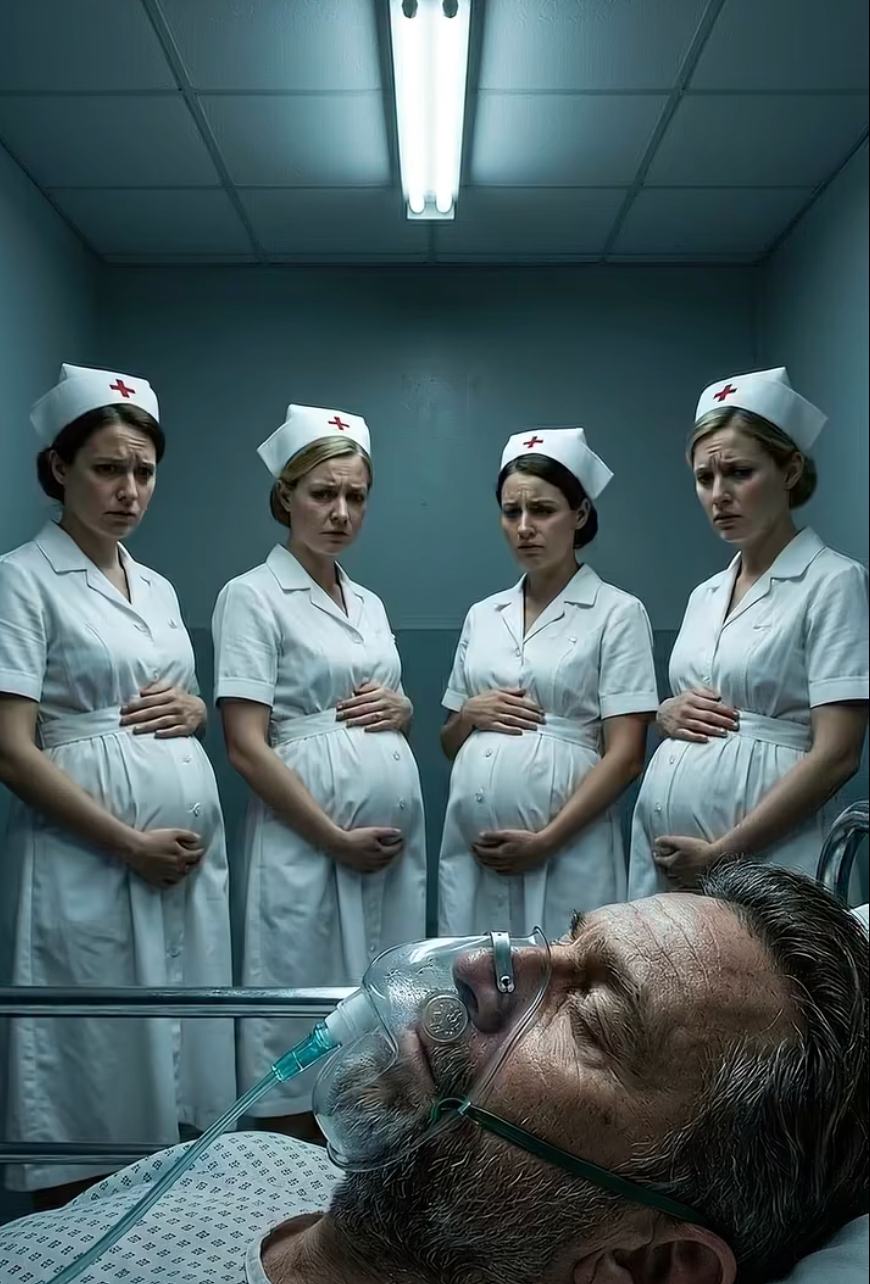
I have always believed that medicine is a fortress of logic. It is a world defined by cause and effect, by symptoms and diagnoses, by the rigid, comforting binary of life and death. As the Chief of Neurology at St. Catherine’s Medical Center, I lived my life by these rules. I trusted data. I trusted what I could see, measure, and quantify. But three years ago, the fortress began to crumble, brick by terrified brick, starting in a quiet, sterile room at the end of the hallway.
Room 312B.
Even now, writing this, the mere mention of that room number sends a phantom chill racing down my spine. It smelled of lavender disinfectant and static electricity—a scent that masked the underlying odor of suspended time. This was the domain of Michael Reeves.
Michael was a tragic celebrity within our walls. A twenty-nine-year-old firefighter, he had been the picture of vitality—strong jaw, compassionate eyes, a body built for saving others. Then came the collapse of the burning tenement building in Detroit. He had taken a three-story fall while shielding a child. The child lived. Michael did not—at least, not in the way that matters. He had been in a persistent vegetative state for thirty-eight months. No speech. No voluntary movement. Just the rhythmic hiss of the ventilator and the steady, hypnotic beep of the cardiac monitor.
He was the “Sleeping Prince” of St. Catherine’s. The nurses doted on him. Families sent cards. He was safe, stable, and utterly silent.
Until the pattern emerged.
It started with Sarah, a senior nurse on the night rotation. When she requested maternity leave, we threw her a small party in the breakroom. There was cake, laughter, and jokes about sleepless nights. It was normal. Life goes on, even when death is close by.
But three months later, Jessica, another night nurse assigned specifically to the neurological wing, came to my office. She was pale, her hands trembling as she sat across from my mahogany desk. She told me she was pregnant. She was single, had ended a relationship a year prior, and swore to me, with tears streaming down her face, that she hadn’t been with anyone.
“It’s a mistake, Dr. Mercer,” she had whispered, gripping the armrests until her knuckles turned white. “It has to be a mistake.”
I comforted her, suggesting false positives or memory lapses caused by stress. I was a man of science; I didn’t believe in immaculate conceptions.
Then came the third. Elena.
And the fourth.
By the time Laura Kane, a quiet, deeply religious woman who had been Michael’s primary caregiver for six months, stood in my office clutching a positive test, the atmosphere in the hospital had shifted from curiosity to a suffocating dread.
Five nurses. All from the same unit. All assigned to Room 312B during the graveyard shift. All pregnant.
The gossip spread through the hospital corridors like a virus. I heard the whispers in the elevator, saw the side-eyed glances in the cafeteria. People were talking about airborne toxins, pharmaceutical leaks, and even—God help us—something supernatural. The hospital board was breathing down my neck, threatening an external audit. The media had caught the scent of a scandal, and reporters were already camping out in the parking lot like vultures waiting for a carcass.
I ran every test imaginable on Michael Reeves. His vitals were boringly stable. His brain scans showed the same flat landscape of minimal cortical activity. He was a shell. He couldn’t move a finger, let alone orchestrate a series of pregnancies.
“It’s impossible, Jonathan,” my colleague, Dr. Evans, told me over stale coffee one rainy Tuesday. “It’s a statistical anomaly. A coincidence.”
“Five times is not a coincidence, David,” I snapped, rubbing the exhaustion from my eyes. “It’s a pattern. And patterns have a source.”
The nurses were terrified. They began refusing shifts in Michael’s room. They looked at him not with the pity and affection of before, but with a superstitious fear, as if he were a cursed object.
I realized then that science wasn’t going to give me the answer. I had to stop being a doctor and start being a detective. I had to see what happened in Room 312B when the rest of the world was asleep.
On a Friday evening, after the administrative staff had gone home, I entered the room alone. Michael lay there, his chest rising and falling with mechanical precision. He looked peaceful, almost angelic in the dim blue light of the monitors. I felt a pang of guilt as I climbed onto a step stool and loosened the vent cover in the corner of the ceiling.
I installed a high-definition, wide-angle camera, its lens no larger than a pinhead, hidden deep within the slats. It pointed directly at the bed.
I told no one. Not the board, not the police, not my wife. It was a violation of privacy, a breach of ethics that could cost me my medical license. But the terror in Laura Kane’s eyes had left me no choice. I had to know the truth.
I activated the remote recording via my phone, took one last look at Michael’s motionless form, and walked out, locking the door behind me. I thought I was prepared for whatever I would see.
I was wrong.
What I saw on that screen the next morning didn’t just break the rules of medicine—it shattered my understanding of reality.
The next morning, Saturday, the hospital was relatively quiet. I locked my office door and pulled the blinds. My heart was hammering against my ribs, a chaotic rhythm that defied my calm exterior. I opened the secure file on my laptop.
The timestamp read 02:13 AM.
The footage was grainy, bathed in the greenish hue of night vision. For the first hour, nothing happened. Just the rise and fall of the sheets. The monotony was hypnotic.
Then, the door opened.
It was Laura Kane. She moved softly, her rubber-soled shoes silent on the linoleum. I leaned in, my breath caught in my throat, expecting… what? An intruder? A lover sneaking in?
Laura approached the bed. She checked the IV drip, adjusted the catheter bag, and noted the vitals on the clipboard. Routine. Professional.
But then, she didn’t leave.
She pulled the visitor’s chair close to the bedside. She sat down and took Michael’s hand in hers. I watched, mesmerized, as she began to speak to him. There was no audio, but the way she leaned in, the softness of her expression, spoke volumes. She was treating him like a confidant.
She stroked his hair. She rested her forehead against his arm. At one point, she wiped tears from her eyes. It was a scene of profound intimacy, but not the kind the rumors suggested. It was the intimacy of grief, of loneliness seeking an echo in the silence. She was pouring her heart out to a man who couldn’t hear her—or so we thought.
I scrubbed through the timeline. 03:45 AM. Another nurse, Rachel, entered.
She, too, lingered. She read a book aloud to him. She adjusted his pillows with a tenderness that went beyond professional duty. She hummed—I could tell by the rhythmic movement of her jaw.
I watched four nights of footage. It was the same story. These women, exhausted and emotionally drained by the trauma center, found solace in Room 312B. Michael was their silent priest, their unjudging confessor. There was no abuse. No sexual misconduct. Just a heartbreaking display of human connection in a sterile world.
I slumped back in my chair. I’m a fool, I thought. There’s no scandal here. Just lonely people. The pregnancies remained a mystery, but clearly, Michael Reeves was not the culprit. He was just a catalyst for their emotions.
I was about to close the laptop, ready to dismantle the camera and accept defeat, when I decided to check the footage from the fifth night one last time.
Timestamp: 02:47 AM.
The room was empty. Michael was alone. The camera captured the steady green line of the heart monitor in the background.
Suddenly, the line flickered.
I narrowed my eyes. The heart rate, usually a steady 60 beats per minute, ticked up. 65. 70. 80.
A nurse—Rachel again—entered the room hurriedly, likely alerted by the station monitor. She checked the machine, looking confused. She placed a hand on his chest.
And then, I saw it.
It was subtle. If I hadn’t been staring directly at his right hand, I would have missed it.
Michael’s index finger twitched.
It wasn’t a spasm. It wasn’t a reflex. It was a deliberate curl. His finger tapped against the bedsheet. Once. Twice.
Rachel didn’t see it. She was looking at the monitor, which was now settling back down. She stroked his shoulder, calmed him down, and eventually left the room.
But I sat frozen in my office, the air conditioning suddenly feeling arctic against my sweating skin. I replayed the ten seconds of footage.
Tap. Tap.
Intent.
I grabbed the phone and paged the neurology lab. “I need a full STAT EEG on Michael Reeves. Now. And get the phlebotomist up there. I want a full genetic panel.”
“Dr. Mercer?” the technician asked, confused. “We did scans last month. He’s vegetative.”
“Just do it!” I barked, slamming the receiver down.
That afternoon, I stood over the EEG machine as the stylus scratched frantically against the paper. The technician, a young man named Gary, went pale.
“Doctor… look at the beta waves,” Gary whispered. “This isn’t vegetative. This is… he’s dreaming. Or thinking.”
The cortical activity was spiking in patterns that suggested high-level processing. It was as if a prisoner, locked in a dark cell for three years, had suddenly started banging on the walls.
But the real shock came three days later.
I had sent samples from the pregnant nurses (obtained under the guise of a routine health check) and a fresh sample from Michael to an independent genetic lab in Chicago. I wanted to rule out the impossible. I needed to see the 0% probability on paper to stop my mind from spinning wild theories.
The courier envelope sat on my desk like an unexploded bomb. I tore it open.
I scanned the rows of data, the allele markers, the probability percentages. My vision blurred. I had to sit down before my legs gave out.
Subject A (Fetus 1): Paternity Probability: 99.99% – Michael Reeves.
Subject B (Fetus 2): Paternity Probability: 99.99% – Michael Reeves.
Subject C (Fetus 3): Paternity Probability: 99.99% – Michael Reeves.
All five of them.
Michael Reeves, a man who could not move, who could not speak, who was fed through a tube, was the biological father of five unborn children.
The room spun. This wasn’t medical science anymore. This was a horror story. I looked at the surveillance feed on my laptop, at the still, silent figure in Room 312B.
How?
How could a paralyzed man impregnate five women without ever leaving his bed, and without them knowing?
I didn’t know the answer yet, but I knew one thing: There was a monster in my hospital. And it wasn’t the man in the bed.
The revelation paralyzed me for a full hour. I sat in the darkening office, the genetic report clutched in my hand like a death warrant. If this got out, St. Catherine’s would be burned to the ground—figuratively and perhaps literally.
This was mass violation. This was assault on an unprecedented scale.
But the mechanics of it gnawed at my brain. The nurses were adamant they hadn’t been intimate. The footage showed only tenderness. Michael was physically incapable.
Think, Jonathan. Think.
I went back to the logs. Not the medical charts, but the security access logs. Who had access to the room? Who had access to the nurses? Who had access to Michael?
I pulled up the digitized archives for the past year. I cross-referenced the shift schedules of the pregnant nurses. I looked for the common denominator.
The obvious answer was the attending physicians, but we rotated constantly. The orderlies? Too much supervision.
Then, I saw a name that made me pause.
Daniel Cross.
Daniel was a former nurse practitioner, a brilliant but socially awkward man who had worked in our neurological department for four years. He had transferred to a private research facility in Ohio eight months ago.
But his name appeared on the electronic keycard logs for the secure storage wing—Wing 4C—three weeks after he had supposedly quit.
Wing 4C wasn’t for patients. It was cryopreservation. It was where we stored biological samples for research trials.
My memory jolted. Two years ago, Daniel had been the lead assistant on a controversial study regarding “Post-Traumatic Fertility Preservation.” The study was designed to harvest and freeze reproductive material from young trauma victims—like firefighters or soldiers—so their lineage wouldn’t die if they did. The ethics board had shut it down due to funding issues and consent concerns.
I typed furiously, accessing the inventory logs for Wing 4C.
There were discrepancies. Minor ones. A discrepancy in liquid nitrogen usage. A mislabeled rack of vials.
And then, the smoking gun.
A log entry from six months ago, flagged by the system but ignored by the night security guard. Access ID: D.Cross. Time: 03:00 AM.
Location: Bio-Storage Unit 7. The unit where Michael Reeves’s samples from the defunct study were kept.
I felt bile rise in my throat. I grabbed my coat and ran for the records room in the basement. I needed the physical hard copies of the medication logs for the nurses.
I tore through the files, dust coating my fingers. I found what I was looking for. During the annual staff wellness checks, which were mandatory, the nurses had received “vitamin boosters” and flu shots.
Who had administered them?
The signature was a scribble, but the employee ID number matched.
Daniel Cross.
He hadn’t left immediately. He had stayed on as a contractor for the wellness program right before his final departure.
The picture formed in my mind, gruesome and terrifying in its clarity. Daniel hadn’t just stolen samples. He had used his position, his access, and his twisted scientific obsession to conduct his own unauthorized experiment. He had turned the nurses into unsuspecting surrogates and Michael into an unwilling patriarch.
But why?
I needed to find him. I called the number on his personnel file. Disconnected. I called the facility in Ohio.
“Mr. Cross?” the receptionist said. “He never showed up for orientation. We assumed he took another offer.”
He was a ghost.
Or so I thought.
I went back to my office, my mind racing. I looked at the live feed of Room 312B again. It was 10:00 PM.
And there was someone in the room.
It wasn’t a nurse.
The figure was dressed in scrubs, wearing a mask and a surgical cap. But the build was wrong for the night shift staff. He was tall, lanky. He was standing over Michael, adjusting the IV drip with a terrifying familiarity.
He leaned down, whispering something into Michael’s ear.
My blood turned to ice. He hadn’t left. He had never left. He was still here, hiding in plain sight, perhaps using a stolen ID, perhaps living in the bowels of the massive hospital complex.
I didn’t call security. There wasn’t time. If he sensed a guard, he might run, or worse, he might hurt Michael—the only proof of his “success.”
I sprinted down the hallway, my lab coat flapping behind me. I burst through the double doors of the neurological wing, ignoring the startled gasp of the desk clerk.
I reached Room 312B and threw the door open.
The figure spun around, a syringe in his hand.
It was him. Daniel Cross.
He looked older, gaunt, his eyes manic and rimmed with red. He didn’t look like a criminal; he looked like a fanatic.
“Dr. Mercer,” he said, his voice raspy. He didn’t raise his hands. He just gestured to Michael. “Quiet, please. He’s listening.”
“Put the syringe down, Daniel,” I commanded, stepping into the room. “It’s over.”
“Over?” He smiled, a chilling, broken expression. “No, Doctor. Look at the monitor. Look at his vitals. It’s not over. It’s finally working.”
The room felt airtight, the pressure immense. Daniel held the syringe like a holy relic.
“What have you done?” I asked, keeping my voice low, edging closer to the panic button on the wall.
“I gave him a legacy,” Daniel said, his eyes darting between me and Michael. “He was a hero, Doctor. He saved that child. And the universe rewarded him by crushing him? By ending his line? It wasn’t fair. Biology is cruel, but science… science balances the scales.”
“You violated five women, Daniel,” I hissed. “You assaulted them. You used them as lab rats.”
“They are vessels!” he snapped, his composure cracking. “They cared for him. They loved him! I saw it. I saw how they looked at him. I just… facilitated nature. I gave them a piece of him to keep. And look!”
He pointed frantically at the heart monitor. “Since the conceptions… look at his brain waves. I’ve been injecting him with a neuro-stimulant compound I developed. The connection… it’s symbiotic. He knows. Somewhere in that dark ocean of his mind, he knows his life is continuing. That’s why he’s waking up!”
“He’s not waking up because of your twisted experiments,” I said, inching closer. “He’s waking up because he’s fighting. And you are going to prison.”
Daniel’s face hardened. “You don’t understand. They wanted to pull the plug. The board… they were talking about hospice. I couldn’t let him die. Not completely.”
He raised the syringe. “One last dose. It stabilizes the neural pathways. Please.”
I didn’t wait. I lunged.
I am not a young man, and I am certainly not a fighter. But rage is a powerful fuel. I tackled Daniel, slamming him into the equipment cart. Trays clattered, metal rang out against the floor, and the syringe skittered across the linoleum.
He was stronger than he looked, fueled by adrenaline and madness. He shoved me back, his hands grasping for my throat.
“You can’t stop progress!” he screamed, his spittle hitting my face.
Suddenly, a high-pitched alarm screamed through the room.
Beep-beep-beep-beep!
We both froze. It wasn’t the security alarm.
It was the cardiac monitor. Michael’s heart rate had spiked to 140.
We both looked at the bed.
Michael Reeves was shaking. A seizure? No. His eyes—those eyes that had been closed for three years—flew open.
They were unfocused, dilated, terrified. But they were open.
Daniel gasped, releasing me. “Michael?” he whispered, stumbling toward the bed, tears springing to his eyes. “Michael, look at me. It’s Daniel.”
He reached out to touch the patient’s face.
And then, the impossible happened.
Michael’s hand shot up. It was a jerky, uncoordinated movement, fueled by primitive instinct. He grabbed Daniel’s wrist. His grip was weak, trembling, but undeniable.
A guttural sound tore from Michael’s throat. It wasn’t a word. It was a sound of pure, unadulterated horror.
He pushed Daniel away.
The rejection was absolute. Even in his delirium, even through the fog of brain damage, Michael knew. He sensed the violation. He sensed the darkness in the man standing over him.
Security burst into the room a second later, tackling Daniel to the ground. He didn’t fight them. He just stared at Michael, weeping, muttering, “I saved you… I saved you…”
I rushed to Michael’s side, checking his pupils, shouting for the crash cart. He looked at me—really looked at me—and then his eyes rolled back, and he slipped into unconsciousness. But this time, it was a natural sleep. The monitor stabilized.
He was back.
Epilogue: The Weight of Truth
The scandal that followed was, predictably, a firestorm.
The story of “The Miracle in Room 312B” dominated the news cycle for months. There were lawsuits, of course. The hospital settled for undisclosed millions with the five nurses. St. Catherine’s reputation was tarnished, perhaps permanently.
Daniel Cross pleaded guilty to multiple counts of medical battery, unauthorized practice, and gross negligence. He is currently serving twenty-five years in a federal penitentiary, still maintaining that he did it for the “greater good.”
The nurses… they were the true victims. Three of them chose to terminate the pregnancies, unable to bear the weight of the violation. Two, including Laura Kane, chose to carry the children to term. They viewed the babies not as products of Daniel’s crime, but as the last remnants of the man they had cared for.
As for Michael Reeves, his recovery was slow and painful. He had to relearn how to swallow, how to move his fingers, how to exist. He never fully regained his speech, but he could communicate with a tablet.
When I told him—months later—what had happened, he wept for three days. He felt a guilt that wasn’t his to carry.
I resigned a year later. I couldn’t walk those halls anymore. I couldn’t look at a patient without wondering what secrets were being kept in the dark. I realized that while science can explain the how, it can never fully explain the why.
I visited Michael one last time before I left. He was sitting up in a wheelchair by the window, watching the rain.
Laura was there, too. She was holding a baby—a boy with Michael’s strong jaw and gentle eyes.
Michael reached out a trembling hand and touched the infant’s cheek. It was a moment of profound complexity—a scene born of a crime, yet resulting in life. It was beautiful, and it was terrible.
I walked out of Room 312B and closed the door. I left the fortress of medicine behind, stepping out into a world that was messy, unpredictable, and frighteningly human.
And I never looked back.
If you want more stories like this, or if you’d like to share your thoughts about what you would have done in my situation, I’d love to hear from you. Your perspective helps these stories reach more people, so don’t be shy about commenting or sharing.